Fossil hunting along Dorset’s Jurassic Coast has moved beyond a pastime. What was once a field trip for schoolchildren and a modest trade for local dealers now underpins a growing market in which rare specimens command significant sums and international interest.
Sale of a flagship collection sparks concern
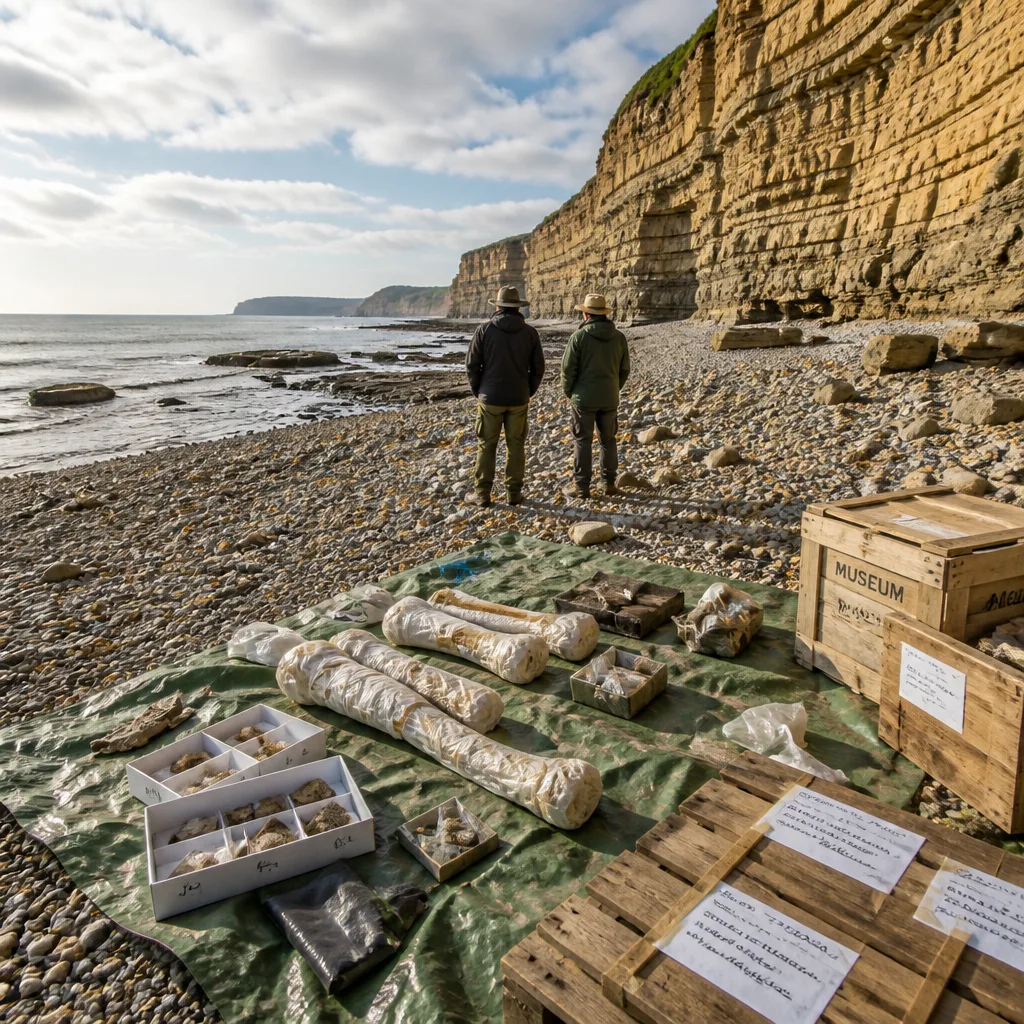
Investigations this week revealed that a private collection amassed over many years — comprising 318 specimens from the Jurassic strata around Lyme Regis and Charmouth — has been purchased by a museum in Abu Dhabi for what is believed to be an eight‑figure price. The acquisition included material that experts say could represent species previously undocumented in scientific literature.
For many palaeontologists and museum professionals the transaction has been uncomfortable. British institutions, constrained by budgets, were unable to match the offer, while well‑funded overseas bodies were not. Some commentators described the result as a loss to the nation’s scientific and cultural patrimony.
From hobby to high value
The scene on Charmouth beach — families and individuals scanning the shale and fallen cliffs for recognisable shapes — captures the continuity of a pursuit stretching back centuries. Mary Anning, who began collecting in the same stretch of coastline in the early 19th century, remains the emblematic figure of that tradition: her finds included the first complete plesiosaur skeleton and helped establish palaeontology as a modern science.
Yet collectors such as the one whose assemblage has now moved abroad show how the practice has evolved. For some, discoveries are a commercial opportunity as much as a scientific or recreational pursuit. Social media has amplified certain collectors into public figures; a burgeoning marketplace has made specimens both sought after and, in some cases, highly lucrative.
- Collection size: 318 specimens
- Geological age represented: roughly 190 million years (Jurassic)
- Reported sale value: believed to be in the eight‑figure range
| Item | Detail |
|---|---|
| Notable collector | Private collection amassed over many years |
| Buyer | Museum in Abu Dhabi |
| Scientific significance | Includes specimens that may represent new species |
Implications for UK museums and science
The episode highlights a longstanding tension: how to reconcile private collecting with public research and display. Museum acquisitions are constrained by public funding cycles and competing priorities. When high‑value collections come up for sale, national institutions frequently find themselves outbid by better resourced international buyers.
That matters because certain fossils provide crucial data for understanding Earth’s history, including evolutionary pathways and palaeoecology. When such material resides outside the UK, access for British researchers may be diminished and opportunities for public engagement reduced.
At the same time, collectors and dealers argue that private stewardship can preserve specimens that might otherwise be lost. Responsible collecting, proper documentation and willingness to collaborate with research institutions can, in many cases, yield scientific benefits irrespective of ownership.
Looking ahead
What the Dorset coastline demonstrates is both the fragility and the resilience of Britain’s natural heritage. The cliffs and beaches continue to reveal remains laid down in the Jurassic seas some 190 million years ago, while a modern economy around those discoveries has formed, with all the attendant opportunities and dilemmas.
Policymakers and cultural bodies face questions about whether existing mechanisms for securing significant finds in the public interest are adequate, and how best to support museums to compete for holdings of scientific importance. For local fossil hunters — bent double at the edge of the tide, eyes on the shale — the incentives have changed: each odd shape could, in the right hands, be worth far more than the price of an afternoon’s entertainment.