
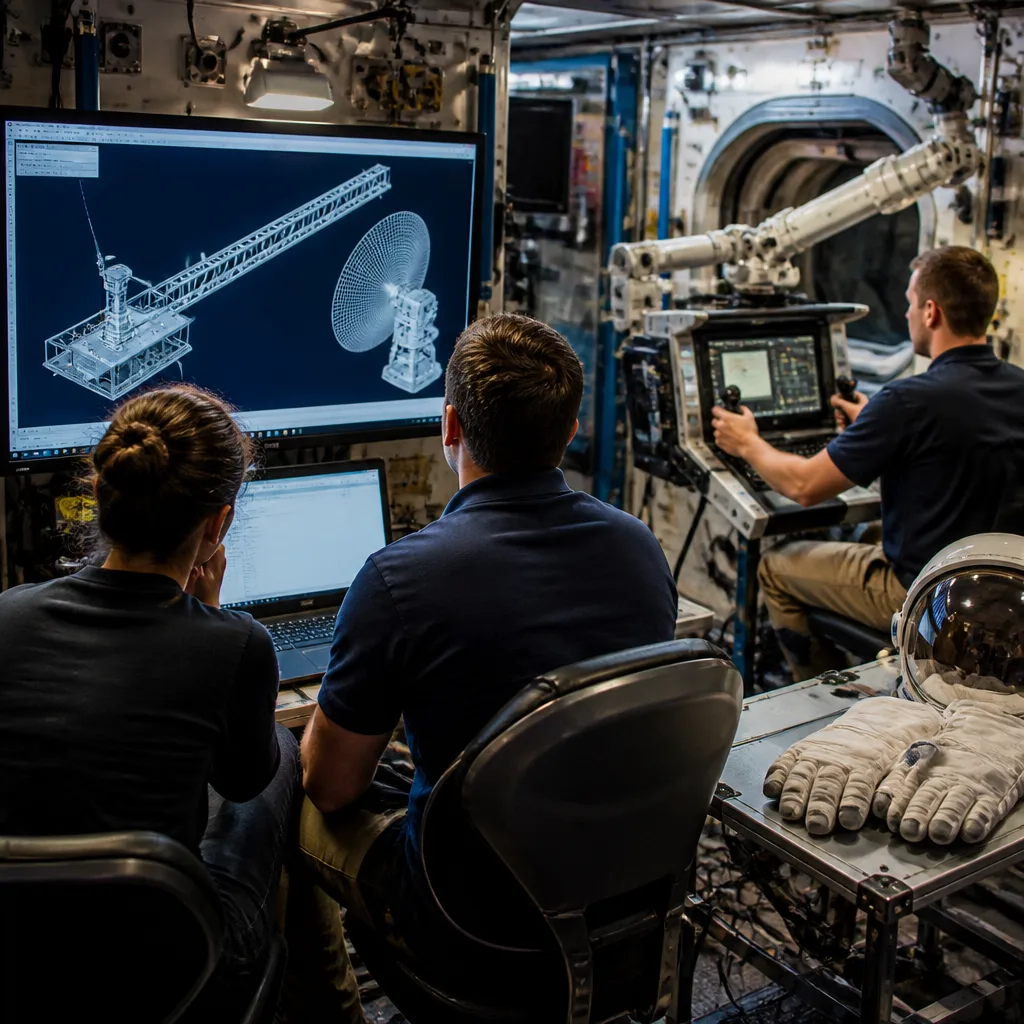
The International Space Station’s Expedition 75 crew have spent the end of the week drilling the choreography that will support a complex orbital maintenance task: replacing a high‑speed data and communications antenna from the station’s Z1 truss on Tuesday, 18 August.
Robotics, rehearsal and redundancy
Flight engineers Anil Menon of NASA and Sophie Adenot of ESA are refining the spacewalking techniques they will use to perform the install and removal, while commander Jessica Meir and flight engineer Jack Hathaway remain inside the station to manage suit ingress and egress and operate the station’s robotic arm, Canadarm2. The extravehicular activity is expected to last about six‑and‑a‑half hours.
The crew gathered on Friday to practise the robotics support on computer simulators, focusing on the arm’s precise motions, the different operating modes and the safety procedures designed to ensure the spacewalker has controlled access to the maintenance worksite. Such rehearsals are a standard risk‑reduction technique: by practising in simulation, operators reduce procedural uncertainty and sharpen the split‑second coordination between an external crew member and robotic systems.
Stepwise procedure for the antenna swap
The exercise the quartet rehearsed follows a clearly defined sequence of operations:
- Uninstall the ageing antenna from the Z1 truss and temporarily stow it;
- Retrieve a spare antenna from an external platform using the Canadarm2;
- Install the spare on the Z1 truss and make sensitive electrical and data connections using a tool adapted for microgravity;
- Return the old antenna to the external platform that housed the spare.
The use of the arm with a suit‑clad Menon attached underscores the hybrid nature of the task: a human outside the station guided by a remotely operated robotic system. Such union of human dexterity and machine precision is common in high‑risk orbital maintenance, offering redundancy in control and reach.
Science and maintenance continued alongside rehearsals
Even with the spacewalk preparation filling a large part of the crew’s schedule, the station’s science agenda continued. Menon completed a pair of assessments designed to measure visual and cognitive adaptation to microgravity — measurements that help chart how human perception and brain function change in weightlessness. Adenot tested the EasyMotion‑2 suit, which uses electrical stimulation to trigger muscle contractions and augment exercise effectiveness in spaceflight conditions.
On the maintenance side, Hathaway inspected hatch seals while Meir completed cleaning and configuration work on electronic equipment — routine, but essential, tasks that preserve long‑term operational safety and data integrity on the outpost.
Who does what: crew roles at a glance
| Crew member | Primary role for upcoming EVA |
|---|---|
| Anil Menon (NASA) | Spacewalker; will be attached to Canadarm2 during antenna swap |
| Sophie Adenot (ESA) | Spacewalker; will perform electrical/data connections with specialised microgravity tool |
| Jack Hathaway | Internal suit ops and Canadarm2 operator |
| Jessica Meir (commander) | Internal suit ops, station systems and electronics configuration |
The combination of simulator practice, procedural reviews and ongoing science work reflects the layered approach agencies apply to minimise risk on the orbital outpost. While no operation in low Earth orbit is without hazards, the documented rehearsals and checks are intended to make both the mechanics and the contingencies as predictable as possible.
For observers on the ground, the coming EVA will be a useful measure of how human–robot collaboration performs under the time pressure and environmental constraints of space maintenance. If all goes to plan, the swap will restore or enhance communications capability for the station — a small but vital upgrade carried out at altitude where even simple hardware changes require meticulous planning and practiced execution.









