
Researchers have revealed that a large rock glacier beneath the summit of Mount Timpanogos, near Salt Lake City and Provo, contains a far greater volume of ice than its rubble-strewn surface would suggest. Using highly sensitive gravity measurements to distinguish between denser rock and lighter ice, the team constructed a three-dimensional picture of the buried glacier and estimated its frozen-water content at roughly 1.5 million cubic metres.
How the hidden ice was measured
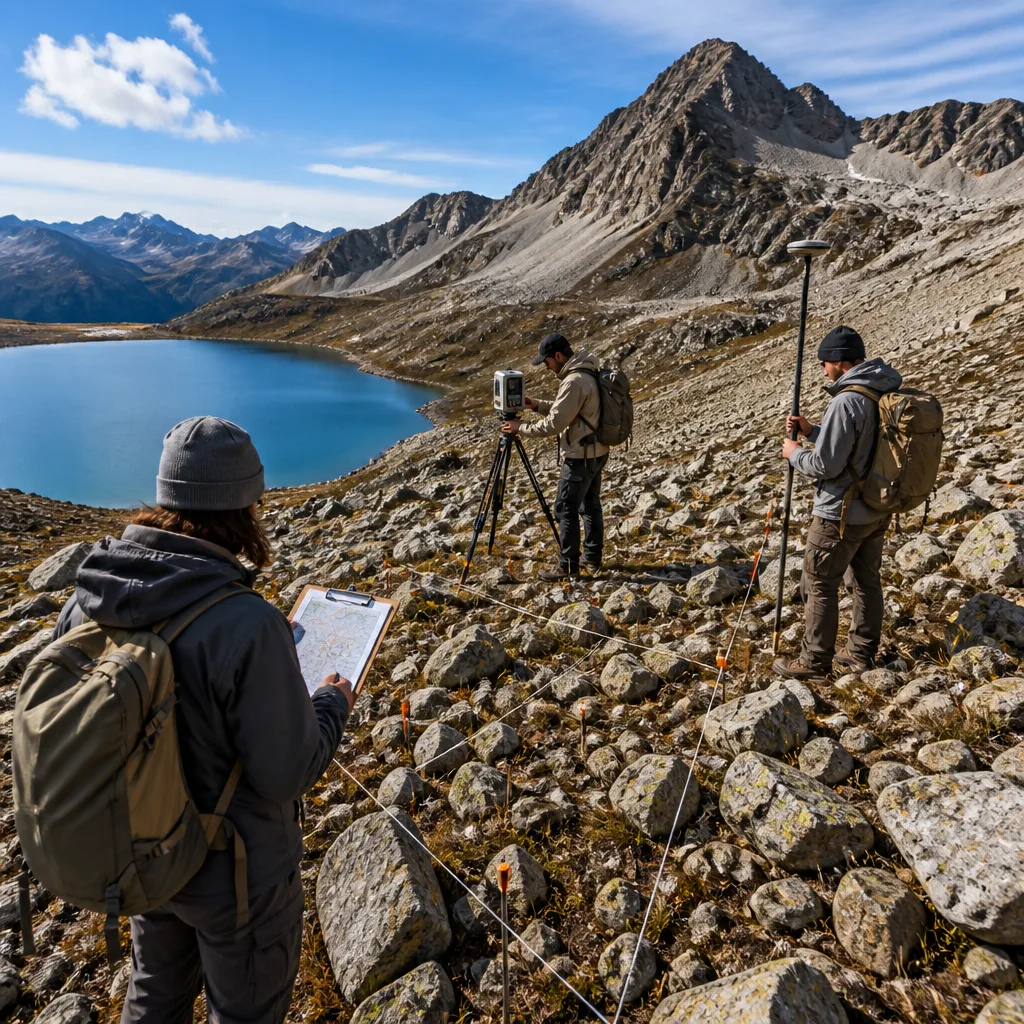
The study involved repeated field campaigns across the rock glacier above Emerald Lake during autumn 2024. Lead fieldwork was carried out by Bronson Cvijanovich, a graduate student within the University of Utah's Department of Geology & Geophysics, who collected gravity readings at 232 locations arranged on a regular grid with approximately 25-metre spacing.
A gravimeter senses minute variations in the local gravitational field produced by contrasts in subsurface density. By mapping those variations across the glacier, the researchers were able to infer the distribution and volume of lower-density material consistent with ice, contrasted with higher-density surrounding rock.
Key findings and scale
The gravitational imaging indicated that the Timpanogos rock glacier is remarkably ice-rich — approximately 83% ice and 17% loose rock by volume. The ice volume equates to about 600 Olympic swimming pools, an analogy the team used to place the volume in familiar terms, and the authors note it is comparable to the volume of the Great Pyramid of Giza.
"Timpanogos Rock Glacier is surprisingly ice rich. It is 83% ice and 17% loose rock," said Bronson Cvijanovich.
Professor Leif Anderson, a co-author and specialist in glaciology, emphasised the hidden nature of this resource: "There's a lot of ice that's hidden in Utah's mountains. When we are high in the mountains and walking across loose rocks or rubble, you don't realize there could be 120 feet of ice buried beneath your feet." These observations underline that surface appearance is a poor guide to subsurface ice content in many mountain settings.
Why the result matters
Rock glaciers are common features in Utah's Wasatch and Uinta ranges, and on the Colorado Plateau in places such as the La Sal Mountains near Moab. Unlike conventional glaciers, which display exposed ice, rock glaciers manifest as fields of talus and boulders that can conceal substantial ice bodies beneath. Quantifying that buried ice changes how hydrologists and resource managers must think about mountain water storage, especially in regions where meltwater supports downstream supplies.
- Volume: ~1.5 million cubic metres of frozen water.
- Composition: ~83% ice, ~17% loose rock.
- Sampling: 232 gravity points spaced ~25 m apart across the feature.
| Parameter | Value |
|---|---|
| Estimated ice volume | 1.5 million m³ |
| Ice proportion | 83% |
| Survey points | 232 |
Although the studies provide a robust snapshot of this particular rock glacier, the researchers did not claim that all rock glaciers contain similar proportions of ice. The gravimetric methodology, however, offers a transferable approach that can be applied to other buried-ice bodies to better map and quantify hidden mountain water stores.
Broader implications and next steps
Hidden, ice-rich landforms have implications for water-resource assessments, glacier monitoring and climate-response planning. In arid and semi-arid regions where seasonal melt feeds rivers and reservoirs, previously overlooked ice reservoirs could moderate seasonal flow variability, at least until they are subject to long-term warming and thaw.
The studies' authors stop short of making broad predictions about regional water supply, but the clear demonstration that a major rock glacier can contain the equivalent of hundreds of Olympic pools of water will prompt further surveys. Applying gravimetry across other rock glaciers would allow scientists to assemble a more complete inventory of buried ice across mountain ranges — an inventory that will prove valuable as agencies and communities adapt to changing hydrological regimes.
For now, Mount Timpanogos offers a striking reminder that, beneath unpromising piles of rubble, there can be enormous quantities of frozen water — an observation that reshapes how we think about mountain cryology and the hidden reservoirs that lie within it.









