Scientists at the University of Connecticut, Columbia University and Brookhaven National Laboratory report they have built a nanostructured material that pairs the purity of glass with DNA-based scaffolding to produce a lattice that is, by their account, five times lighter and four times stronger than steel. The team describes the result as the strongest material known for its density, a claim that if borne out could have wide-ranging implications for aerospace, defence and lightweight construction.
How DNA and glass were combined
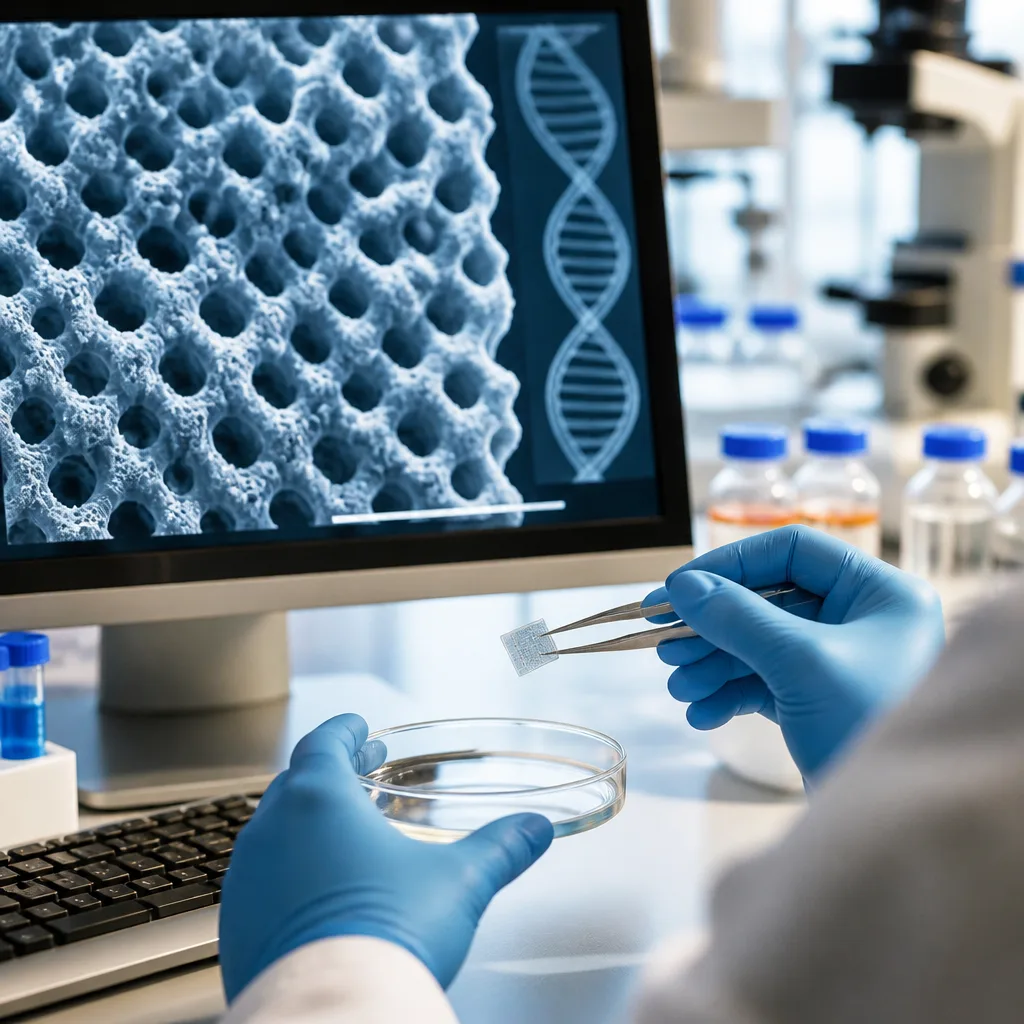
The approach exploits two complementary properties. Glass, in its most flawless forms, can survive extreme stress; DNA can be programmed to form precise, three-dimensional templates at the nanoscale. By using DNA assemblies to define the architecture of a tiny glass framework, the researchers avoid many of the flaws that make bulk glass brittle. The final product is a nanolattice — a repeating, open-cell structure in which the material’s mechanical performance derives more from geometry than from the bulk properties of the solid phase.
“I am a big fan of Iron Man movies, and I have always wondered how to create a better armor for Iron Man. It must be very light for him to fly faster. It must be very strong to protect him from enemies’ attacks. Our new material is five times lighter but four times stronger than steel. So, our glass nanolattices would be much better than any other structural materials to create an improved armor for Iron Man,”
The quoted remark, from Oleg Gang of Columbia University, reflects a conceptual inspiration rather than a proposed consumer product. The team’s contribution is methodological: using biomolecular self-assembly as a scaffold for depositing high-purity glass at extremely small length scales, then removing the biological template to leave a glass-only architecture.
Claims, context and caveats
Two headline numbers anchor the report: 5× lighter and 4× stronger than steel. Those ratios compare the new material to conventional steel on the metrics of density and strength. The researchers characterise the result as the strongest known material for its particular density — a comparative, density-normalised claim that highlights efficiency rather than absolute performance.
Important caveats remain. Small-scale lattice architectures frequently show exceptional specific strength (strength per unit mass) but can be sensitive to manufacturing defects, environmental conditions and scale-up challenges. The work reported by the team demonstrates a proof of principle: that DNA-guided nanofabrication can produce ultralight, high-strength glass lattices. It does not yet provide evidence that large, load-bearing structures could be manufactured economically or perform identically outside laboratory conditions.
- Institutions involved: University of Connecticut, Columbia University, Brookhaven National Laboratory.
- Reported performance: 5× lighter, 4× stronger than steel (strength normalised by density).
- Method: DNA templating to shape pure-glass nanolattices; removal of biological scaffold leaves glass-only architecture.
Those bullets summarise what the researchers report; they do not imply immediate commercial readiness. Translating nanoscale demonstrations into macro-scale components typically requires further innovation in fabrication, joining and quality control.
| Metric | New nanolattice | Conventional steel |
|---|---|---|
| Relative density | ~0.2× (five times lighter) | 1× |
| Relative strength | ~4× (four times stronger at same density) | 1× |
Beyond the numbers, the conceptual advance matters: it reframes glass from a brittle bulk material into a high-performance structural component when organised at the nanoscale. That shift echoes other work in architected materials, where geometry — trusses, lattices, and cellular networks — delivers mechanical advantages that raw material properties alone do not.
Next steps will be telling. The research community will test reproducibility, environmental resilience (for example, how the lattices fare under thermal cycling or moisture exposure) and the economics of scaling production. If those hurdles can be cleared, the technique could join a growing toolbox of methods — including metallic foams, carbon lattices and ceramic architectures — that engineers select for mission-specific trade-offs between weight, strength and cost.
For now, the work stands as an elegant demonstration of how biology-inspired assembly can reshape the design space for structural materials: tiny strands of DNA guiding pure glass into forms that, at least on paper, could let engineers make things that are both astonishingly light and stubbornly strong.