
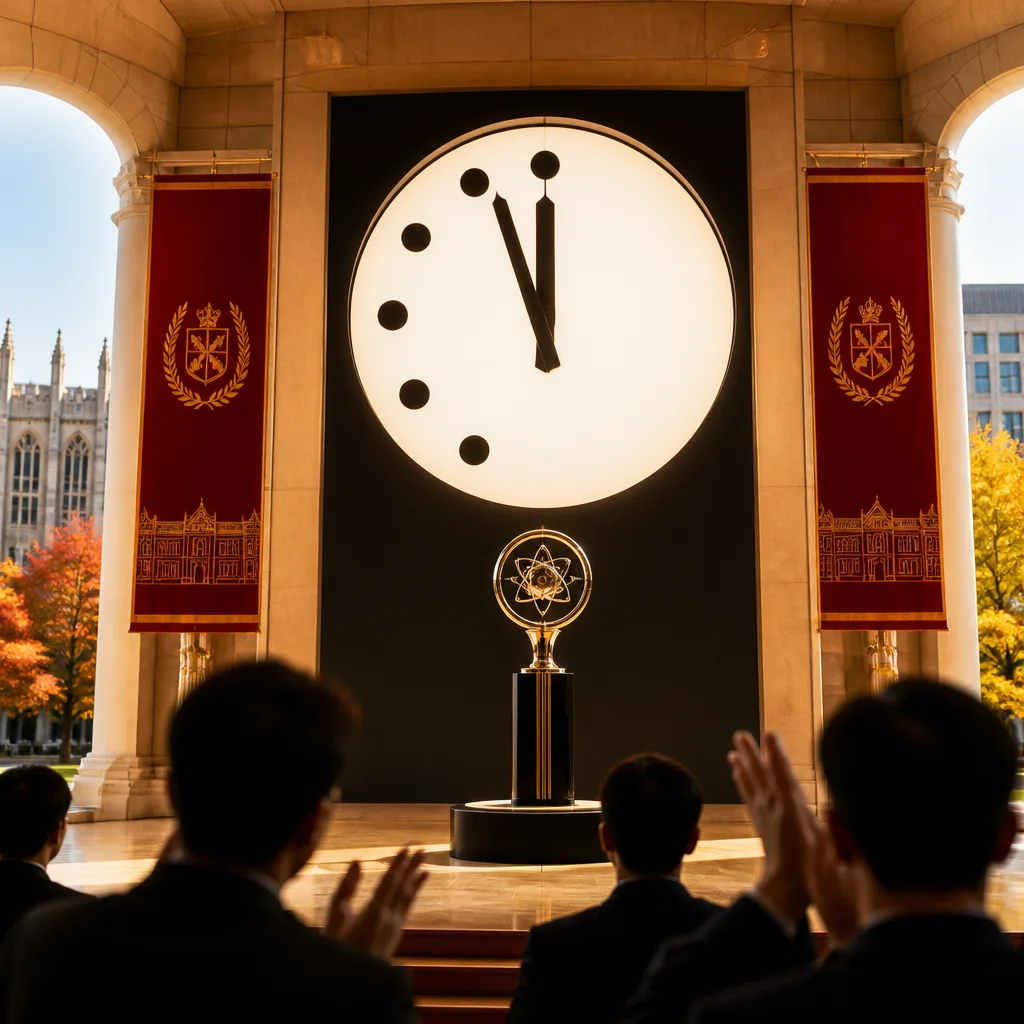
The Bulletin of the Atomic Scientists has been awarded the 2026 Miwon Peace Prize in recognition of its sustained work raising international awareness of existential risks and applying scientific rigour to warn about threats to humanity and civilisation.
The prize was presented on 21 September at Kyung Hee University in Seoul. Bulletin officials who travelled to accept the honour included President and CEO Alexandra Bell, Governing Board Chair David Kuhlman, Science and Security Board Chair Daniel Holz, and Chief Strategy Officer John Pope.
“For over 80 years, our publication has sought to connect the public and policymakers directly with scientists and experts who focus on managing existential risks,” said Alexandra Bell.
Why the award matters
Established in 2024 by the Kyung Hee University System, the Miwon Peace Prize honours individuals and organisations that have made distinguished contributions to the future of humanity, civilisation and peace. The award commemorates the peace philosophy of Dr Young Seek Choue (1921–2012), the university system's founder, and his goal of "unfolding cultural worlds for humanity." The recipients are selected for work seen to promote global cooperation and the long-term security of civilisation.
The Bulletin is best known for the annual Doomsday Clock, a symbolic measure of how close humanity is to global catastrophe. Former UN Secretary-General Ban Ki‑Moon, appearing via video remarks at the Seoul ceremony, highlighted the Clock's role as a global benchmark for existential risk. He recalled that in January 2020 the Clock was placed at 100 seconds to midnight, and he noted that it now stands at 85 seconds to midnight, signalling a worsening of the risks it tracks.
| Year (example) | Clock setting |
|---|---|
| January 2020 | 100 seconds to midnight |
| 2026 (current) | 85 seconds to midnight |
Scope and implications
The Miwon Peace Prize citation and the Bulletin's own statement emphasise the publication's mission of translating complex scientific analysis into information that can inform policy. The Bulletin's work spans nuclear risk, climate change, emerging biotechnologies and other systemic threats; its Doomsday Clock synthesises such assessments to convey broad changes in the global risk environment.
At the ceremony, Bell argued that the dangers produced by modern science and warfare are not problems that nation-states can solve alone, saying they "require international cooperation, the participation of all levels of society, and an understanding that the stakes are no less than our shared survival." That framing underlines a persistent tension in science diplomacy and risk governance: technical analysis must be paired with international institutions and public engagement if policy responses are to be effective.
- Recognition: The prize underscores the role of independent science communication in shaping global debates about long-term risks.
- Signal: The Doomsday Clock's movement to 85 seconds to midnight was highlighted as an indicator that risk levels tracked by the Bulletin have risen since 2020.
- Messaging: The award stresses the need for cross-border cooperation and broader societal involvement to address complex, interlinked threats.
Former UN Secretary-General Ban Ki‑Moon, a member of The Elders—the inaugural Miwon Peace Prize recipient in 2024—said the Bulletin’s Clock has become a global benchmark. His comments linked the prize to an emerging tradition in Seoul of honouring work aimed at strengthening international peace and foresight.
While symbolic, awards such as the Miwon Peace Prize can amplify a recipient's reach. For the Bulletin, the prize is likely to increase attention to its analysis at a time when governments, scientists and the public are grappling with accelerating technological change and persistent geopolitical instability. The challenge remains translating heightened attention into policy decisions that measurably reduce the risks the Bulletin documents.
The award ceremony in Seoul, attended by the Bulletin delegation and featuring international remarks, reinforces the transnational character of contemporary risk debates. It also reflects a broader trend in which academic and civil society organisations seek to shape the framing and prioritisation of global threats through public-facing tools and symbolic acts.









