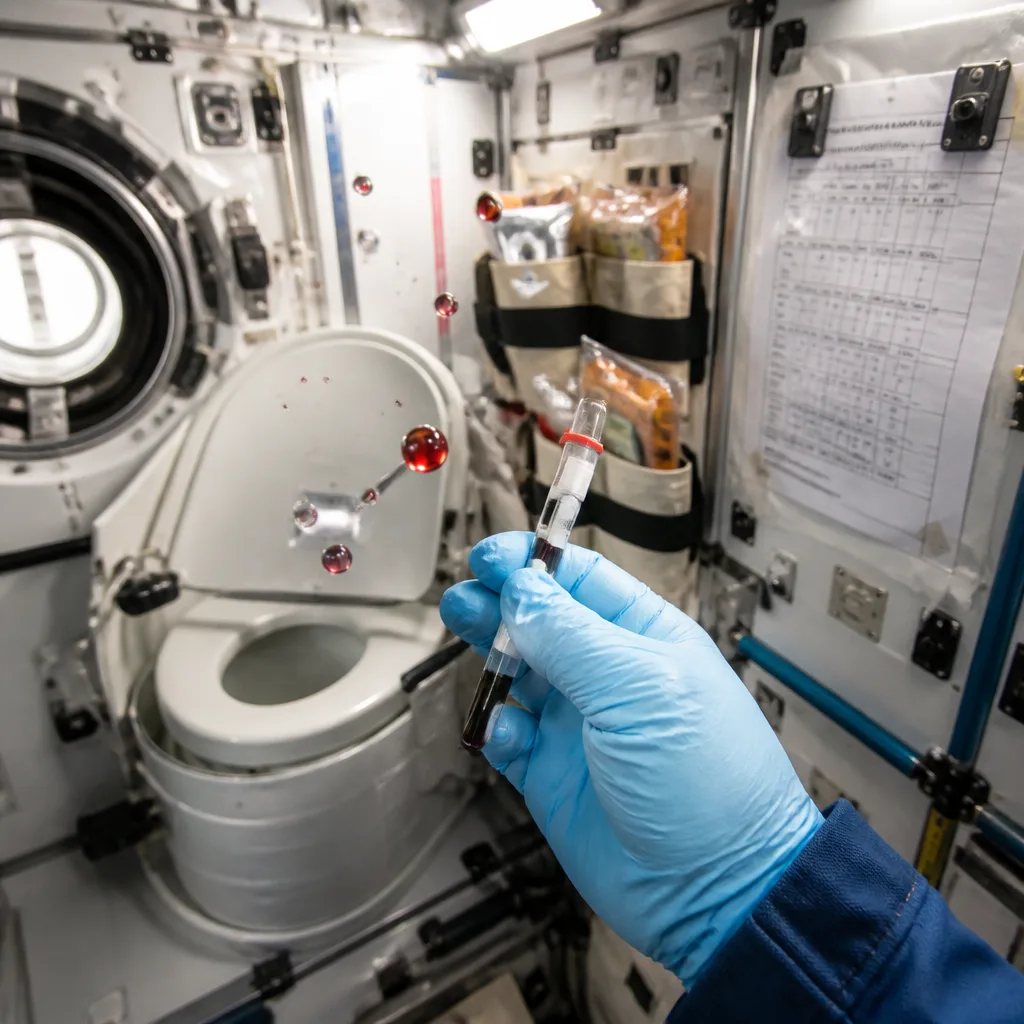
Scientists have for the first time used a blood test to pinpoint why astronauts find it harder to pass stool in space, and their results have uncovered an additional, unexpected consequence that could complicate long‑haul missions. The finding, reported this week, transforms a long‑standing anecdote from space crews into a measurable physiological phenomenon.
From nuisance to medical data
Astronauts and cosmonauts have long reported that defecating in orbit is more difficult than on Earth. While the mechanics of using a zero‑gravity toilet present obvious challenges, the problem has not been solely logistical: many crew members experience altered gastrointestinal function, and some require laxatives during missions. Laxatives are routinely carried on crewed flights, including the recent Artemis II mission.
The new work used a blood test to move beyond observation. Researchers say the assay provides a biological readout that explains why bowel movements change in microgravity. Although the study stops short of offering a ready‑made cure, the test gives clinicians and mission doctors a diagnostic tool to quantify the problem and to monitor crew members in flight.
Implications for long‑duration exploration
What was once largely a quality‑of‑life complaint now assumes operational importance. On short missions, constipation may be an inconvenience that can be managed with on‑board medication. But the researchers warn that the newly identified side effect could represent a hazard on extended missions where medical resources and privacy are limited.
- Diagnostic advance: a blood test translates a subjective symptom into measurable biology.
- Operational reality: laxatives are already part of mission medical kits, as used on Artemis II.
- Long‑mission risk: the newly described side effect may require specific countermeasures for journeys to Mars and beyond.
The study therefore reframes cosmic constipation from a crew anecdote into a health risk that merits research and mitigation. The blood test could enable pre‑flight screening, in‑flight monitoring and targeted treatment strategies rather than blanket use of laxatives.
What we know and what remains unknown
The published report establishes that a detectable blood signal correlates with altered bowel function in microgravity. It does not, however, claim at this stage to have developed a proven therapeutic intervention. The findings point mission planners and space medicine specialists to several next steps: validating the assay across larger crew cohorts, integrating the test into medical protocols, and testing interventions that address the newly identified physiological change.
| Aspect | Status |
|---|---|
| Symptom | Widely reported — harder to defecate in orbit |
| Diagnostic tool | New blood test identifies correlated biological signal |
| Treatment | Laxatives used routinely; specific countermeasures not yet established |
| Mission relevance | Known issue on short missions; newly identified side effect may affect long‑haul plans |
Space agencies have long sought to catalogue and mitigate the many ways human physiology changes off Earth. Fluid shifts, bone and muscle loss, and radiation exposure are well established concerns; this blood test adds gastrointestinal function to the list of physiological systems that can be monitored with molecular precision. For mission designers, the practical question will be how to incorporate this knowledge into crew selection, monitoring and medical provisioning without adding undue weight or complexity to spacecraft.
For astronauts, the immediate outcome may be greater confidence that a previously mysterious complaint has a measurable basis. For planners of longer voyages, the take‑away is more consequential: an apparently small change in bowel function could carry implications for crewmember wellbeing and mission safety on journeys where medical care must be improvised and supplies are finite.
Further work will be required to translate the blood test into routine operational use and to define targeted countermeasures. Until then, laxatives remain part of the standard medical kit — a practical, if imperfect, patch for a problem now better understood but not yet fully solved.