
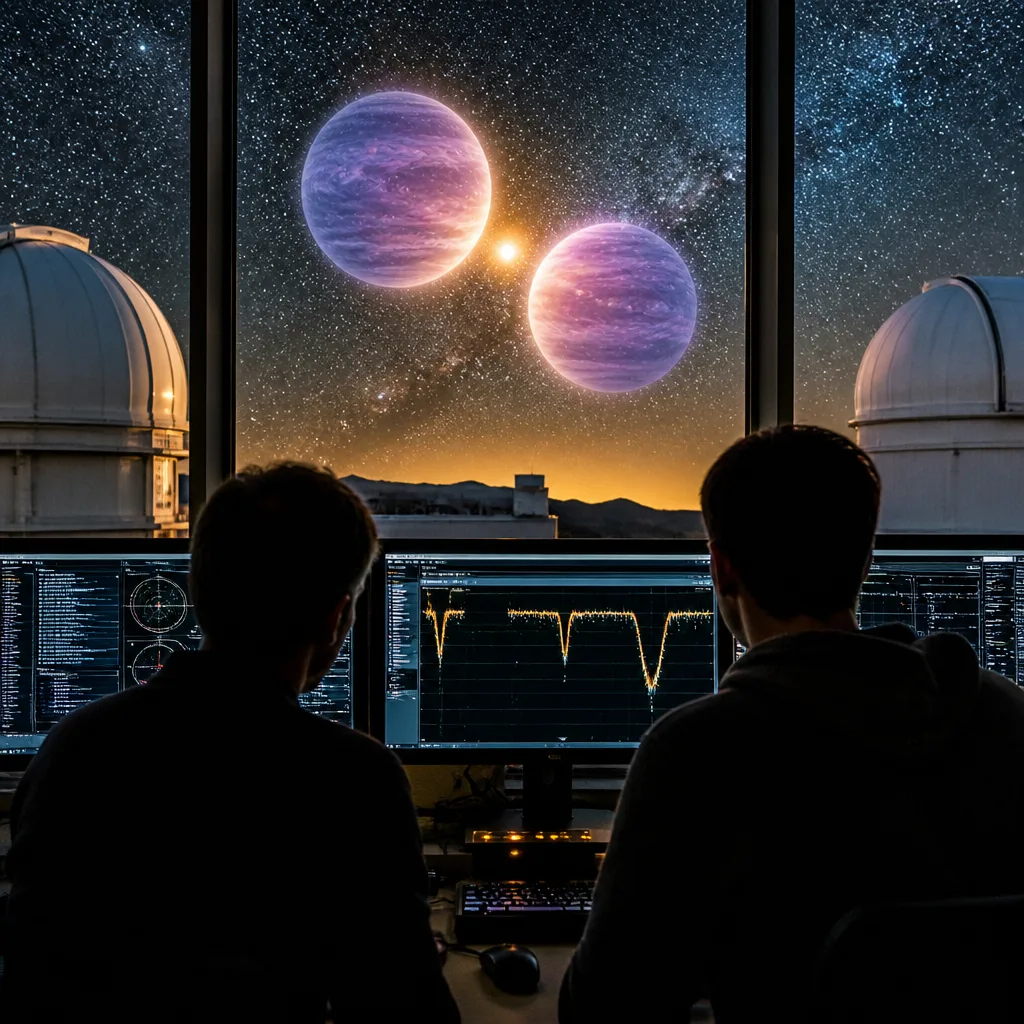
A pair of enormous but astonishingly light exoplanets has been reported by an international team of astronomers led by researchers at the University of Oxford. The planets, designated TOI‑791 b and TOI‑791 c, are roughly the size of Jupiter yet have average densities so low they are described by the team as being even less dense than candy floss.
Surprisingly fluffy giants
Both worlds orbit an F7‑type dwarf star approximately 1,110 light‑years away in the southern constellation Volans. Although comparable to Jupiter in radius, the inner planet, TOI‑791 b, has an average density of 0.038 g cm⁻³, while the outer planet, TOI‑791 c, has a density of 0.047 g cm⁻³. For context, candy floss typically has a density of around 0.05 g cm⁻³, and Jupiter’s mean density is about 1.33 g cm⁻³.
The extreme disparity in density means these worlds are tens of times less dense than Jupiter — a striking reminder that similar size does not imply similar internal structure or composition.
“densities comparable to a nice blob of shaving foam, fresh from the can,”
The unusual physical properties make TOI‑791 b and c members of the rare class known as ‘super‑puffs’ — giant planets with very low mass relative to their radii. Such planets are infrequently observed and present a challenge to planet formation and atmospheric evolution theories because they must retain extremely extended, low‑mass envelopes despite stellar irradiation and other mass‑loss processes.
How the system was probed
The pair also occupies a 5:3 mean‑motion resonance, meaning the inner planet completes five orbits for every three orbits of the outer planet. That gravitational commensurability produces measurable variations in the timing of the planets’ transits across their star, known as transit timing variations (TTVs). These timing shifts give astronomers extra leverage to constrain planetary masses and orbital dynamics without relying solely on radial‑velocity measurements.
- Host star: F7‑type dwarf in Volans, at ~1,110 light‑years
- Planets: TOI‑791 b and TOI‑791 c — Jupiter‑sized but extremely low density
- Resonance: 5:3 mean‑motion resonance, enabling transit timing analysis
The authors emphasise that the system is a particularly valuable target for follow‑up observations. Spectroscopy of the planets’ atmospheres, ideally with sensitive space telescopes, could reveal whether the low bulk densities are due to extremely extended hydrogen‑helium envelopes, high altitude hazes, or other structural explanations.
| Object | Average density (g cm⁻³) |
|---|---|
| TOI‑791 b | 0.038 |
| TOI‑791 c | 0.047 |
| Candy floss (typical) | 0.05 |
| Jupiter | 1.33 |
What this means for planetary science
Super‑puffs are important because they occupy an extreme part of parameter space: large radii but low masses. The discovery of two such planets in the same system strengthens the case that their properties arise from processes that can operate together — for instance, accretion of very light gases in the protoplanetary disc followed by modest contraction, or the presence of high‑altitude particulate layers that inflate measured radii. Alternatively, observational effects such as extended dusty outflows might make planets appear larger than their solid or deep atmospheric layers actually are.
Whatever the explanation, systems like TOI‑791 provide a natural experimental setup to test competing ideas. Because the planets share a common stellar environment and orbital history, comparative study reduces the number of variables scientists must wrestle with.
The research team has called for further observations of the pair’s atmospheres and long‑term monitoring of transit timing to refine mass estimates and probe atmospheric escape. These data will be vital to determine whether such featherweight giants are stable over long timescales or are transient phases in planetary lifecycles.
As exoplanet surveys continue to expand their sensitivity to low‑mass, large‑radius objects, more super‑puffs may be found — and with them a sharpened understanding of how planets can grow large without becoming dense.









