
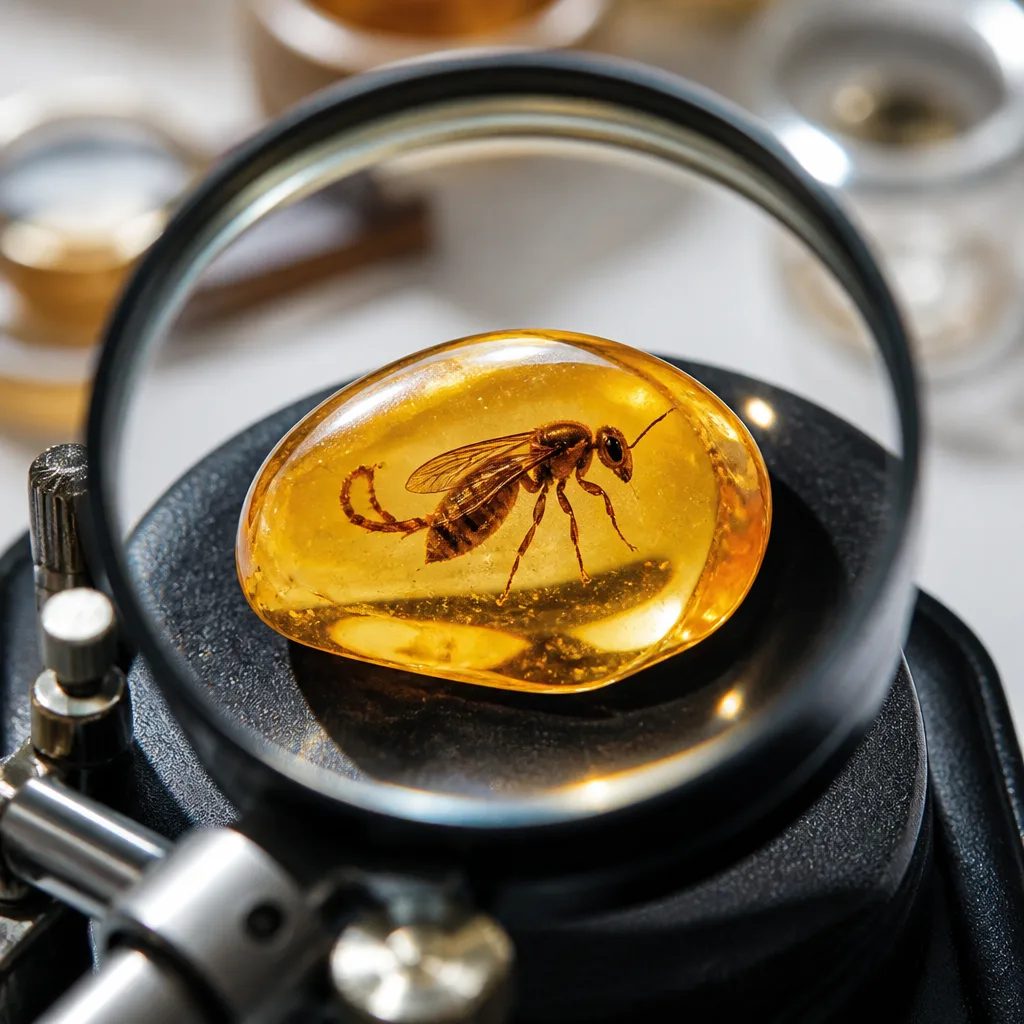
Scientists have identified a previously unknown species of parasitic wasp preserved in mid‑Cretaceous amber that carries a highly unusual structure at the tip of its abdomen that appears to have operated as a grasping device. The species, named Sirenobethylus charybdis, was described from 16 specimens entombed in amber from what is now Myanmar, and dates to roughly 99 million years ago, when dinosaurs still roamed the Earth.
Discovery and interpretation
The fossils, analysed by an international team including researchers at the Natural History Museum of Denmark and Capital Normal University in Beijing, reveal a small wasp with an expanded structure at the end of the abdomen. Initially mistaken for an air bubble, repeated inspection showed the enlargement to be anatomical and, crucially, mobile.
“When I looked at the first specimen, I noticed this expansion at the tip of the abdomen, and I thought this must be an air bubble. It’s quite often you see air bubbles around specimens in amber,”
The study’s authors describe instances where this lower flap was preserved both open and closed. That variability, together with the morphology, led them to conclude the structure was a movable flap “used to grasp something”, consistent with a predatory or parasitic function.
Analogy and limits of inference
Because direct observation of behaviour is impossible for an animal that lived almost 100 million years ago, researchers sought analogues among living organisms. They concluded there is no close counterpart among extant wasps or other insects; instead, the closest superficial comparison is with a carnivorous plant: the Venus flytrap.
As the authors caution, analogues only offer hypotheses. The Venus flytrap similarity is morphological and functional in a broad sense — a structure that closes upon contact and secures a target — rather than implying close evolutionary relationship. The team suggests the device may have allowed the wasp to seize prey and then oviposit, implanting eggs into or onto the victim, a strategy consistent with many parasitic wasps.
What the fossils reveal
- Specimens analysed: 16 individual wasps preserved in amber.
- Geological age: ~99 million years (mid‑Cretaceous).
- Publication: Findings reported in BMC Biology.
The presence of 16 specimens showing the same unique morphology in different orientations strengthens the interpretation that the structure was part of the animal’s anatomy and not an artefact of preservation. Preservation in amber can capture fine details of soft tissues and mobile parts that are rarely fossilised by other means.
| Attribute | Detail |
|---|---|
| Species | Sirenobethylus charybdis |
| Number of specimens | 16 |
| Age | ~99 million years (Cretaceous) |
| Preservation | Amber (Myanmar) |
| Journal | BMC Biology |
Broader significance
The discovery expands our view of morphological experimentation in ancient insects. Parasitic wasps today display a wide range of specialised appendages and behaviours used to locate, secure and parasitise hosts; the Cretaceous fossil record now demonstrates that similarly novel solutions were already evolving deep in the Mesozoic.
Beyond the immediate interpretation, the find illustrates the value of amber as a window into ecosystems long vanished. Amber can capture delicate, movable parts and behavioural snapshots that leave little trace in other types of fossil deposits. Each such discovery refines how palaeontologists reconstruct the ecology and evolutionary pathways of extinct groups.
While the Venus flytrap comparison will attract attention, researchers emphasise that the analogy is a heuristic — a way to envisage how the structure might have functioned — and not proof of behaviour. Further study of the specimens’ microstructure and comparisons with living parasitic wasps may help clarify how the appendage worked and what kinds of hosts the wasp targeted.
The work underlines that even minute fossils can yield disproportionately large insights into ancient life: a miniature, movable tail in amber opens a new chapter in the story of parasitic strategies among insects at the age of dinosaurs.









