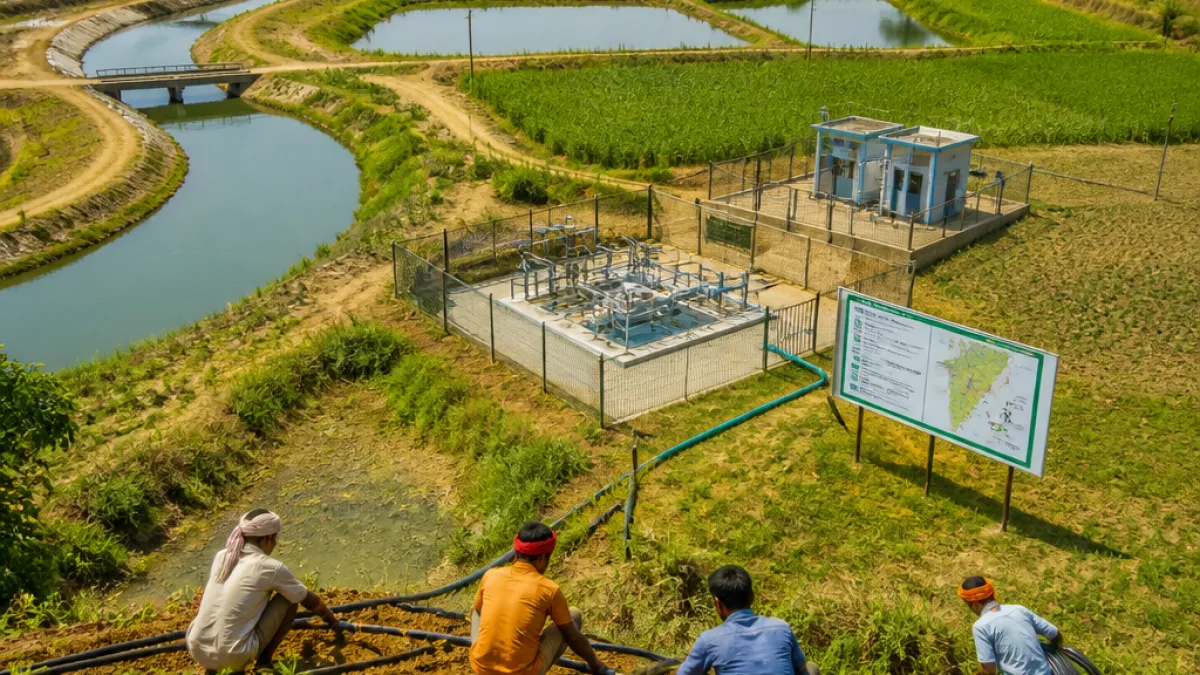
The World Bank has approved a ₹5,714.80-crore programme aimed at making Haryana more self-reliant in the water sector, the state government said on Saturday. The scheme, titled Water Secure Haryana Programme, will be rolled out in phases from 2026 to 2032 and covers interventions across irrigation, water conservation and reuse.
Approval, financing and governance
Haryana Chief Minister Nayab Singh Saini chaired a meeting of the Standing Finance Committee-C (SFC-C) to review the programme. According to the state government, the World Bank will provide a loan of ₹4,000 crore, while the remaining ₹1,714.80 crore will be met from state funds.
Officials described the package as a flagship integrated water-resources management initiative, to be implemented in 15 clusters that together encompass about 48.94 lakh acres of land. The state has drawn up a multi-year timeline, with major works taking place over a six-year period.
Major components and targeted outcomes
State authorities highlighted several core elements of the programme, which include large-scale civil works on canals, micro‑irrigation expansion, land reclamation and promotion of water-conserving crop practices.
- Canal rehabilitation: 104 canals will be upgraded at an estimated cost of ₹2,484.87 crore, supported by World Bank financing.
- Micro‑irrigation and command development: 620 watercourses (khals) are slated for rehabilitation under MICADA to supply irrigation to 3.18 lakh acres.
- Canal-based micro‑irrigation projects: 120 projects planned to benefit 56,830 acres.
- Land reclamation: Roughly 2 lakh acres of waterlogged land will be reclaimed for productive use.
- Agronomic shifts: Promotion of Direct Seeded Rice (DSR) over 5 lakh acres and a crop diversification programme (MPMV) on 1.12 lakh acres to encourage water‑sensitive farming practices.
- Waterbody construction and sewage reuse: Some 131 new water bodies will be created across seven districts to aid groundwater recharge, and treated sewage from four major STPs will be reused.
| Component | Scale / Cost |
|---|---|
| Total project cost | ₹5,714.80 crore |
| World Bank loan | ₹4,000 crore |
| State contribution | ₹1,714.80 crore |
| Area covered | 48.94 lakh acres |
Geographic focus and infrastructure
Government documents list seven districts for concentrated waterbody development: Bhiwani, Jind, Kaithal, Mahendragarh, Rewari, Charkhi Dadri and Sirsa. In addition, the plan includes reuse of treated effluent from four sewage treatment plants: two in Jind, one in Kaithal and one at Dhanwapur in Gurugram. Officials say these treated flows will support irrigation and recharge activities covering about 28,000 acres.
Why the state says it is needed
Haryana faces long‑standing pressures on surface and groundwater resources due to intensive agriculture and changing water tables. The state government framed the programme as an integrated response — combining engineering, on‑farm technology and cropping-pattern changes — intended to reduce freshwater withdrawal, raise irrigation efficiency and improve groundwater replenishment.
As part of demand management, the scheme emphasises expansion of micro‑irrigation and sowing techniques such as Direct Seeded Rice, which require less water compared with traditional transplantation. Officials also underscored the role of canal modernisation in reducing conveyance losses.
Implementation and scrutiny
The project will be executed in phases with timelines through 2032. It will involve multiple state departments, including irrigation, agriculture and agencies such as MICADA. The involvement of an international lender adds conditionalities on procurement, safeguards and monitoring, which the state administration will be required to meet.
Opposition parties and water‑policy analysts are likely to examine details such as the project's social and environmental safeguards, timelines for land‑level changes, beneficiary selection and the extent to which reclaimed and treated water will substitute for groundwater abstractions. The state government has not yet released the full operational plan or a project implementation unit structure.
Authorities said the Standing Finance Committee-C meeting discussed funding modalities and the phases of work; further approvals and project-level clearances will follow before civil works commence.