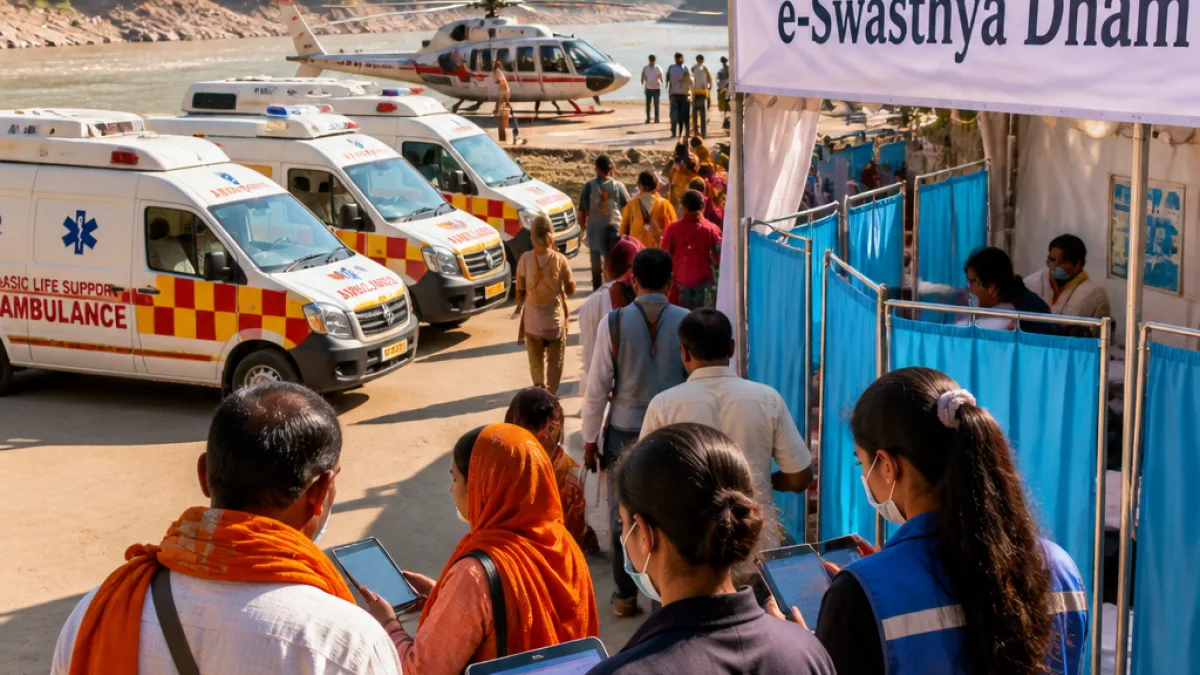
The Uttarakhand government has launched e‑Swasthya Dham, a digital portal to monitor pilgrims' health in real time during this year’s Char Dham Yatra, officials said on Tuesday. The initiative is part of a package of expanded medical arrangements intended to ensure timely care along the pilgrimage routes and at the four Dhams.
Real‑time monitoring, staffed medical posts
According to the health department, the e‑Swasthya Dham portal will enable authorities to track health parameters and coordinate immediate medical response where required. Permanent and temporary medical units will be staffed by experienced doctors and paramedical teams stationed at major halting points and at each of the four Dhams.
Health Minister Dr. Dhan Singh Rawat said the state had taken steps to keep ambulance response times to a minimum so pilgrims receive prompt care. "The response time of ambulances along the Yatra routes will be kept to a minimum so that pilgrims can receive timely medical care," he said.
Ambulance and emergency resources
Officials listed a multi‑tiered emergency fleet to be deployed along the pilgrimage routes. The overall arrangements include advanced life support and cardiac ambulances, regular emergency service ambulances, one boat ambulance for operations in Tehri, and a helicopter ambulance to be operated through AIIMS Rishikesh.
- 177 ambulances will be stationed along the Yatra routes, including advanced life support and cardiac ambulances.
- One boat ambulance will be positioned in Tehri to cover waterway access.
- A helicopter ambulance will be available, operated through AIIMS Rishikesh.
Medical personnel and screening points
To staff the expanded network, the state said specialist doctors, medical officers and paramedical staff will be rotated on fixed rosters. The deployment figures provided are:
| Category | Number |
|---|---|
| Specialist doctors | 16 |
| Medical officers | 46 |
| Paramedical staff | 85 |
| Health volunteers | 100 |
| Medical relief posts | 25 |
| Health screening points | 33 |
The government said the specialist doctors, medical officers and paramedical teams will be posted on a 15‑day roster to maintain continuous coverage during the Yatra. In addition, 100 health volunteers will augment on‑ground support for pilgrims.
Coordination and likely advantages
State officials framed the digital monitoring system as a tool to improve coordination between field units and referral hospitals, aiming to reduce delays in escalation to higher‑level care. The availability of a helicopter ambulance through AIIMS Rishikesh and a boat ambulance at Tehri are intended to address access challenges in difficult terrain and waterway locations respectively.
Health screening points along the routes will perform routine checks and provide treatment where necessary, while medical relief posts will act as first‑response hubs. The combination of human resources, emergency vehicles and the e‑monitoring portal is intended to shorten the interval between the onset of a medical event and the arrival of definitive care.
What pilgrims should note
- Pilgrims are advised to carry basic medical information and any essential medicines for chronic conditions.
- Those with existing cardiac, respiratory or mobility issues should be aware that specialised ambulances and screening points are available en route.
- Use of the e‑Swasthya Dham portal will be managed by officials; pilgrims should follow guidance from on‑site medical teams and volunteers.
Officials did not provide details on public access to the e‑Swasthya Dham portal or whether pilgrims will be able to view their own monitored parameters. The state has emphasised that the system is primarily a management and rapid‑response tool for health teams during the Yatra.
Authorities said the expanded medical coverage reflects a precautionary approach given the large numbers of devotees who undertake the Char Dham pilgrimage each season and the logistical challenges posed by Uttarakhand’s mountainous terrain.