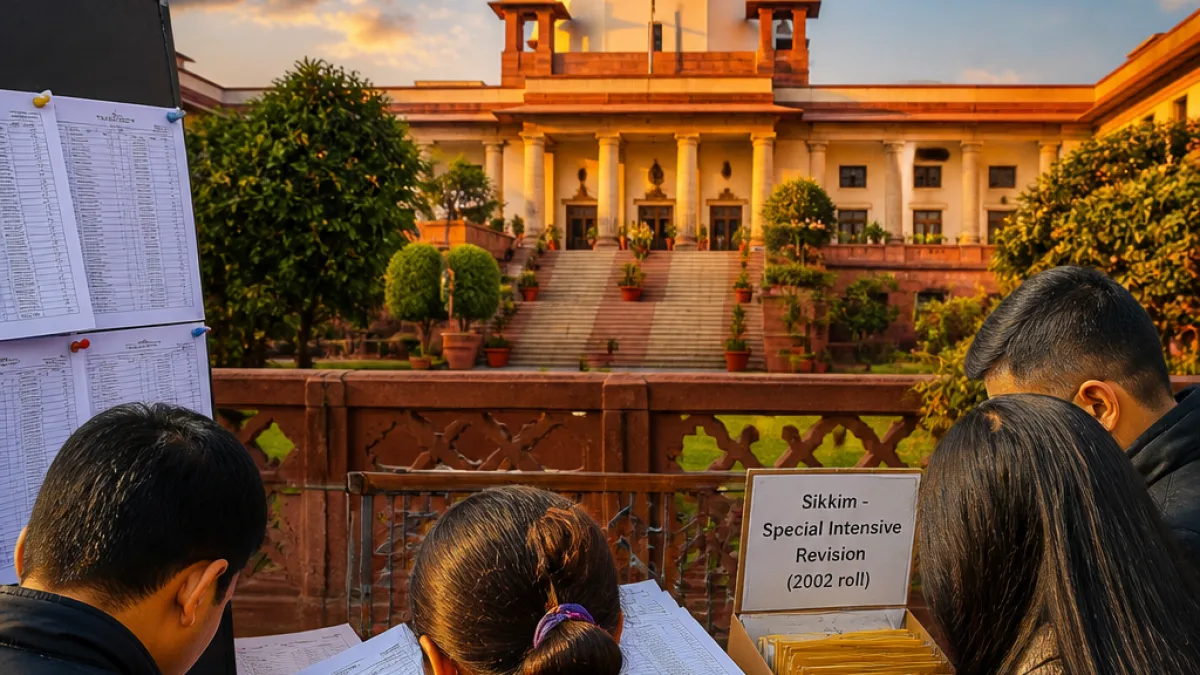
Gangtok, Aug 17: The Supreme Court on Monday declined to interfere with the Election Commission of India’s (ECI) decision to treat the 2002 electoral roll as the baseline for the ongoing Special Intensive Revision (SIR) of voters' lists in Sikkim, dismissing a public interest litigation (PIL) that had sought adoption of the 1993 roll instead.
Bench, grounds and reasoning
A Constitution bench comprising Chief Justice Surya Kant and Justices Joymalya Bagchi and V. Mohana heard the challenge brought by the Sikkimese Mulniwasi Surakacha Sangh. The petition argued that the 2002 additions to electoral data did not align with Sikkim’s demographic profile and that using 2002 could produce anomalies.
The bench, however, observed that electors enrolled in the 2002 roll had subsequently exercised their franchise in state elections and that the ECI had consistently fixed 2002 as the reference year across states, since the last nationwide SIR had been carried out that year. The court said there were no grounds to interfere at this stage with the ECI’s uniform approach.
“The goal post cannot be shifted in the middle of the exercise. 2002 has been kept as the base year for the entire country. We will not interfere with the decision of the Election Commission of India (ECI).”
The bench also noted that the petitioner had not placed any aggrieved individual's representation before the court and warned that permitting such NGO-led challenge to the ECI’s decision could be a “dangerous proposition”. Justice Bagchi highlighted that border states routinely face issues of migration and demographic change, implying that the court should be cautious before disrupting an ongoing administrative exercise.
What the order means for the SIR in Sikkim
With the court declining to intervene, the SIR in Sikkim will proceed on the basis of the 2002 electoral roll as the qualifying reference date. The SIR process — designed to identify eligible voters and remove names liable for deletion on recognised grounds such as death, permanent migration or duplication — remains under the administrative control of the ECI and the Office of the Chief Electoral Officer (CEO), Sikkim.
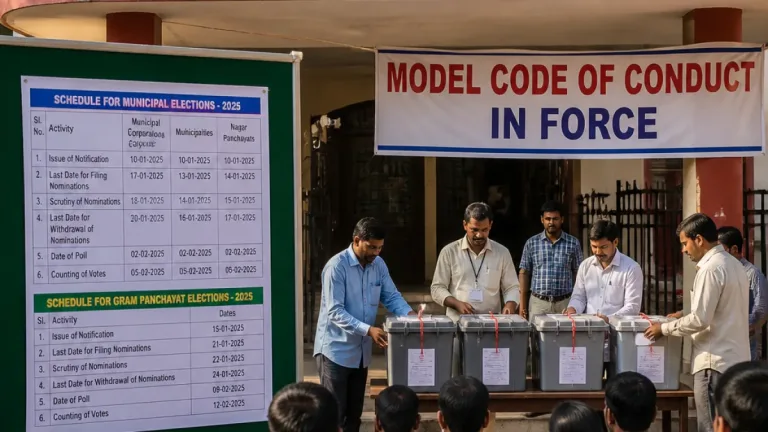
- The CEO, Sikkim, has already published material related to the 2026 SIR, including the draft electoral roll and lists of claims and objections.
- The Supreme Court suggested the petitioner may approach the ECI for a "reasonable exemption" for Sikkim, signalling that administrative remedies with the poll body remain available.
- The court’s decision leaves the ECI’s nationwide practice of using 2002 as base year intact for the present exercise.
Bench details and immediate outcome
| Bench | Decision |
|---|---|
| Chief Justice Surya Kant; Justices Joymalya Bagchi and V. Mohana | PIL dismissed; no interference with ECI’s choice of 2002 as base year |
The bench concluded that the petition did not establish a cause warranting judicial intervention in the electoral machinery’s ongoing exercise. It left open the administrative route of seeking relief directly from the ECI.
Context and implications
Sikkim’s electoral history and its unique constitutional and demographic framework have often been treated as requiring special consideration. The petition’s contention — that the 1993 roll would better reflect historical links of Sikkimese electors — underscores ongoing sensitivities in states where migration and demographic shifts are significant factors.
However, the Supreme Court’s ruling emphasises stability and uniformity in a national exercise. By refusing to permit a state-specific change of the qualifying reference mid-course, the court has safeguarded the ECI’s administrative uniformity across states undertaking the SIR.
For residents and stakeholders in Sikkim, the immediate practical effect is procedural: claims, objections and corrections during the current SIR will be judged against the 2002 roll. Those who believe they have been adversely affected by the baseline selection retain the option of approaching the ECI for any special consideration the Commission may deem appropriate.
No further orders were issued by the court; the petition by the Sikkimese Mulniwasi Surakacha Sangh stands dismissed. Inputs to the reporting included PTI material.