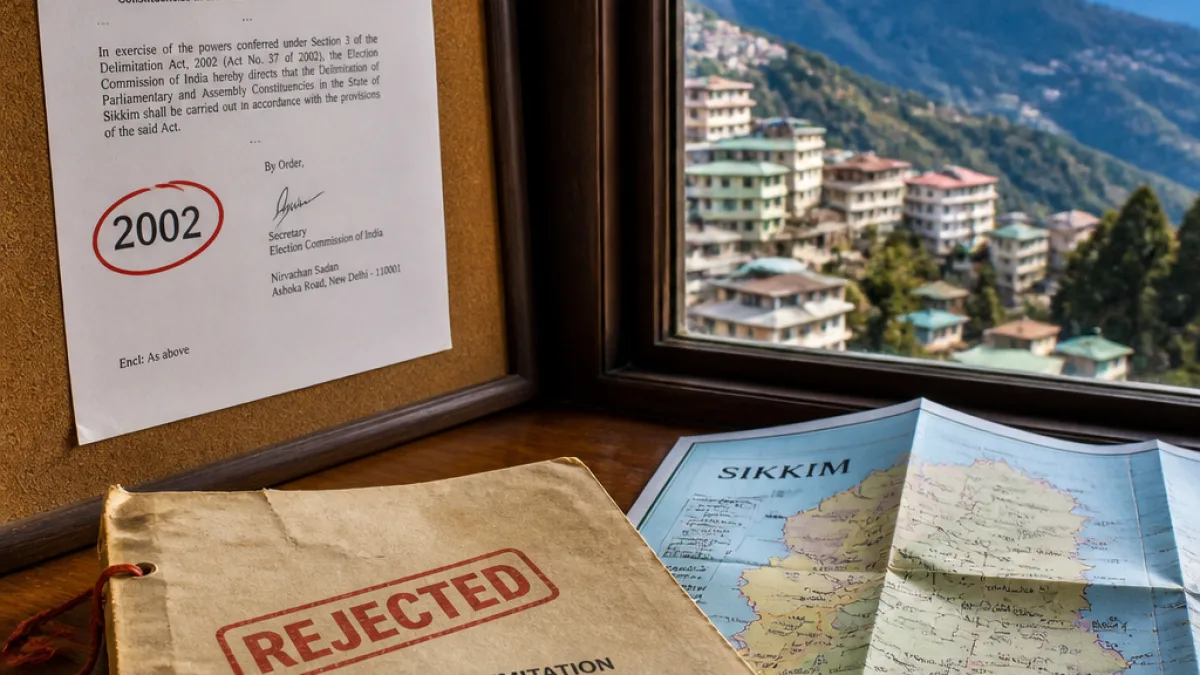
Gangtok: The Supreme Court on Monday refused to interfere with the Election Commission of India's decision to use the 2002 electoral roll as the reference or base year for the ongoing Special Intensive Revision (SIR) of electoral rolls in Sikkim.
Bench upholds uniform baseline, rejects PIL
A bench comprising Chief Justice Surya Kant and Justices Joymalya Bagchi and V. Mohana dismissed a public interest litigation filed by the Sikkimese Mulniwasi Surakacha Sangh, an NGO, which had sought a direction to the Election Commission to adopt the 1993 roll instead of 2002 for the State's SIR.
The court said the poll authority had uniformly fixed 2002 as the baseline across the country since that was the year of the last comprehensive SIR, and added that it would not permit the "goal post" to be shifted while the exercise was underway. The bench observed that electors enrolled in 2002 had subsequently exercised their franchise in later elections, undermining the petitioners' contention that the 2002 roll was an inappropriate reference.
"The goal post cannot be shifted in the middle of the exercise. 2002 has been kept as the base year for the entire country. We will not interfere with the decision of the Election Commission of India (ECI)," the bench said.
Court points to administrative remedies with ECI
While rejecting the PIL, the bench advised the petitioner to approach the Election Commission if there was a need for a reasonable exemption specific to Sikkim. The court said no sufficient ground had been made out to judicially set aside the ECI's choice at this stage.
Chief Justice Kant also noted that, apart from the NGO, there was no record of an aggrieved individual approaching the court over the matter, and warned that asking the judiciary to intervene at the behest of an organisation could be a problematic precedent.
Justice Bagchi remarked on the broader administrative difficulty faced by border States: demographic change and migration are common concerns for such regions. The bench observed that these factors alone did not establish a basis to overturn the Commission's uniform approach.
Background and implications for Sikkim's electoral roll revision
The SIR is a targeted exercise by the ECI to verify, update and clean electoral rolls by identifying eligible electors and removing names liable for deletion on recognised grounds such as death, permanent migration or duplication. The choice of a qualifying reference roll is central to how historical linkage to the State's electorate is established.
The petitioner argued that the electoral additions recorded in 2002 did not reflect Sikkim's demographic reality and that reverting to the 1993 roll would better capture the State's historical electorate. The court, however, pointed to practical considerations: electors on the 2002 roll have participated in subsequent elections, which supports continuity of the roll as a frame of reference for revision.
| Year | Significance |
|---|---|
| 1993 | Referenced by petitioners as historically appropriate baseline for Sikkim |
| 2002 | Chosen by ECI as the uniform base year for the current SIR exercise nationwide |
What the order means on the ground
- The SIR in Sikkim will continue to use the 2002 roll as the qualifying reference for assessing claims and objections.
- Individuals or groups seeking a different treatment for Sikkim must approach the ECI for a possible exemption; the court has not closed off administrative remedies.
- No immediate change to draft rolls, published lists of claims and objections, or other SIR documents is expected as a result of this order.
The court's refusal to intervene preserves the ECI's nationwide uniformity in the revision exercise while signalling the judiciary's preference for administrative resolution of state-specific anomalies. Observers say the decision reduces the likelihood of litigation-induced delays in the ongoing SIR, but leaves open the question of how the ECI will respond to any requests for Sikkim-specific accommodations.
The matter raises broader electoral-administration questions for States with distinctive demographic histories. For now, the ECI's operational decision stands and the SIR process in Sikkim will proceed on the 2002 baseline unless the Commission itself chooses otherwise after considering any representation from stakeholders.