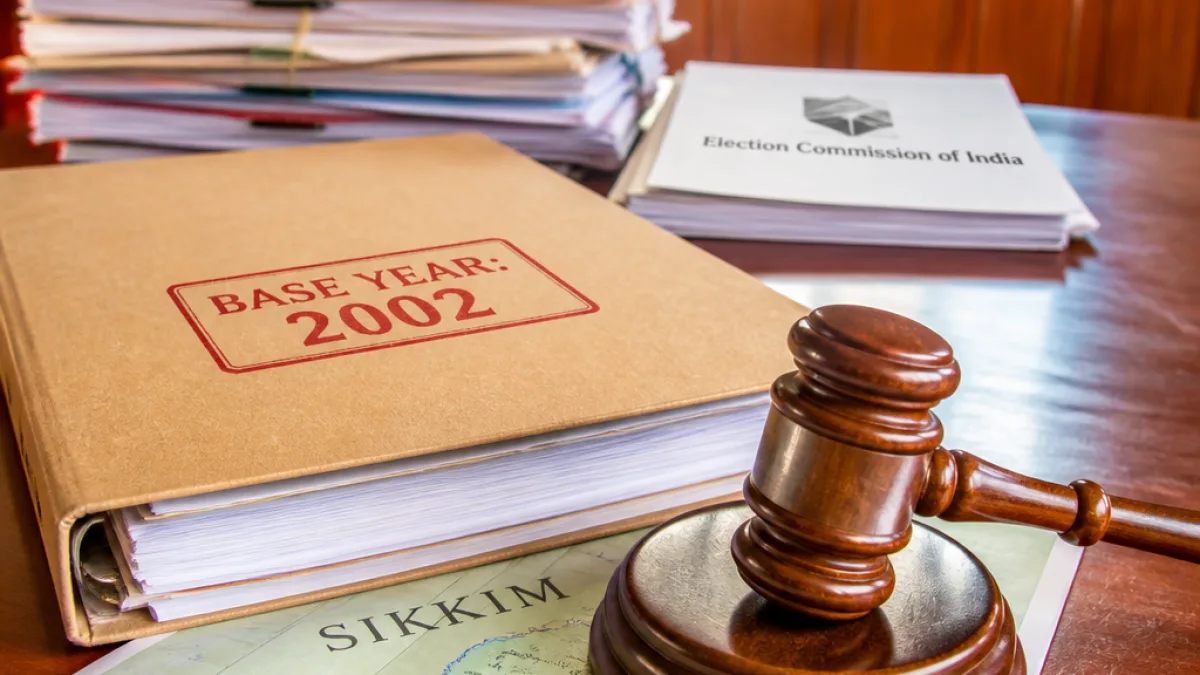
Gangtok, Aug 17: The Supreme Court on Monday declined to interfere with the Election Commission of India’s (ECI) decision to retain 2002 as the base year for the ongoing Special Intensive Revision (SIR) of electoral rolls in Sikkim, dismissing a public interest litigation filed by a local NGO.
Bench cites need for uniformity, rejects mid-process change
A three-judge bench led by Chief Justice Surya Kant and comprising Justices Joymalya Bagchi and V Mohana ruled that the revision exercise could not be reconfigured midway and that the ECI had fixed 2002 uniformly across the country. The petition by the Sikkimese Mulniwasi Surakacha Sangh had sought that 1993 be adopted as the base year on the ground that it would provide a more accurate foundation for the state's rolls.
The bench observed that voters included in the 2002 rolls had participated in subsequent elections, and therefore there was no justification to alter the base year during the SIR. The court said the petitioner could seek an exemption or redressal from the ECI itself, rather than pressing for judicial intervention.
“The goal post cannot be shifted in the middle of the exercise. 2002 has been kept as the base year for the entire country. We will not interfere with the decision of the Election Commission of India,” the bench said.
Concerns raised by petitioners and court response
The NGO contended that the demographic data added in 2002 did not accurately reflect Sikkim’s population dynamics and that adopting the earlier year, 1993, would prevent anomalies in the rolls. The court, however, noted the absence of any aggrieved individual approaching it directly; the challenge had been mounted only by the organisation.
Chief Justice Kant cautioned against permitting a single organisation to seek judicial reversal of an administrative decision of this scale, describing such a possibility as a potentially "dangerous proposition" for the integrity of election administration. Justice Bagchi pointed to migration-related pressures that border states routinely face, underscoring the complex context within which roll revisions occur.
What the ruling means for Sikkim's revision exercise
- ECI's nationwide framework for SIR remains intact; 2002 continues as the benchmark year in Sikkim.
- The petition dismissal consolidates the Commission's authority to apply uniform base years across states during special revision drives.
- The court signalled that grievances should be pursued with the ECI for any state-specific relief rather than through the judiciary at this stage.
By refusing to change the base year at the judicial level, the Supreme Court has effectively endorsed the continuity of the ongoing revision process, removing the possibility of disruption that could have arisen from a successful challenge. The bench did, however, leave open the administrative route by suggesting the petitioner approach the ECI for any specific exemptions or adjustments.
| Item | Detail |
|---|---|
| Petitioner | Sikkimese Mulniwasi Surakacha Sangh (NGO) |
| Relief sought | Adoption of 1993 as base year for SIR in Sikkim |
| Bench | CJI Surya Kant; Justices Joymalya Bagchi and V Mohana |
| Court outcome | PIL dismissed; no judicial interference with ECI decision |
Background and administrative context
Special Intensive Revision (SIR) is an exercise the ECI deploys to update electoral rolls comprehensively in a targeted area or state. The choice of a base year establishes the reference point for inclusion and reconciliation of past enrolments and subsequent changes. In this instance, the ECI had fixed 2002 as the base year nationwide, referencing the timing of the last SIR conducted in many parts of the country.
The court's judgement underscores the judiciary's reluctance to intervene in broad administrative frameworks set by the ECI, particularly when a uniform national approach is at stake. It further clarifies that administrative remedies remain the primary avenue for stakeholders seeking state-specific adjustments during roll revisions.
State election administrators and political parties in Sikkim will now continue the SIR process under the existing parameters set by the ECI, while civil society groups may pursue representations before the Commission for any perceived anomalies or exceptions.