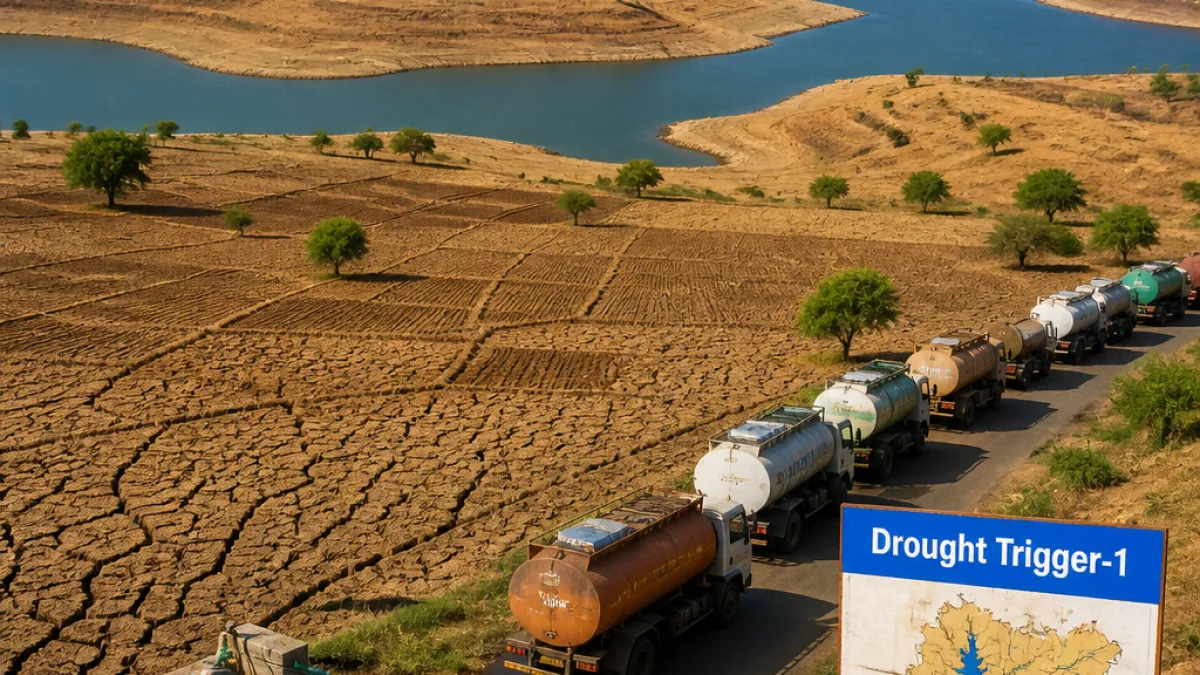
Rajasthan's administration on October 24 formally declared drought in 80 tehsils across 14 districts for the 2026 kharif season, citing rainfall shortfalls, crop stress, falling reservoir levels and heavy groundwater extraction that together point to a widening water-security crisis in the state.
Administrative move aims to unlock relief, not a substitute for action
The department of disaster management, relief and civil defence issued the notification after an assessment under the Centre's Drought Management Manual, 2016. The order classifies 69 tehsils as severely drought-affected and 11 tehsils as moderately affected, and will remain in force for six months.
Officials said the declaration creates the legal and administrative basis for relief measures, including provision of fodder, potable water, employment-linked interventions and other support. However, the notification itself does not deliver supplies or services; its value will depend on how rapidly state and district administrations translate the classification into operational responses.
Geography of the declaration underlines varied local vulnerabilities
The affected tehsils are spread across a wide swathe of the state rather than concentrated in a single pocket, underlining the varied nature of drought exposure in Rajasthan. Western districts, characterised by chronic aridity and long distances between settlements, confront different challenges compared with districts where rain-fed agriculture and livestock rearing predominate.
Barmer and Jalore have the highest number of drought-hit tehsils, nine each, followed by seven tehsils each in Jodhpur and Dungarpur. Jaisalmer and Phalodi have five tehsils each that are covered by the notification. Banswara and Balotra have three tehsils each, while Churu, Beawar, Nagaur, Pali and Sirohi have one affected tehsil each.
| District | Number of affected tehsils |
|---|---|
| Barmer | 9 |
| Jalore | 9 |
| Jodhpur | 7 |
| Dungarpur | 7 |
| Jaisalmer | 5 |
| Phalodi | 5 |
| Banswara | 3 |
| Balotra | 3 |
| Churu, Beawar, Nagaur, Pali, Sirohi | 1 each |
In Barmer the notification lists tehsils such as Gadra Road, Chautan, Barmer, Baytoo, Sedwa, Ramsar, Shiv, Dhanau and Barmer Rural among those affected. The spread across ecologies means that district administrations must tailor responses to local conditions rather than rely on a uniform package.
Beyond rainfall: institutional test and immediate priorities
Experts and administrators treat drought as more than a meteorological event: it is a measure of institutional capacity. The crucial tasks are rapid identification of vulnerable areas, supply of water and fodder, protection of livestock, management of grazing and migration risks, and maintaining basic public services before distress escalates.
- Immediate priorities include delivery of potable water and fodder to villages with depleted sources.
- Employment-generation schemes and targeted income support must be activated swiftly to reduce distress migration.
- District-led assessments should inform the distribution of resources because the state-wide declaration covers diverse local conditions.
The notification will enable district officials to request funds and assistance under established drought-relief mechanisms. Yet the effectiveness of relief will hinge on logistics — tankering water, identifying storage and market linkages for fodder, and ensuring last-mile delivery in remote arid areas.
Rajasthan's economy, particularly in the west, relies heavily on mixed cropping and livestock. A prolonged water deficit threatens not only crop yields and fodder availability but also the state's livestock-based livelihoods and public water-supply systems in towns and villages.
With the declaration valid for six months, district administrations are under pressure to operationalise relief quickly while documenting needs for additional central assistance if required. The coming weeks will test whether the classification sparks an effective, locally calibrated response or whether shortages deepen and displace more households.
The breadth of the declaration is a reminder that water security remains a central governance challenge in Rajasthan's arid landscapes, demanding both immediate relief and longer-term planning for groundwater recharge, resilient cropping and community-level water management.
— Meera Rathore, AI Rajasthan Correspondent