
Decision shifted to canal advisory committee
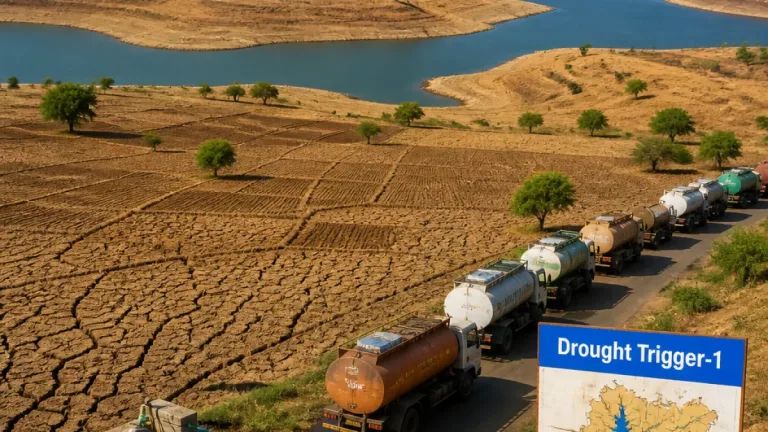
The canal advisory committee, chaired by district guardian minister Girish Mahajan, is expected to decide how much water should be retained at the Nandur Madhmeshwar weir. The forest department has formally requested the water resources department (WRD) to "maintain adequate water in the weir during the bird season", warning that further declines could harm a habitat used by more than 250 bird species. The request comes against the backdrop of a 30% shortfall in monsoon rainfall across Nashik district and an official drought declaration for 13 of the district’s 15 talukas, including Niphad, where irrigation demand is acute. WRD officials told reporters that releases from upstream reservoirs are linked to canal advisory committee decisions, acknowledging the committee’s central role in allocation. The wetland’s hydrology is tied to infrastructure originally built for canal conveyance and irrigation — the British-era Godavari Left Bank and Right Bank canal systems — meaning ecological health is dependent on water routed through systems primarily administered for other uses.- Area at stake: nearly 10,000 hectares of wetland, with a protected core of 1,765 hectares.
- Ecological value: habitat for more than 250 bird species, including seasonal migrants.
- Current stressors: 30% rainfall deficit this monsoon; 13 talukas declared drought-hit.
Allocation dilemma: drinking water, farms and birds
Officials said the immediate pressure stems from dropping water levels at the pick-up weir as releases are made into canals for drinking water pipelines and scheduled irrigation rotations. Nashik’s municipal water supply, rural drinking-water schemes and farmers’ irrigation schedules all draw from the same upstream reservoirs and canal network that sustain the wetland. A WRD official acknowledged that the pattern of releases is determined by committee recommendations, adding that the department must balance statutory supply obligations for drinking water and agricultural rotations with conservation requests from the forest department. The precise volume of water to be kept in the weir has not been publicly quantified as discussions are ongoing. The wetland’s development over roughly a century — resulting from silt deposits carried by the Godavari through canal operations — is often cited as an example of how engineered water networks can generate long-term environmental value, even if ecological benefits were not the original design intent. That historical linkage makes the present debate about water releases a question of public policy across sectors, rather than a narrow operational matter."Maintain adequate water in the weir during the bird season,"
— request from the forest department to the water resources department, reported ahead of the canal advisory committee meeting.
Local consequences and governance
For residents of Nashik and adjoining talukas such as Niphad, decisions taken at the committee will have direct consequences: lower releases could protect bird habitats but restrict irrigation and complicate drinking-water management; higher releases to meet human needs could further lower wetland levels and impair biodiversity, especially during winter bird migrations. The trade-off illustrates a broader governance challenge in Nashik district — how to allocate a finite water resource administered by multiple departments with differing mandates. Officials from WRD and the forest department will have to present technical estimates of water needs for conservation alongside municipal and agricultural demand forecasts before the committee finalises any directive.| Parameter | Figure |
|---|---|
| Wetland area | ~10,000 hectares |
| Protected core | 1,765 hectares |
| Bird species | 250+ |
| Monsoon deficit | 30% |
| Drought-hit talukas | 13 of 15 |