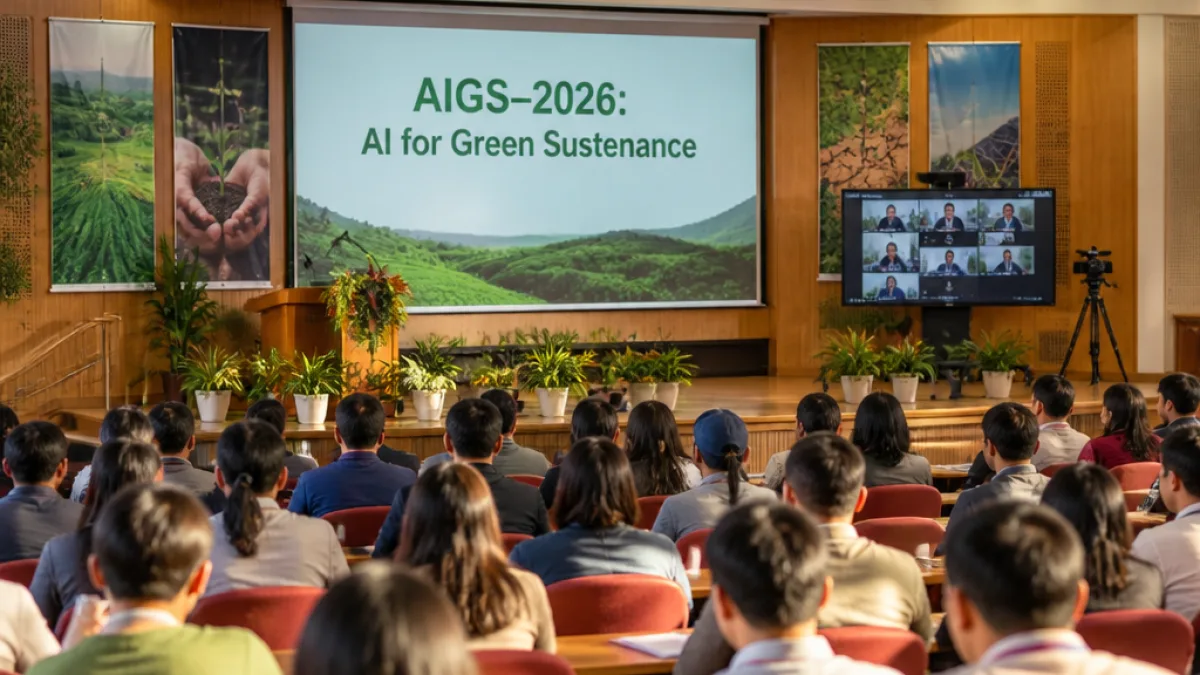
The two-day International Seminar AIGS–2026 concluded on August 11 at the School of Engineering & Technology, Nagaland University, Meriema Campus, Kohima, bringing together researchers and educators to examine the role of artificial intelligence in supporting environmental sustainability and agricultural practice.
Hybrid gathering of scholars and practitioners
Organised in collaboration with the Anusandhan National Research Foundation (ANRF) and Nagaland University, the event ran in a hybrid format and attracted academicians, scientists, faculty members and early-career scholars from across India and overseas. The seminar was convened by Prof Prabhakar Sharma, Dr Subhashis Banerjee and Dr Prasenjit Pal.
The programme was designed as an interdisciplinary platform to widen the conversation on artificial intelligence beyond narrow technical applications, emphasising intersections with ecology, agriculture, environmental humanities and pedagogy.
Plenary sessions and focal themes
The opening plenary set the seminar's interdisciplinary tone. Prof Shyam S Phartyal of Mizoram University presented on citizen science in the age of AI, highlighting the convergence of scientific methods, humanities perspectives and educational practice to support environmental stewardship. From Nagaland University, Prof Nigamananda Das addressed the ecological consequences of increasing AI deployment.
Parallel sessions in the afternoon split along two broad tracks: one focusing on Science & Technology and another on Education, Humanities & Social Sciences. Topics in the science track included greenhouse-gas emissions from hydropower reservoirs and environmental monitoring techniques, while the humanities and education strand explored how AI can be woven into pedagogy and community-engaged research.
| Speaker | Affiliation | Topic |
|---|---|---|
| Prof Shyam S Phartyal | Mizoram University | Citizen science and AI for green sustenance |
| Prof Nigamananda Das | Nagaland University | Environmental impacts of artificial intelligence |
| Prof Amit Kumar | Nanjing University of Information Science & Technology | GHG emissions from hydropower reservoirs |
| Prof Ashutosh Tripathi | (Affiliation presented) | Pollution and environmental monitoring |
| Prof Ambrish Singh | (Affiliation presented) | Applications of AI |
Key topics discussed
- How AI tools can assist in environmental monitoring and pollution detection;
- Potential ecological footprints and unintended consequences of AI deployment;
- Opportunities to integrate AI into agricultural practice and pedagogy, and the role of citizen science in bridging disciplines.
Speakers combined technical analyses with perspectives from the humanities and education, indicating an effort to balance innovations in computing with social and ecological considerations.
Regional relevance and research linkages
For Nagaland and the broader Northeast, discussions on AI-enabled environmental monitoring and agricultural support carry particular relevance given the region's dependence on natural resources and smallholder farming. While the seminar did not announce specific programmes or funding during its sessions, the presence of national research agencies and international contributors highlighted potential avenues for future collaboration.
Experts at the event noted that responsible adoption of AI requires evaluating both benefits and risks — from improved data-driven decision-making in agriculture to increased energy consumption and hardware waste associated with intensive computing.
Outlook and next steps
Organisers framed AIGS–2026 as a stepping stone to sustained interdisciplinary engagement, encouraging participants to pursue collaborative research and curriculum development that reflect ecological priorities. The hybrid format allowed wider participation and ensured that recorded sessions and presentations could be accessed beyond the campus, extending the seminar's reach.
Given the multidisciplinary focus, the seminar is likely to inform discussions in university departments, local research centres and policy forums that consider how emerging technologies can be adapted for sustainable development in the Northeast.
Attendance and convenors: The event, convened by Prof Prabhakar Sharma, Dr Subhashis Banerjee and Dr Prasenjit Pal, was supported by ANRF and Nagaland University and held at the Kohima (Meriema) campus.