
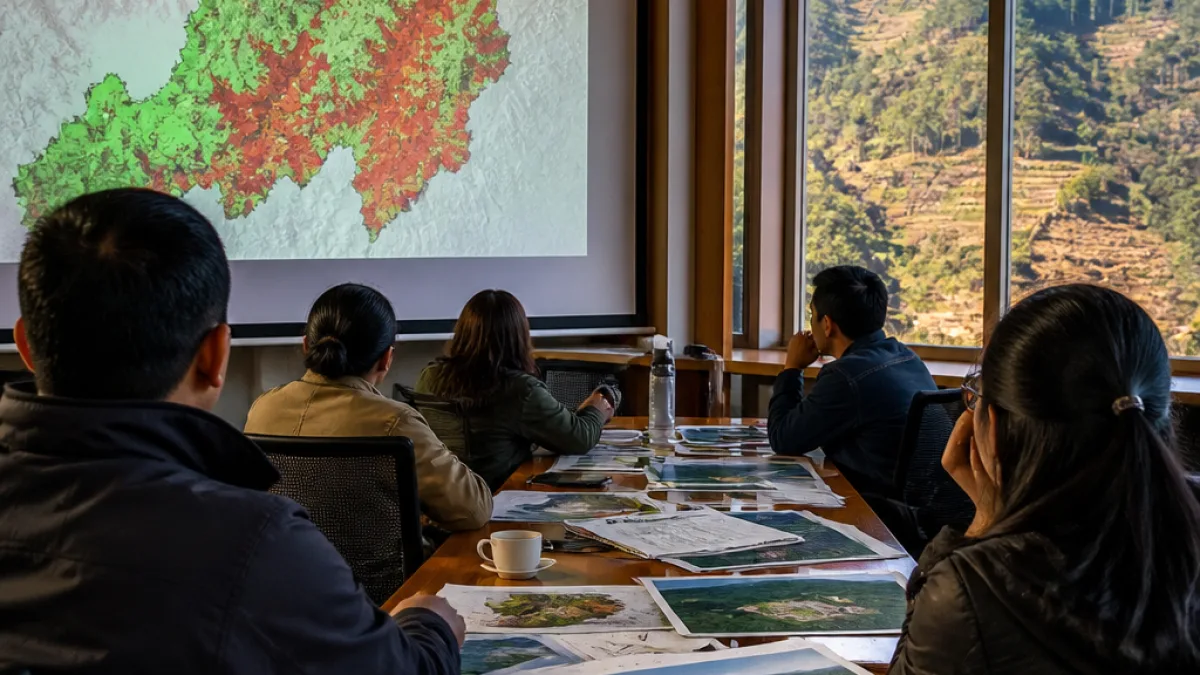
Kohima: Nagaland has experienced an estimated 10% decline in forest cover over the last 10–15 years, a senior Forest Department official said on Wednesday, flagging growing pressure on the state's biodiversity and calling for urgent revision of conservation strategies.
Official figures and workshop context
The estimate was provided by Supongnukshi, IFS, Additional Principal Chief Conservator of Forests (Territorial), during a consultation workshop in Kohima convened to revise the Nagaland State Biodiversity Strategy and Action Plan (NSBSAP). The workshop was organised by the Nagaland State Biodiversity Board in collaboration with The Nature Conservancy and the Foundation for Ecological Security.
According to state records cited at the workshop, Nagaland has a geographical area of 16,579 sq km. The recorded forest area stands at 8,629.30 sq km, equivalent to about 52.04% of the state.
| Forest category | Area (sq km) |
|---|---|
| Very dense forest | 1,256.38 |
| Moderately dense forest | 4,461.81 |
| Open forest | 6,504.28 |
| Scrub | 667.27 |
Who owns the forests?
Ownership of forest land in Nagaland differs from many other states. Communities and village institutions control around 7,621.07 sq km — about 88.30% of the recorded forest area — while just 11.70% is under state government ownership, covering reserved forests, wildlife sanctuaries, protected forests and purchased forests.
Drivers of decline and conservation concerns
Supongnukshi described the roughly 10% reduction in forest cover as "unprecedented" and linked it to population growth and increasing dependence on forest resources. He warned that ongoing degradation is affecting animals, plants, insects and other components of biodiversity across the state.
"Without discovering those species, we are just losing them without knowing,"
The official also highlighted that several species in Nagaland remain undocumented scientifically, making loss of habitat a threat to species that may be unknown to researchers.
Participants at the workshop cited traditional shifting cultivation (jhum) as integral to rural livelihoods, but noted that shorter fallow periods and rising population pressure are contributing to degradation. Recent data referenced at the meeting indicated that Nagaland lost around 794.88 sq km of forest cover between 2013 and 2023.
Implications for policy and local stakeholders
The consultation to revise the NSBSAP aims to update the state’s biodiversity planning in light of these trends. The facts presented at the workshop underline several immediate implications:
- Need for systematic documentation and inventory of species that may be undocumented.
- Community engagement in conservation given the majority of forest area is community-owned.
- Addressing land-use pressures arising from population growth and changing agricultural practices.
Officials and conservation partners at the workshop stressed that effective revision of the NSBSAP will require data-driven assessments and collaboration between government departments, local communities and conservation organisations. The Nature Conservancy and the Foundation for Ecological Security were listed as collaborators for the process.
What the figures mean on the ground
Loss of forest cover of the magnitude reported can have multiple local effects — reduced availability of non-timber forest products for communities; declines in pollinators and other insects crucial for agriculture; increased vulnerability of watersheds; and pressure on species that may be restricted to specific habitats. With just over half the state's area recorded as forest, the trajectory of cover change will influence livelihoods, ecosystem services and climate resilience.
At the Kohima workshop, the combination of administrative figures and the field experience of local stakeholders was presented as the basis for updating the strategy and action plan. The revision process is intended to translate these findings into conservation priorities and practical measures for both state agencies and community institutions.
Further details on timelines or specific measures from the NSBSAP revision process were not released at the session.












