
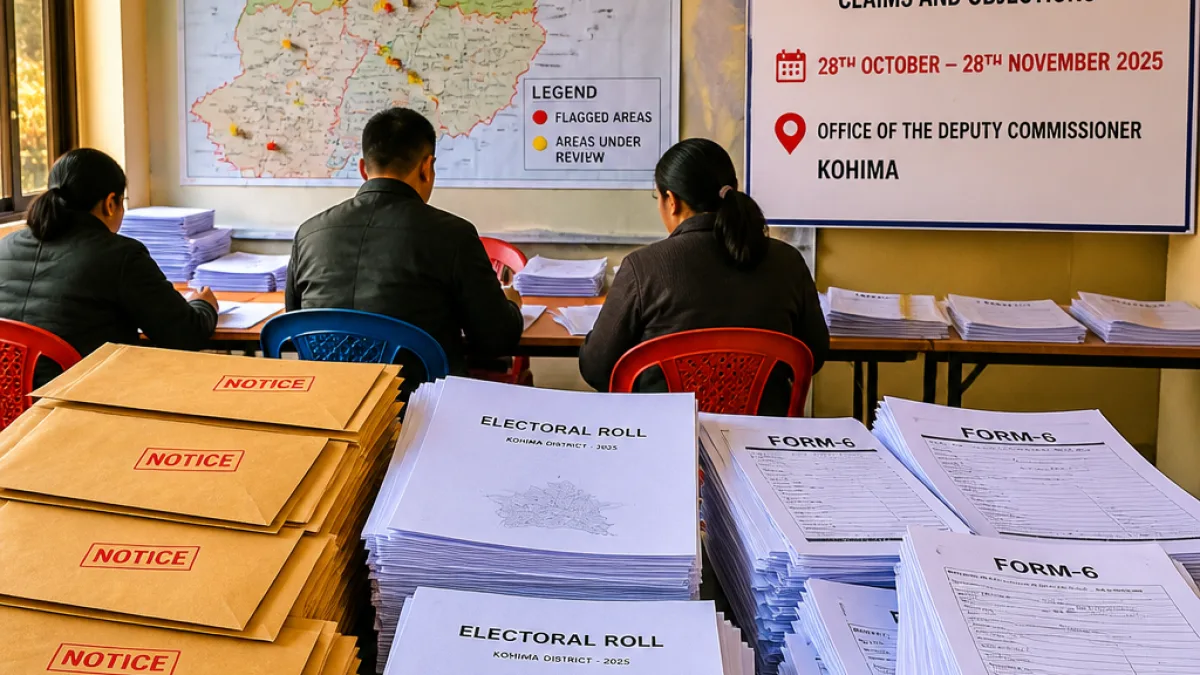
Nagaland officials have identified a large number of discrepancies in the State’s Synchronized Information Roll (SIR) and will issue notices to nearly 5 lakh electors, Chief Electoral Officer Bhagyashree Banayat said on Monday. The move follows the enumeration phase carried out between August 16 and September 14 and is intended to give genuine voters an opportunity to seek inclusion or correction ahead of the final publication of the electoral roll.
Claims and objections window, camps for verification
Banayat said the formal period for claims and objections runs from September 20 to October 20. During this time, electors whose names were inadvertently omitted from the draft roll may apply for inclusion by submitting Form‑6 together with the prescribed declaration and supporting documents. The same window applies for newly eligible voters who have attained 18 years of age by the qualifying date of 1 October 2026.
To facilitate verification and to ensure accessibility, electoral registration officers (EROs) will conduct hearing camps at convenient locations — including ERO headquarters, district headquarters and polling-station level venues. The CEO’s office said the entire exercise is scheduled for completion by 18 November, ahead of the final roll publication.
How to apply and what information is voluntary
- Forms and information related to the SIR are available with Booth Level Officers (BLOs), at election offices and on the CEO’s website.
- Applications can also be filed online through the official portal.
- Submission of Aadhaar number in the SIR enumeration form is voluntary and is not being used for Aadhaar seeding in the electoral roll.
"Submission of the [Aadhaar] number in the SIR process is optional and the card by itself is not proof of citizenship," Banayat said, adding that Aadhaar and mobile number details sought through the enumeration form were voluntary.
Summary of enumeration findings
According to the CEO’s office, the SIR enumeration phase covered 13,57,208 electors. Of these, 11,99,456 electors — or 88.38% — submitted their Enumeration Forms by the deadline of 14 September. The exercise flagged several categories of discrepancy that will require verification or disposal under electoral rules.
| Category | Number | Share of covered electors |
|---|---|---|
| Deceased electors | 29,944 | 2.13% |
| Absent / permanently shifted / other | 1,23,749 | 9.12% |
| Enrolled at multiple places | 5,059 | 0.37% |
The CEO’s statement said nearly 1.59 lakh entries were identified as belonging to the combined categories of deceased, absent/shifted or enrolled at multiple places. Electors whose names are found enrolled at multiple locations will be retained at only one place as per prevailing rules.
District-level issues and next steps
Districts recorded varied patterns of uncollected enumeration forms. Among them, Dimapur had the highest number of uncollectable forms, followed by Choumoukedima. EROs and BLOs have been tasked with conducting local camps and outreach to reach electors who did not submit forms or whose status remains unclear.
Officials said the "absent/shifted/other" category includes electors who have migrated to other States or Union Territories, could not be located during enumeration, failed to submit their forms by the deadline, or were unwilling to register. The CEO’s office reiterated that the claims-and-objections phase is the statutory avenue for redress and urged electors to act within the stipulated timeline.
Electors seeking inclusion or correction should approach their BLO, the ERO at the designated camp, or use the online facility on the CEO’s website. The verification camps are intended to validate documents, hear objections and finalise adjustments before the roll is published.
The SIR exercise is part of periodic efforts by the Election Commission of India to ensure accuracy and integrity of electoral rolls, and to protect the franchise by removing ineligible entries while enabling genuine but omitted electors to be registered.













