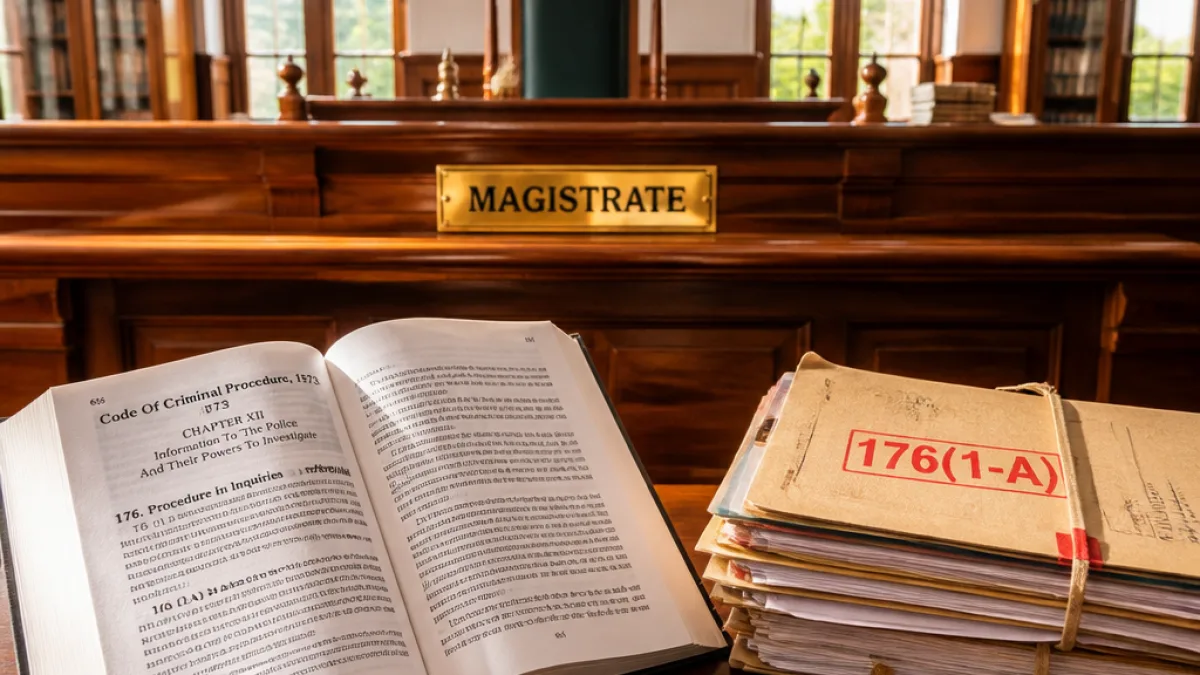
The Madhya Pradesh High Court has upheld a magistrate's judicial enquiry report in a custodial death case and ruled that a magistrate is fully empowered under Section 176(1-A) of the Code of Criminal Procedure (CrPC) to document the circumstances of a custodial incident and explicitly name the persons whose actions or omissions culminated in the fatality.
Bench finds magistrate acted within statutory authority
A Single Bench of Justice Jai Kumar Pillai rejected a petition seeking certiorari to quash the enquiry report and all consequential actions, including the registration of a First Information Report (FIR) against the petitioners. The Court said the magistrate's powers under Section 176(1-A) are not limited to ascertaining only the physiological or medical cause of death but allow a comprehensive enquiry into the entire sequence of events.
"In light of the statutory scheme and the afore‑quoted precedent, this Court firmly holds that the power exercisable by a Magistrate under Section 176(1‑A) of the Cr.P.C. is not strictly confined merely to ascertaining the physiological or medical cause of death... The Magistrate is fully empowered to examine the complete sequence of events, document the specific circumstances under which the custodial incident took place, and explicitly name the accused persons whose actions or omissions culminated in the fatality."
The petitioners had challenged the judicial enquiry report and subsequent actions which included registration of an FIR against them for various substantive offences under the Indian Penal Code, 1860. Senior Advocate Ajay Bagadia represented the petitioners while Government Advocate Ambuj Patel appeared for the respondents.
Factual background of the custodial death
The case concerns a jail inmate, Bheru, son of Bagdiram Ji Maru (deceased), who had been convicted in 2019 for offences punishable under Sections 366, 376(2)(n) and 506 of the IPC, read with the provisions of the POCSO Act. The deceased had been transferred to undergo a specialised ITI training course as a trained carpenter when the custodial incident occurred. The magistrate conducted a judicial inquiry into the circumstances of the death and named certain police officials and doctors as responsible.
The petitioners contended before the High Court that the magistrate exceeded jurisdiction by naming perpetrators and detailing circumstances; the Bench found this contention legally unsustainable.
Practical implications
- Magistrates' scope broadened: Judicial inquests under Section 176(1‑A) can address systemic and circumstantial facets of custodial deaths beyond purely medical causes.
- Police and medical accountability: Enquiry reports can explicitly identify responsible individuals, potentially leading to FIRs and criminal prosecution.
- Precedent for future cases: The ruling clarifies that magistrates may conduct holistic investigations into custodial deaths without being confined to narrow medical findings.
The decision emphasises the statutory scheme and precedents that shape the magistrate's role in custodial death inquiries, reinforcing that judicial enquiries are instruments to uncover not just how a person died but also the circumstances and actors involved.
Legal provisions cited
| Provision | Subject |
|---|---|
| Section 176(1‑A), CrPC | Judicial inquiry by Magistrate into cause of death in police custody / question surrounding custodial deaths |
| IPC Sections 366, 376(2)(n), 506 | Charges for which the deceased had earlier been convicted (as noted in the case record) |
The court’s reasoning also implicitly affects how investigative agencies and magistrates interact in post‑mortem and judicial inquiry stages, particularly in custodial contexts where allegations of foul play or negligence surface.
Human rights groups and criminal justice practitioners often stress the importance of independent and thorough judicial enquiries in custodial deaths; while the present order does not create new statutory law, it clarifies the ambit of existing provision and bolsters magistrates’ capacity to produce detailed findings that can form the basis for further criminal proceedings.
The High Court’s judgment will be closely watched by lawyers, police departments and prison authorities in the state for its consequences in accountability, procedural practice and the conduct of enquiries into custodial fatalities.