
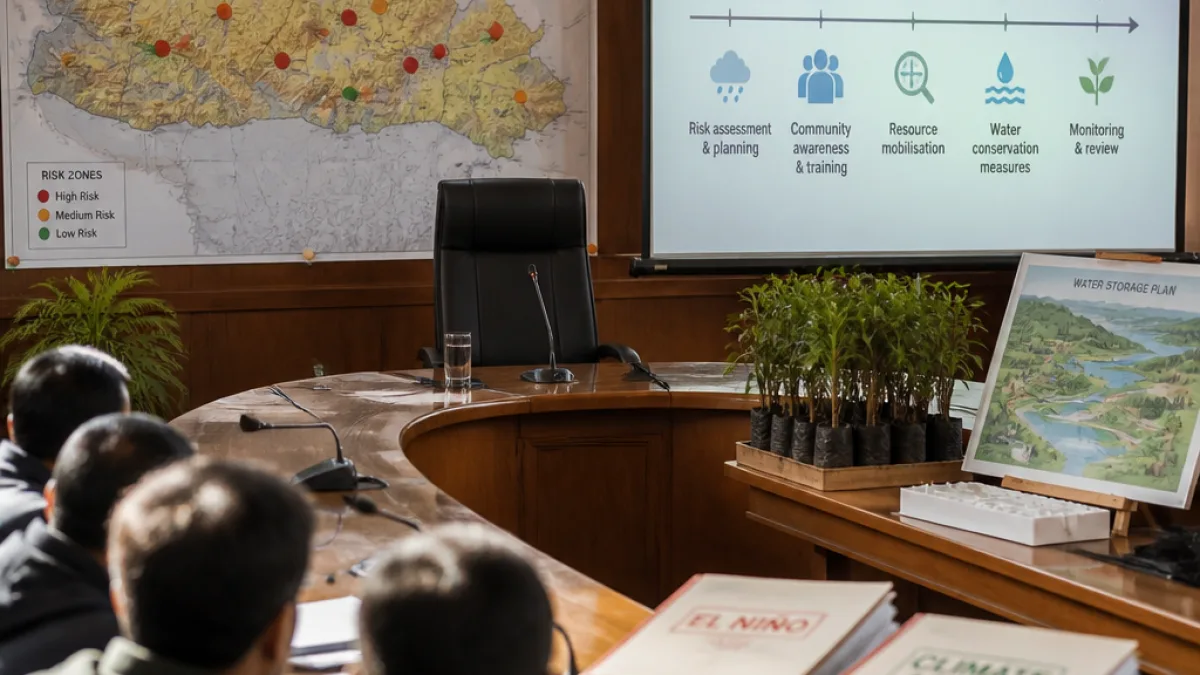
State ramps up preparedness as El Niño looms
Shillong: Meghalaya Chief Minister Conrad K. Sangma on Friday chaired a meeting of the Meghalaya State Council on Climate Change to review the state's readiness for potential impacts linked to El Niño and other emerging climate risks. Officials were told to activate local structures, bolster water sources and step up coordination across departments ahead of a crucial November–March period.
Sangma noted that the pre-monsoon season was near normal but emphasised that uncertainty around El Niño's eventual effects required enhanced preparedness. Districts were directed to map vulnerabilities and develop clear, situation-specific Standard Operating Procedures (SOPs) to guide response efforts.
"While El Niño is a reality, its exact impacts remain difficult to predict," Sangma said, stressing the need for preparedness and adaptation measures backed by clear plans and SOPs for different scenarios.
The meeting reviewed a range of measures to reduce climate risk and strengthen resilience at the grassroots. Key actions discussed included establishing Block-Level Climate Action Teams, reviving springs and other critical water sources, expanding plantation drives in vulnerable catchment areas and scaling up natural farming practices through improved convergence and farmer-led training.
- Activation of District Climate Adaptation and Resilience Task Forces to coordinate local preparedness and monitoring.
- Block-Level Climate Action Teams to be formed to implement community-level adaptation measures and awareness campaigns.
- Water security interventions, including rejuvenation of springs and protection of catchment areas, identified as priorities in case of below-normal rainfall.
- Natural farming expansion via convergence of schemes and farmer-to-farmer training, with attention to crop-specific pest and disease challenges such as ginger soft rot.
- Strengthened IEC (Information, Education and Communication) and involvement of elected representatives in community awareness programmes.
Sangma instructed immediate activation of district-level task forces and called for robust monitoring and periodic reviews at district, block and village levels to track progress and evaluate the effectiveness of preparedness measures. He stressed that community engagement and clear communication would be central to implementing adaptive actions.
Practical focus on water and agriculture
Officials flagged drinking water preparedness as a principal concern should rainfall decline during the November–March window. The council discussed measures to protect and augment local water resources, including spring rejuvenation and catchment-area plantations that can improve recharge and reduce erosion.
On agriculture, the meeting looked at strengthening natural farming initiatives and improving farmer support through training and convergence of existing programmes. The council also acknowledged ongoing agronomic challenges, notably soft rot affecting ginger crops, and sought to incorporate crop-specific responses into the broader adaptation plan.
| Priority | Action | Level |
|---|---|---|
| Water security | Rejuvenate springs; protect catchments; plantation drives | Village/Block/District |
| Community preparedness | Activate District Task Forces; form Block Climate Action Teams; IEC | District & Block |
| Agriculture | Scale up natural farming; farmer-to-farmer training; address crop diseases | Block & Community |
Officials were asked to prepare SOPs for different scenarios to ensure that responses were timely and well-coordinated. Sangma underlined the need for resilience planning to be integrated into routine governance and for monitoring mechanisms to provide regular feedback to the council.
The council's decisions reflect a precautionary approach amid uncertainty over El Niño's trajectory. By prioritising local-level institutions and practical measures such as spring rejuvenation and plantation in catchments, the state aims to reduce vulnerability to water stress and agricultural losses.
District administrations will be expected to report on the activation and functioning of task forces, the status of water-source rejuvenation efforts, progress on plantation and natural farming initiatives, and the effectiveness of IEC campaigns in mobilising communities and elected representatives.
The meeting did not provide a detailed timeline for each intervention but made clear that the period from November to March will be critical for monitoring rainfall trends and executing preparedness actions. Officials were directed to ensure that plans are actionable and that roles and responsibilities are clearly assigned at every administrative level.
By focusing on both structural measures and community-based adaptation, the state government seeks to build resilience against a range of potential climate-driven shocks while keeping an eye on the practical needs of farmers and rural communities.












