
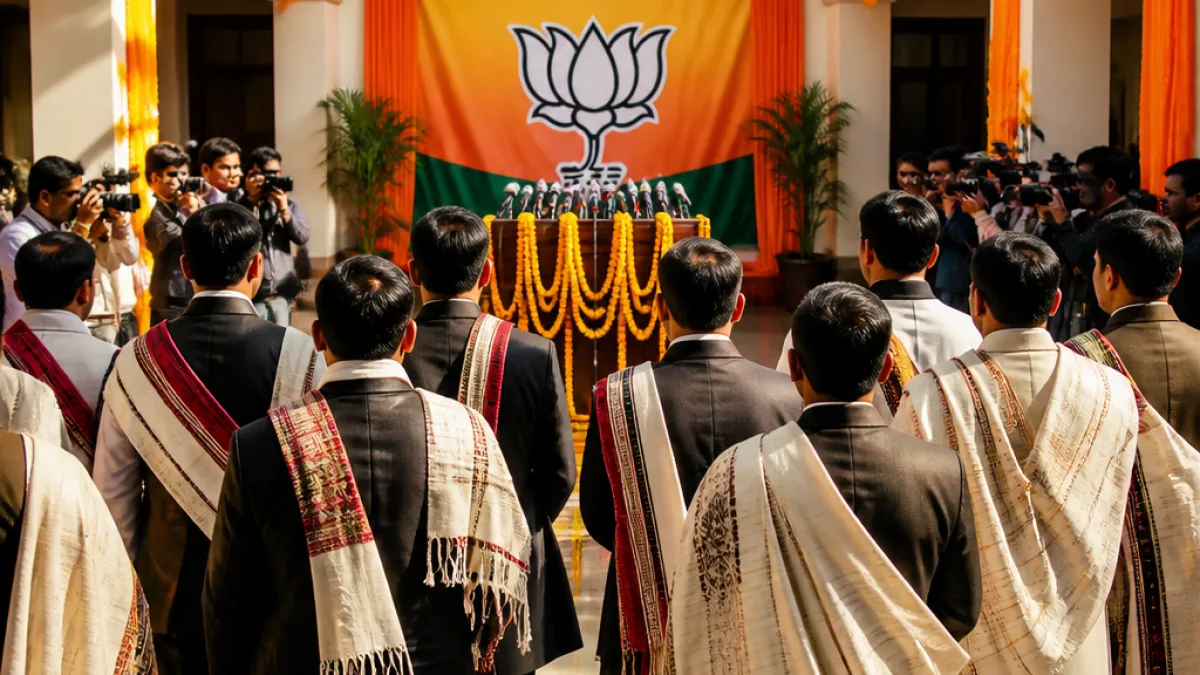
NEW DELHI: Eight legislators of Meghalaya's United Democratic Party (UDP) formally joined the Bharatiya Janata Party (BJP) at the party headquarters in New Delhi on Wednesday, a development that makes the BJP the second-largest party in the northeastern state ahead of the next Assembly polls.
Mass induction at party headquarters
The eight MLAs — Lahkmen Rymbui, Pius Marwein, Kyrmen Shylla, Mayralborn Syiem, Matthew Kurbah, Ollan Singh Suin, Balajied Kupar Synrem and Synshar Kupar Roy — joined the BJP in the presence of senior party leaders, including Union Parliamentary Affairs Minister Kiren Rijiju and BJP national spokesperson Sambit Patra, who is the party’s coordinator for the northeastern states.
Patra announced the names of the legislators at a press conference and said the party had been in discussions with them for some time. Rijiju said the MLAs had been influenced by what he described as the transformation of the Northeast under the BJP-led government over the past 12 years.
“All eight MLAs are extremely impressed and influenced by Modi ji and our BJP-led government’s performance,” Rijiju said at the press conference.
Impact on party arithmetic in Meghalaya
The induction reduced the UDP’s strength in the 60-member Meghalaya Assembly and raised the BJP's legislative strength significantly. According to the party announcement, the move changed the numerical balance between the two parties within the state.
| Party | Strength before induction | Strength after induction |
|---|---|---|
| UDP | 12 | 4 |
| BJP | 2 | 10 |
Both UDP and BJP are constituents of the NPP-led Meghalaya Democratic Alliance government. The defections will therefore have implications for coalition equations and the distribution of influence among partner parties in the state.
Reasons cited for switch
Rijiju attributed the MLAs’ decision to the region’s development under Prime Minister Narendra Modi and the BJP’s engagement with the Northeast. He framed the induction as a significant political development for the region and the country.
Some of the defecting legislators, including Kyrmen Shylla and Ollan Singh Suin, have previously said their move would be conditioned on the BJP accepting certain demands. Those demands, raised publicly in recent weeks, included:
- Recognition of the Khasi language in the Eighth Schedule of the Constitution
- Relaxation or lifting of restrictions on coal mining in Meghalaya
- Implementation of the Meghalaya Residents Safety and Security Act (MRSSA)
Party leaders at the induction said these issues had been discussed with the BJP, and that the legislators received responses they found encouraging.
Political context and implications
Meghalaya is a Christian-majority state where regional parties have traditionally held sway. The BJP’s gain of eight elected members marks a notable advance for the saffron party in the state, potentially positioning it to contest the 2028 Assembly elections with a strengthened organisational and legislative presence.
While the induction bolsters the BJP numerically, the practical effect on governance, ministerial berths and portfolio allocation within the ruling alliance will depend on further discussions among coalition partners and the state leadership.
What leaders said
Rymbui, one of the legislators who joined the BJP, said the decision followed discussions on matters important to Meghalaya. Patra described the move as part of the BJP’s broader outreach in the region.
No formal comment from the UDP leadership was included in the party’s announcement at the induction, and details on any internal UDP response were not provided at the time of the press conference.
The induction marks one of the largest group defections into the BJP from a single regional party in Meghalaya in recent years. Observers say it could prompt renewed efforts by regional parties to shore up cadres and voter outreach ahead of the next state polls.
Further developments, including any formal reshuffle within the coalition or changes to government functioning in Shillong, are likely to unfold in the coming weeks as party leaders and alliance partners assess the political arithmetic.













