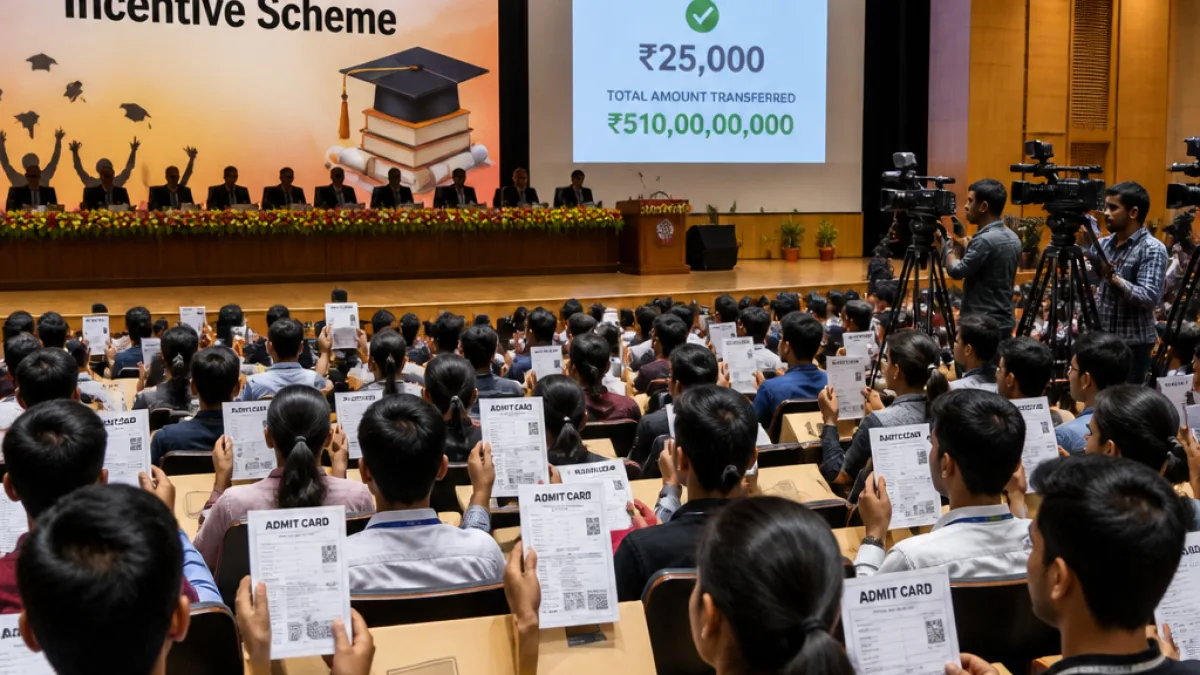
Madhya Pradesh Chief Minister Mohan Yadav will transfer ₹25,000 each into the bank accounts of about 1.22 lakh students who secured at least 75 per cent marks in their first attempt in the Class 12 examination, the School Education Department said on Monday. The money is intended to help meritorious pupils purchase laptops for higher education and e-learning.
Event and implementation
The government will make the payments during a laptop distribution programme scheduled for 1 September at the Kushabhau Thakre International Convention Centre in Bhopal. The transfers will be made directly to beneficiaries' bank accounts through Direct Benefit Transfer (DBT), according to officials. The initiative is being implemented under the Talented Student Incentive Scheme (Pratibhashali Vidyarthi Protsahan Yojana), managed by the School Education Department.
The scheme, launched in the 2009–10 academic year, does not provide physical laptops. Instead, qualifying students receive the cash assistance to purchase devices of their choice, giving them flexibility to select specifications that meet higher-education or vocational needs.
Eligibility and scale
Students who clear the Madhya Pradesh Board Class 12 examination with at least 75 per cent marks in their first attempt are eligible for the incentive. This year around 1.22 lakh students will receive the payment, with the government transferring more than ₹304.98 crore in total.
Since the scheme began, officials said, more than four lakh students have benefited. The government has spent over ₹1,000 crore on the programme in previous years, underscoring its long-term commitment to bridging the digital divide among meritorious pupils.
- Eligibility: Minimum 75% in Class 12 (first attempt).
- Amount: ₹25,000 per eligible student.
- Mode of payment: Direct Benefit Transfer to bank accounts.
- Event: Transfer to be marked at a public programme in Bhopal on 1 September.
Expected impact and rationale
Officials said the assistance aims to expand access to online learning resources, e-textbooks and e-learning platforms, helping students adapt to technology-driven higher education and the modern economy. By providing cash rather than a standard issue laptop, the scheme allows beneficiaries to select devices tailored to academic courses, whether general degree programmes, professional diplomas or competitive-exam preparation.
Education experts and officials who have promoted the scheme argue the financial assistance can reduce the digital gap between urban and rural students, especially where household incomes or local infrastructure limit device access. The cash transfer approach also reduces logistical hurdles related to procuring and distributing thousands of machines across the state.
Programme data
| Parameter | Figure |
|---|---|
| Per-student assistance | ₹25,000 |
| Beneficiaries this year | Approx. 1.22 lakh students |
| Total disbursal this year | More than ₹304.98 crore |
| Beneficiaries since 2009–10 | Over 4 lakh students |
| Government expenditure in previous years | Over ₹1,000 crore |
The scheme's proponents highlight that linking the incentive to academic merit encourages scholastic effort while addressing a practical need: access to computers for coursework, research and online assessments. The cash transfer also permits support for peripheral costs such as peripherals, software or internet connectivity where necessary.
As the September 1 event approaches, district education officers and school administrators across Madhya Pradesh are expected to verify beneficiary lists and ensure bank details are up to date to expedite DBT payments. The state’s continued investment in the scheme indicates a policy focus on digital inclusion for higher-education aspirants from diverse socio-economic backgrounds.