Ladakh will be one of the first regions to implement the revised Census 2027 population enumeration, the Registrar General and Census Commissioner has said, with the Union Territory scheduled to begin self-enumeration in August and house-to-house enumeration in September. The 2027 exercise introduces an open-ended caste question, a change with potentially wide-ranging implications for demographic data and policy planning.
What will change in Census 2027
For the first time since Independence, Census 2027 will record caste using an open-ended column rather than a pre-determined list. Under the new method, the enumerator is to record the caste name exactly as declared by the respondent, according to the official gazette notification of 3 August referenced by the census authority.
Officials have said the change follows methodology tested during a July pre-test across 16 states and Union Territories. The open-ended approach aims to capture self-identification instead of fitting responses into a closed taxonomy, though the final tabulation and categorisation will be a technical exercise to be carried out by the census authorities.
Timeline for Ladakh
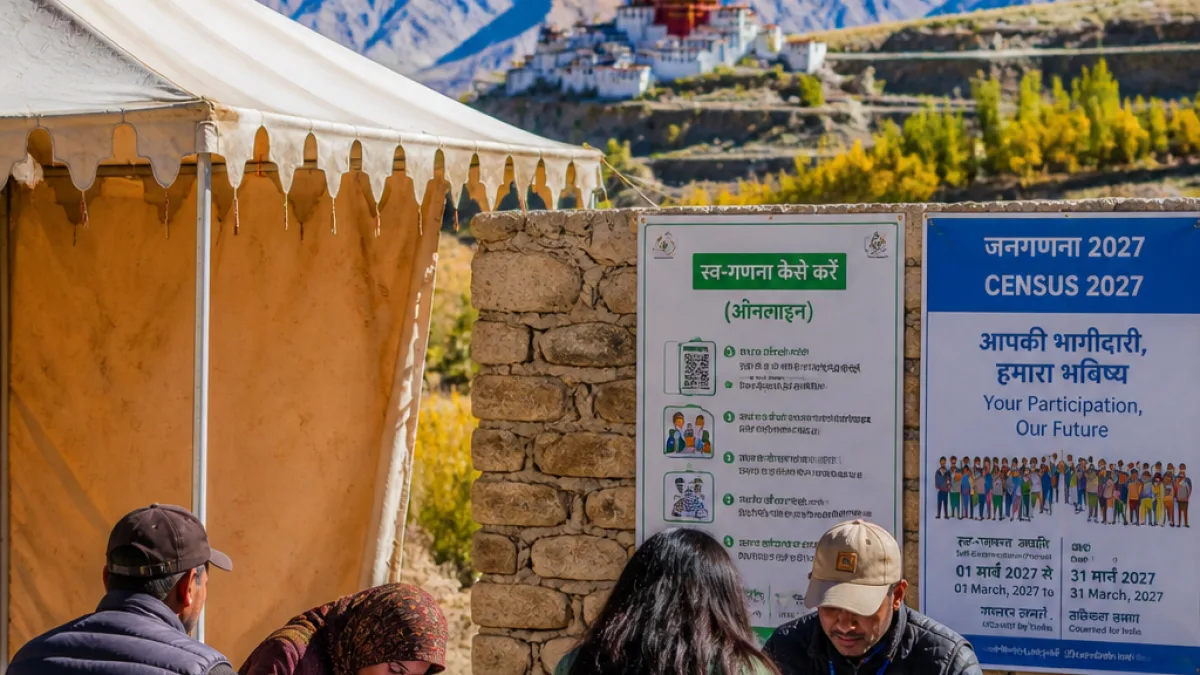
The census schedule for the Union Territory has been advanced because large parts of Ladakh are snow-bound during winter and must be enumerated before access becomes difficult. The census authority has laid out a two-stage population enumeration for the region:
- Self-enumeration: 17–31 August 2026
- House-to-house population enumeration: 1–30 September 2026
These dates apply to Ladakh specifically; the remainder of India will undertake the population enumeration phase in February 2027. The phased approach reflects logistical constraints in high-altitude and remote areas and the government’s decision to pilot certain elements of the new form in regions with special requirements.
| Activity | Dates (Ladakh) |
|---|---|
| Self-enumeration | 17–31 August 2026 |
| House-to-house enumeration | 1–30 September 2026 |
| Nationwide enumeration | February 2027 |
Digital census, with local exceptions
Census 2027 is being conducted as India’s first fully digital census, requiring enumerators and respondents to use digital devices and geotagging to record and validate data. However, the census authority has instructed exceptions in sensitive areas. Large defence establishments along borders with China and Pakistan cannot be geo-tagged for security reasons, which has implications for how enumeration is carried out in frontier parts of Ladakh.
Because of these constraints, paper-based or alternate procedures will be used where geotagging is restricted, the notification indicates. The advance scheduling for Ladakh takes such practical and security constraints into account.
Local impact and practical considerations
The inclusion of an open-ended caste column is likely to generate substantial quantities of raw responses that will require cleaning, standardisation and classification before they can be compared with earlier data. In Ladakh — where population is dispersed across high-altitude valleys and border districts — the exercise will test the operational readiness of enumerators to record responses accurately and to manage digital tools in challenging terrain.
Residents and institutions in Ladakh should note the following practical points:
- Households in Ladakh will be expected to complete self-enumeration online between 17 and 31 August, where connectivity and procedures permit.
- Where self-enumeration is not possible, or for verification, trained enumerators will visit homes during 1–30 September.
- Defence and other security-sensitive sites will follow special protocols; respondents in such locations may not see geo-tagging applied to their entries.
Process and next steps
The census authority’s move to field the new questions first in snow-bound areas is a logistical decision designed to avoid disruptions from winter conditions. Once Ladakh completes its enumeration phases, the procedures and lessons learned will inform implementation across other parts of the country in February 2027.
Officials will subsequently need to outline how the open-ended caste responses will be standardised for tabulation and how the data will be used for policy-making. Given the sensitivity and potential policy consequences of detailed caste data, transparent documentation of methodology and timelines for release of provisional results will be important for public confidence.
Authorities have emphasised operational readiness and the need for trained enumerators in remote terrain; local administrations in Leh and Kargil will play key roles in the coming weeks to mobilise staff and inform residents about the new procedures.