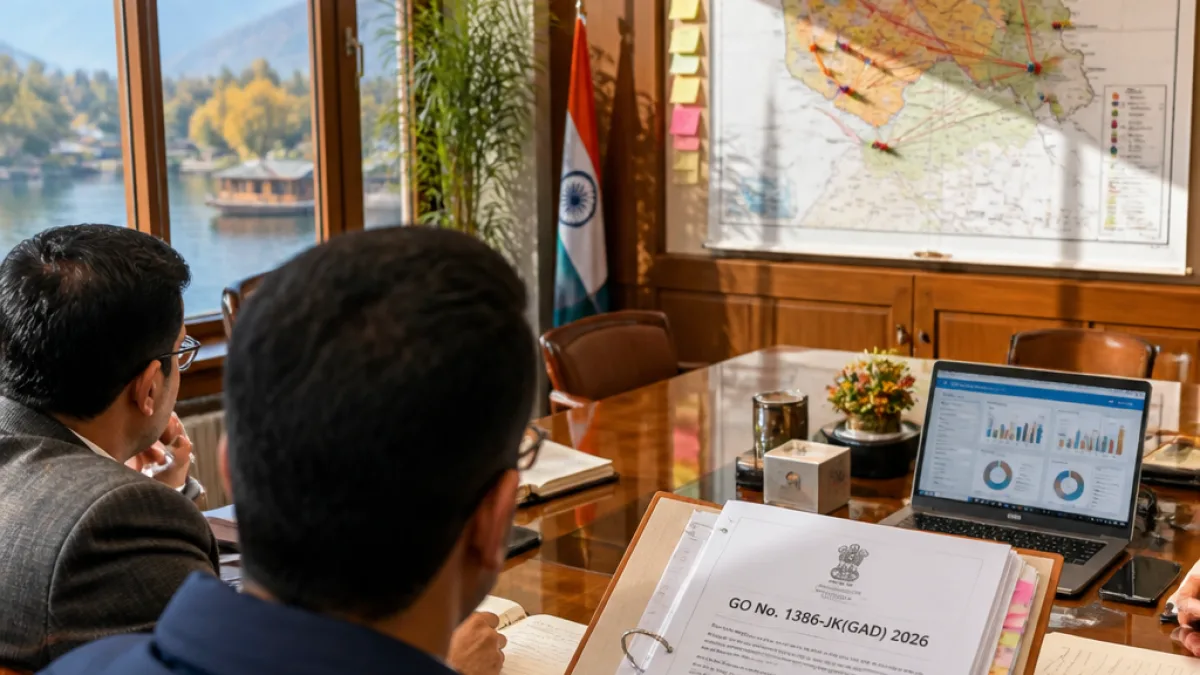
The Jammu and Kashmir administration has reconstituted the Union Territory Project Monitoring Group (UT PMG) to strengthen coordinated oversight and accelerate clearance of impediments affecting infrastructure and investment works with a sanctioned cost of ₹5 crore or more, the General Administration Department said on Monday.
New order, leadership and secretariat
The decision was formalised through Government Order No. 1386‑JK(GAD) of 2026, which replaces an earlier notification issued in October 2022. Under the revised arrangement, the Chief Secretary will chair the UT PMG while the Administrative Secretary of the Planning, Development and Monitoring Department (PD and MD) has been named the Member Secretary and will act as the nodal officer for operational matters.
The PD and MD has been assigned responsibility for coordination, implementation and the day‑to‑day running of the UT PMG Portal. The department will liaise with the Department for Promotion of Industry and Internal Trade (DPIIT) and other concerned agencies to monitor projects registered on the portal, convene PMG meetings, follow up on decisions and manage reporting mechanisms.
Composition and scope
The group brings together Administrative Secretaries of key sectors to review and monitor projects, schemes and programmes that are registered on the PMG Portal. Departments explicitly included in the reconstituted panel are:
- Jal Shakti
- Power Development
- Agriculture Production
- Finance
- Public Works (R&B)
- Information Technology
- Housing and Urban Development
- General Administration
- Health and Medical Education
- Social Welfare
- Industries and Commerce
- School Education
- Higher Education
Other Administrative Secretaries or District Development Commissioners may be co‑opted into the PMG as required for project‑specific or regional issues.
Mandate and working mechanism
The UT PMG is tasked with reviewing major flagged projects and facilitating prompt resolution of inter‑departmental hurdles and project‑specific problems that impede implementation. It will co‑ordinate with Central ministries, the DPIIT, administrative departments, district administrations and project proponents to expedite redressal of pending issues.
Periodic reviews of issue resolution status, recommendations to address systemic or procedural blockages and approval of progress reports on project execution are among the functions listed in the government order.
Operational elements and transparency
By designating the PD and MD as the nodal agency for the PMG Portal, the administration has signalled an emphasis on digital tracking and centralised follow‑up. The portal will be used to register projects, track action taken, schedule PMG meetings and produce reports for approval by the reconstituted group.
Officials said the arrangement seeks to ensure that projects do not languish owing to coordination gaps between departments and agencies. The order envisages regular monitoring and institutionalised escalation to bring stalled or slow‑moving schemes back on track.
| Aspect | Details |
|---|---|
| Governing order | GO No. 1386‑JK(GAD) of 2026 (supersedes Oct 2022 order) |
| Chair | Chief Secretary, J&K |
| Member Secretary & Nodal Dept. | Administrative Secretary, PD and MD (Planning, Development & Monitoring Dept.) |
| Project coverage | Infrastructure & investment projects costing ₹5 crore and above |
Implications for projects and investors
The reconstituted UT PMG is aimed at reducing delays that can arise from departmental overlap, procedural bottlenecks or lack of follow‑up. By institutionalising a mechanism to escalate and monitor issues through the PMG Portal, the administration intends to improve delivery timelines for priority projects and provide greater certainty for investors and project proponents.
Authorities will review the performance of the mechanism and propose measures to resolve systemic shortcomings in policy or procedure that come to light during periodic monitoring.
The government order lays out the administrative architecture and responsibilities; the effectiveness of the arrangement will depend on timely meetings, active inter‑departmental coordination and regular use of the PMG Portal to track and close issues.
"The reconstituted UT PMG will review and monitor major projects, schemes and programmes flagged on the PMG Portal and facilitate the resolution of inter‑departmental and project‑specific bottlenecks delaying implementation," the government order said.
Officials will also coordinate with Central ministries and DPIIT on cases requiring Union intervention or further facilitation.