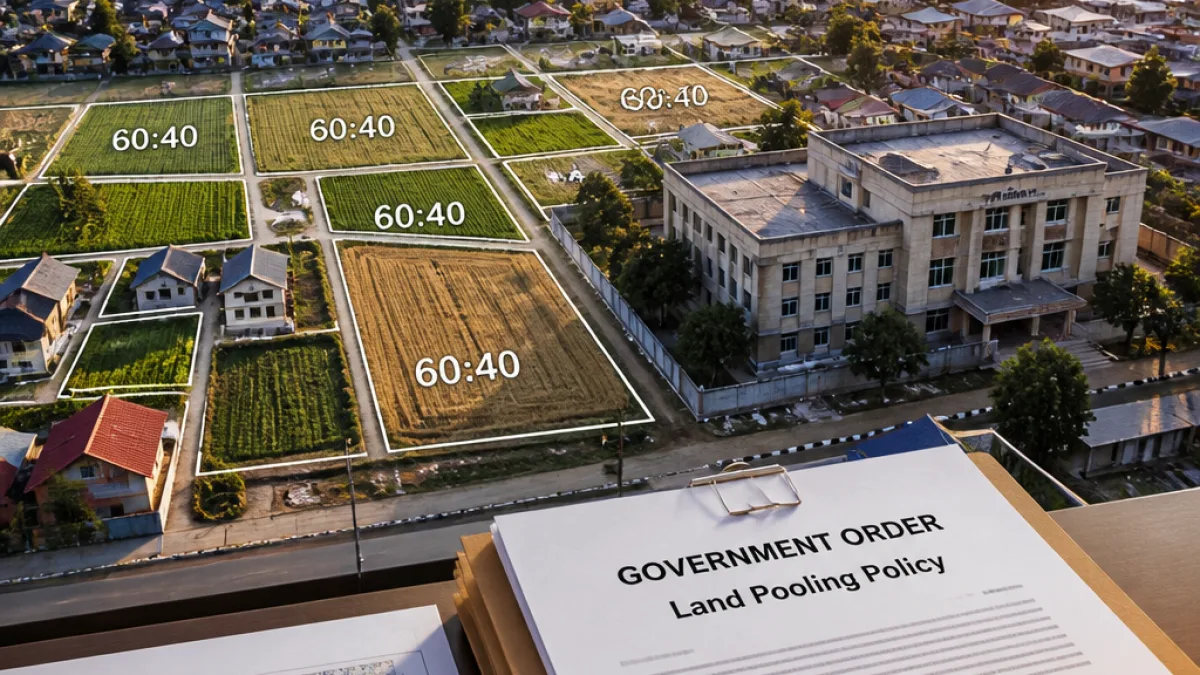
Srinagar: The Jammu and Kashmir administration has formally notified the Jammu and Kashmir Land Pooling Policy, 2026 through Government Order No. 172-JK(HUD) of 2026, dated August 17, aiming to promote coordinated urban development by encouraging voluntary participation of landowners, the Housing and Urban Development Department reported.
Policy objectives and mechanism
The policy seeks to address issues arising from fragmented land holdings, uneven urban growth and deficient infrastructure by creating a framework for land consolidation and planned redevelopment. Landowners may voluntarily pool contiguous parcels in areas notified by the relevant Development Authority and become partners in the development process, according to the government order.
Under the notified arrangement, a Developer Entity or Consortium involved in a pooling project may retain 60 per cent of the pooled area for development of residential, commercial, institutional and neighbourhood-level facilities, while 40 per cent of the land will be transferred to the Development Authority for city-level physical infrastructure and public amenities in line with the Master Plan or Zonal Development Plans.
| Component | Share of pooled land |
|---|---|
| Developer Entity / Consortium | 60% |
| Development Authority (city-level infrastructure) | 40% |
Participation, redistribution and safeguards
The policy allows parcels of any size to be included, provided they fall within areas officially notified for pooling. Land put forward must have lawful ownership, physical possession and be free from encumbrances, the order states. The developed land or built-up space will be redistributed among participating owners as per terms set out in an Implementation Plan, which will require the consent of all landowners involved.
The order emphasises voluntary participation and envisages mutual agreement on redistribution arrangements. It also sets out that retained areas can be used for a range of planned purposes but remain subject to existing land‑use norms and building bye‑laws applicable in the notified area.
Expected outcomes and administrative role
Authorities said the policy is intended to streamline urban expansion, improve provision of public facilities and create land for infrastructure such as roads, parks, drainage and other city‑level amenities. By consolidating fragmented plots, the government expects to enable more coherent development and reduce ad hoc, unplanned construction.
The Development Authority will have a role in securing the 40 per cent portion that will be used for city‑level infrastructure and public or semi‑public facilities, aligning allocations with the Master Plan and Zonal Development Plan for the area where pooling is undertaken.
Practical implications for landowners and developers
- Landowners retain the choice to opt into pooling schemes only in areas formally notified for the mechanism.
- Ownership clearances and absence of encumbrances will be preconditions for inclusion.
- Redistribution of developed plots or built space will be governed by the Implementation Plan agreed by participants.
The order does not specify timeframes for implementation of individual pooling projects, nor does it provide financial figures or explicit compensation rates; such details are expected to be worked out in project‑level implementation plans and agreements between landowners, developer entities and the Development Authority.
Context and background
Land pooling as a planning tool has been adopted in several Indian cities to enable acquisition of land for infrastructure without resorting to compulsory land purchase. The mechanism aims to balance the interests of landowners and the state by offering developed plots back to contributors and setting aside portions for public use.
In Jammu and Kashmir, the new policy introduces a formal route for pooling within the legal and planning framework administered by the Housing and Urban Development Department and the relevant Development Authorities, the government order reported.
The notification marks a policy step intended to support more managed urban growth and make land available for public infrastructure in line with local master plans.
Further operational details, including area notifications, implementing agencies and project timelines, are expected to be issued by the Housing and Urban Development Department and Development Authorities as they roll out specific pooling schemes.
Reporting from Srinagar.