Protest over eviction drive turns confrontational in central Shimla
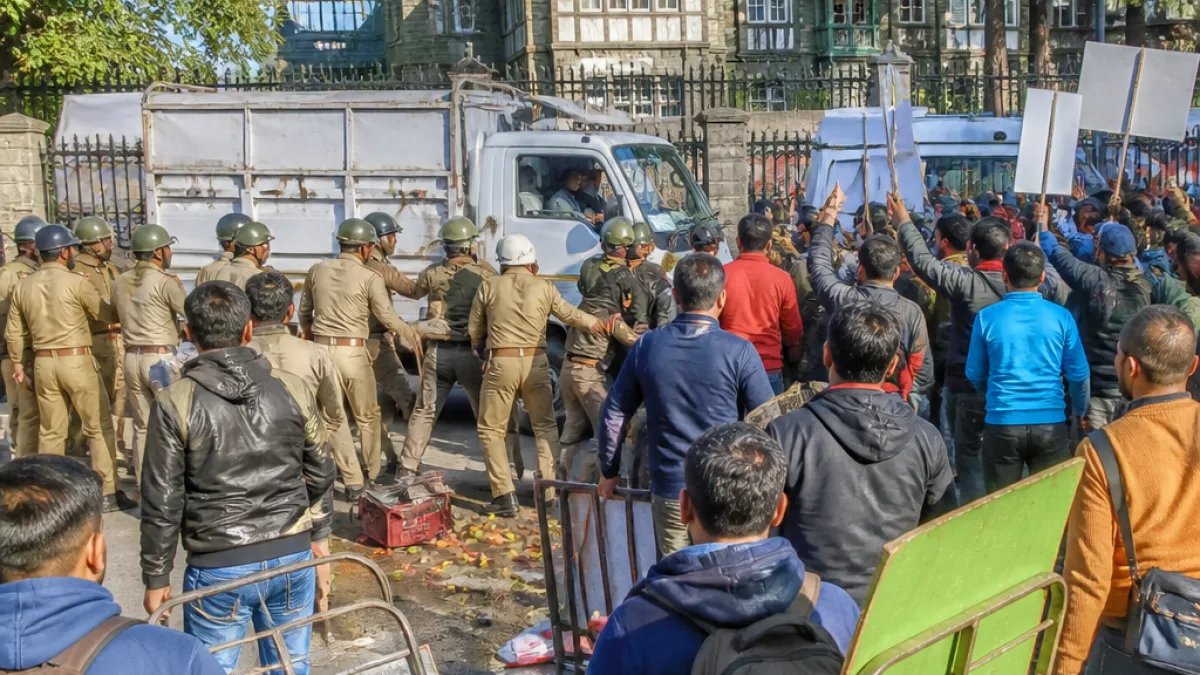
A demonstration by street vendors and members of the Centre of Indian Trade Unions (CITU) against the Shimla Municipal Corporation’s (SMC) ongoing eviction drive turned tense on Saturday when a corporation vehicle reached the protest site outside the Deputy Commissioner’s office and police personnel stepped in, local sources reported.
According to accounts of the event, hundreds of vendors and CITU activists had gathered to demand an end to what they described as continuous harassment and to press for permanent arrangements that would safeguard their livelihoods. The situation escalated into a scuffle as protesters attempted to stop the corporation vehicle, prompting police intervention and an exchange of slogans and resistance from the demonstrators.
Demands and legal reference
Addressing the crowd during the protest, Vijendra Mehra, State President of CITU, said thousands of families survive through street vending in Shimla and called on authorities to provide formal space and job security for vendors. He urged the SMC to streamline licensing and vending arrangements and insisted on full implementation of the Street Vendors (Protection of Livelihood and Regulation of Street Vending) Act, 2014.
“Thousands of families have been earning their livelihoods as street vendors in Shimla for years. Despite this, the corporation is continuously harassing the vendors instead of finding a permanent solution to their problems,” said Vijendra Mehra.
The protesters also demanded that no vendor be removed without following the legal provisions laid down in the 2014 Act.
Immediate consequences and administrative response
The demonstration, which took place at a key administrative location in the city, briefly disrupted normal activity near the Deputy Commissioner’s office and drew a police presence to prevent escalation. Organisers maintained that their action was peaceful and aimed at drawing attention to what they called arbitrary eviction measures. Officials from the SMC were reported to be carrying out the eviction drive but the corporation has not issued an official statement on the scuffle at the time of reporting.
- Location: Outside Deputy Commissioner’s office, Shimla
- Participants: Hundreds of street vendors and CITU members
- Key demand: Implementation of the Street Vendors Act, 2014, and provision of permanent vending space
What the 2014 Act provides and local implications
The Street Vendors Act seeks to protect the livelihoods of street vendors by requiring local authorities to notify vending zones, prepare a register of vendors and provide protection against eviction except in accordance with prescribed procedures. Protesters in Shimla cited this legislation when calling for formalised vending arrangements and licences. The absence of such localised, permanent arrangements, they say, has left many dependent families vulnerable to sudden clearances.
| Demand | Reference |
|---|---|
| Permanent vending space | Local implementation of Street Vendors Act, 2014 |
| Streamlined licensing and vending arrangements | Provisions under the 2014 Act for vendor registers and licences |
| No eviction without legal process | Protections in the Street Vendors Act, 2014 |
For Shimla residents, the dispute raises questions about urban management on the Ridge and in market areas where tourism, pedestrian movement and informal trade intersect. Any prolonged enforcement action without agreed alternatives could affect shopkeepers, vendors and visitors, and may complicate traffic and public access in central parts of the city.
Next steps and avenues for resolution
CITU has signalled that it will continue to press its demands unless municipal authorities engage on a permanent solution. The outcome will hinge on talks between vendor representatives, the municipal administration and district authorities, and on whether the SMC moves to formalise vending zones and a licensing mechanism in accordance with the 2014 law. At present, the details of any forthcoming administrative or legal steps have not been disclosed by the corporation or the district administration.
The incident places renewed emphasis on balancing enforcement of civic regulations with protection of informal livelihoods in Shimla, a city where street vending has long been an integral part of the urban economy.