
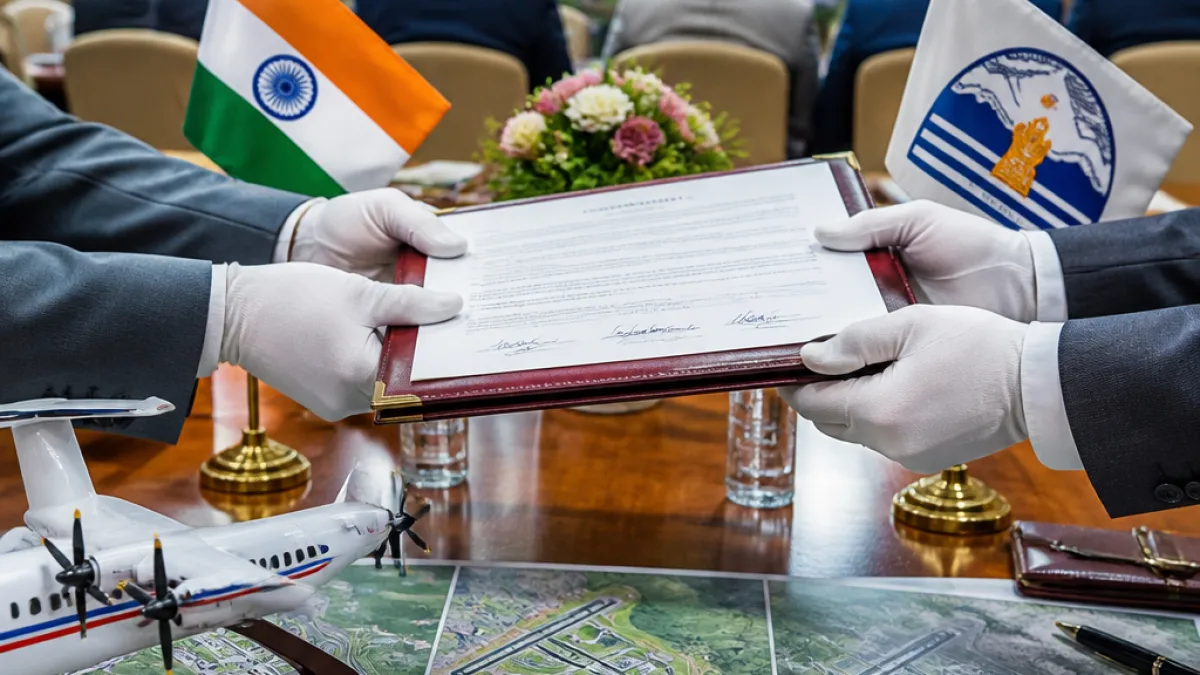
NEW DELHI / SHIMLA: The Union government will shoulder 80 per cent of the viability gap funding (VGF) for Himachal Pradesh under the revised Regional Connectivity Scheme (UDAN) after a 10-year tripartite memorandum of understanding (MoU) was signed on Tuesday between the state administration, the Ministry of Civil Aviation and the Airports Authority of India (AAI).
How the agreement is structured
The MoU lays down a framework for cooperation on both existing and new UDAN routes and for development and operationalisation of eligible aviation infrastructure in the hill state. Under the arrangement, the Himachal Pradesh government will contribute the remaining 20 per cent of VGF.
The ceremony in New Delhi was attended by Union Civil Aviation Minister Kinjarapu Rammohan Naidu and Minister of State for Civil Aviation Murlidhar Mohol, officials of the state Tourism and Civil Aviation Department said. The agreement is for a decade and aims to reduce the cost burden on the state while encouraging airlines to operate routes that may otherwise be commercially unviable.
Background and state demands
Himachal had sought a more generous sharing pattern from the Centre, with Chief Minister Sukhvinder Singh Sukhu recently urging a revised 90:10 split to reflect the extra challenges and higher operating costs in mountainous terrain. The Centre’s approval of an 80:20 split represents a partial accommodation of state concerns while keeping the central share substantial enough to attract carriers.
Officials said the MoU assumes significance for Himachal, where limited flight frequency and high fares have restricted the arrival of higher-spending tourists and made access to remote areas difficult despite strong tourism potential.
Current infrastructure and operational challenges
Himachal presently has three operational airports: Jubbarhatti (Shimla), Bhuntar (Kullu) and Gaggal (Kangra). All three face constraints in terms of flight frequency, aircraft size that can be accommodated and seasonality of operations — factors that have kept fares elevated and limited connectivity.
| Airport | District | Role |
|---|---|---|
| Jubbarhatti | Shimla | State capital access |
| Bhuntar | Kullu | Gateway to Kullu-Manali |
| Gaggal | Kangra | Regional link for Kangra valley |
Expected benefits and limitations
Officials say enhanced central funding is expected to facilitate better movement of tourists and business travellers and open up remote destinations, potentially addressing two persistent problems: limited connectivity and steep airfares. By reducing the financial burden on the state, the arrangement could accelerate the introduction and strengthening of routes under UDAN.
However, the MoU itself does not immediately increase flight frequency or lower fares; it establishes a funding mechanism and institutional framework. Operational outcomes will depend on airline interest, infrastructure upgrades and seasonal weather constraints that affect operations in the hills.
What UDAN and VGF mean for travellers and the state
- VGF (viability gap funding): A subsidy to make otherwise uneconomical regional routes attractive for airlines.
- UDAN (Regional Connectivity Scheme): A government programme aimed at enhancing air connectivity to underserved and unserved airports.
- For travellers: Potentially more routes and options over time, though immediate fare reductions are not guaranteed.
State Tourism and Civil Aviation Department officials framed the MoU as a step towards unlocking the tourism economy by improving access for higher-yield visitors and easing logistics for local businesses. The agreement also creates scope for coordinated investment in airside and landside facilities where required.
While the state will still bear 20 per cent of VGF, officials indicated that sharing the central 80 per cent is expected to make it easier to plan route development and negotiate with carriers. Detailed route-level decisions, allocations and timelines will be worked out under the MoU’s institutional mechanisms.
Implementation, officials cautioned, will be incremental and contingent on assessments of demand, safety clearances and AAI-led infrastructure works. The MoU provides the legal and financial scaffolding; translating it into more flights and lower fares will require coordinated action across ministries, the state administration and private carriers.













