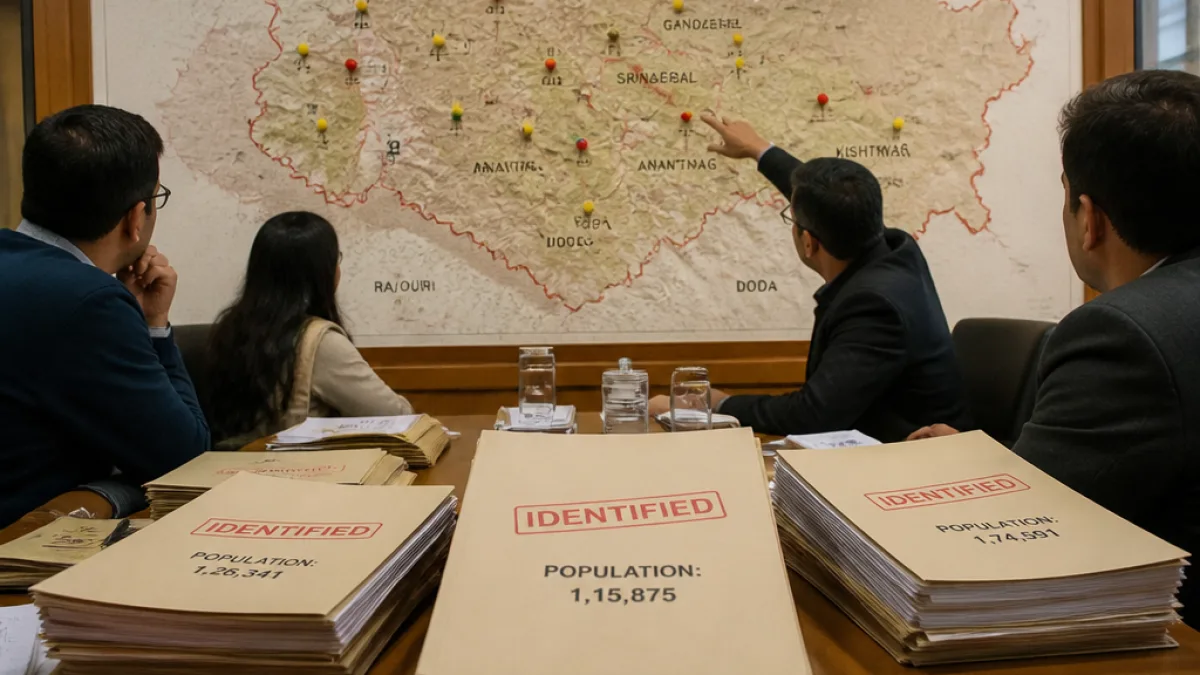
The Jammu and Kashmir administration has reported to the High-Level Committee on Demographic Changes (HLCDC) that a total of 7,656 Rohingya and 504 Bangladeshi nationals have been identified across the Union Territory, government data cited by The Tribune showed.
Distribution across regions
According to figures placed before four members of the HLCDC during their first field visit to Jammu on August 10 to examine demographic changes in border and adjoining areas, the bulk of the identified population is concentrated in the Jammu region.
| Region | Rohingyas | Bangladeshis |
|---|---|---|
| Jammu region (10 districts) | 6,737 | 46 |
| Kashmir Valley | 919 | 458 |
| Total | 7,656 | 504 |
Cases registered and security concerns
Officials informed the committee that legal cases have been registered in relation to some members of these communities. In the Jammu region, 101 cases were recorded involving 179 men and 21 women. In the Valley, authorities reported 16 cases involving four men and 41 women.
Security officials presented concerns about a perceived rise in criminal activities linked to some members of the Rohingya population, including allegations of organised crime, drug trafficking and human trafficking. The submissions were presented as concerns to the HLCDC; officials emphasised that such claims do not amount to a finding of collective criminality against the Rohingya community.
“There was a detailed discussion on issues related to illegal immigration in border districts and the need to strengthen monitoring and surveillance,”
Officials also drew attention to the geographical pattern of settlements, saying most identified Rohingya settlements are in the Jammu region rather than the Valley. A senior police officer cited movement of Rohingyas through Hyderabad before relocating to Jammu, with notable movements reported during 2012 and 2017, according to the account placed before the committee.
Committee engagement and civil society meetings
The HLCDC members met civil society organisations working with people living in Rohingya settlements during the Jammu visit. The committee’s field examination is intended to assess demographic change in border and adjoining areas — a matter that has prompted both administrative and security scrutiny.
Officials told the committee that the number of Rohingya settlements had increased only marginally over the past two years but noted that their presence in border districts remained a cause for concern because of proximity to the international boundary.
- Field visit date: August 10 (first HLCDC visit to Jammu)
- Reported totals: 7,656 Rohingya; 504 Bangladeshi nationals
- Regional concentration: Majority in Jammu region (10 districts)
Implications and next steps
The data provided to the HLCDC is likely to inform recommendations on monitoring, surveillance and administrative action in border districts. The presentation included law-enforcement concerns that may shape future coordination between civil administration and security agencies.
The disclosures underline the continuing administrative focus on immigration and settlement patterns in the Union Territory. The authorities’ emphasis on strengthening monitoring in border districts signals a policy priority that could involve intensified verification drives, inter-agency sharing of intelligence and engagement with non-governmental organisations operating in affected areas.
As the HLCDC continues its assessments, the administration has so far confined public commentary to the figures and the official account presented to the committee. The claims about alleged criminal links were described as concerns raised by security agencies and do not constitute a judicial finding.
Further public updates are expected as the HLCDC concludes field visits and frames recommendations for the government on demographic and border-area management.