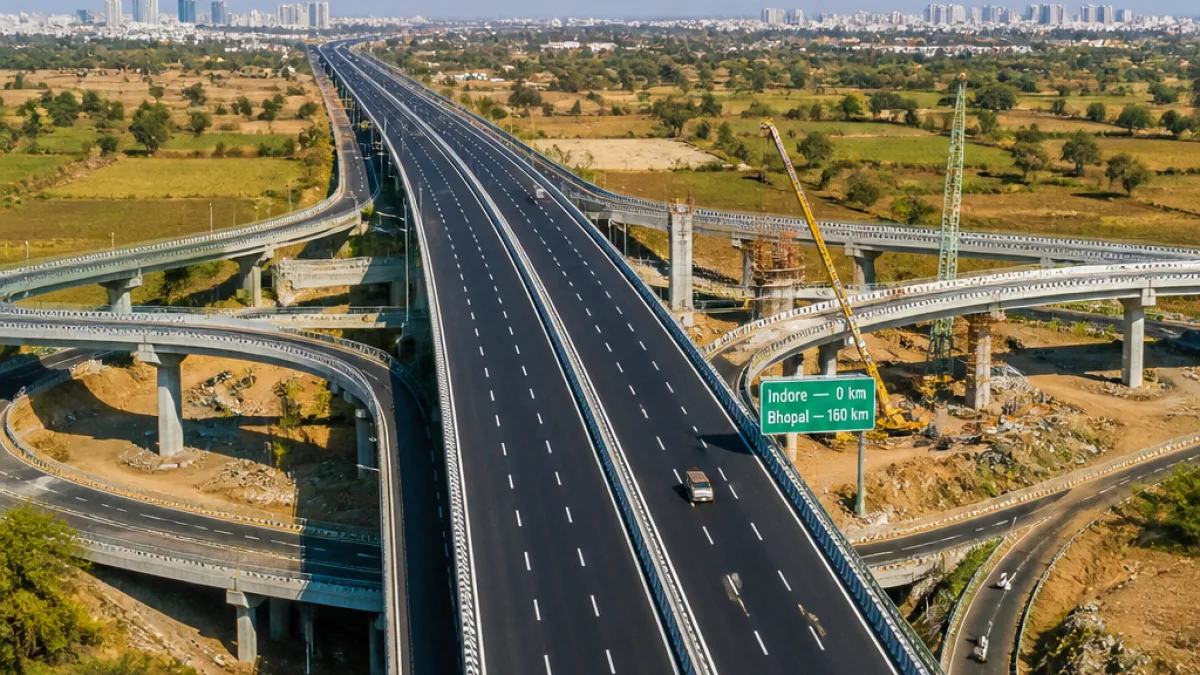
New greenfield corridor aims to cut travel time and ease congestion
Authorities are advancing plans for a new 160‑km, six‑lane access‑controlled expressway to link Indore and Bhopal, a development that could halve current road travel times and recalibrate movement between the two major urban centres of western Madhya Pradesh. The project, estimated at ₹4,000 crore, will be built on a fresh alignment instead of widening the existing highway, according to NDTV.
Planners say the expressway is intended to avoid the frequent intersections, local traffic and slow‑moving vehicles that slow journeys on the present route and to provide uninterrupted high‑speed connectivity for through traffic. The corridor is being developed on an access‑controlled model, with grade‑separated interchanges to reduce delays and enhance safety for long‑distance movements.
“The journey that currently takes around 4 hours could come down to 2 to 2.5 hours,”
This time saving would have direct consequences for business travel, freight movement and passenger convenience between Indore and the state capital. The alignment is reported to follow a more direct path than the existing road, bypassing congested towns to the benefit of long‑haul users while retaining feeder links to local markets and district headquarters.
Regional connectivity and economic implications
Beyond journey time reductions, the corridor is planned to strengthen links among urban and economic centres across western Madhya Pradesh. Dewas and Sehore are specifically mentioned as districts likely to benefit from faster connectivity, improving access for commuters, traders and logistics operators. At the Indore end, the proposed expressway is expected to tie into the Garoth‑Indore link expressway which connects with the Delhi‑Mumbai Expressway, potentially giving travellers faster high‑speed access towards national corridors.
- Direct travel time estimate: 2–2.5 hours (current: about 4 hours)
- Length and specification: 160 km, six lanes, access‑controlled
- Estimated cost: ₹4,000 crore
- Target operational timeframe: around 2028, ahead of Simhastha in Ujjain
State planners are treating the project as a priority, with attention to completing operational sections — or the full corridor — by 2028 when the region will see a significant rise in passenger movement due to Simhastha. Faster connectivity could also alter freight patterns, lower vehicle operating costs and reduce travel‑time risks for perishable goods moving between Indore’s markets and producers in surrounding districts.
Environmental and local considerations
Because the expressway is proposed as a greenfield facility, it will require fresh land acquisition and environmental clearances. Greenfield alignments can reduce urban disruption along the present road but raise questions about land use, ecological impact and resettlement. The corridor is reported to connect with the envisaged Narmada Expressway network around the Sehore area, indicating a larger regional planning footprint that will need coordination among departments and mitigation plans for environmental and social impacts.
| Feature | Detail |
|---|---|
| Length | 160 km |
| Type | Six‑lane, access‑controlled greenfield expressway |
| Estimated cost | ₹4,000 crore |
| Target operational | Around 2028 |
| Key linkages | Garoth‑Indore link / Delhi‑Mumbai Expressway / Narmada Expressway |
For residents in rural and peri‑urban areas, the project could bring both opportunities and challenges. Improved access to Indore’s markets, hospitals and educational institutions may spur growth in hinterland communities. At the same time, careful planning will be needed to protect agricultural land, water resources and community livelihoods affected by acquisition and construction.
Implementation will require a sequence of clearances, land procurement and coordinated works by state agencies and the executing authority. With the state government reportedly keen to push the scheme as a priority infrastructure project, subsequent public disclosures on alignment details, environmental impact assessments and compensation packages will be critical for assessing local consequences.
The expressway forms part of a broader push to augment high‑speed connectivity across the region and to integrate Indore more closely with national highway networks. If realised on schedule, the corridor could reshape travel patterns and economic linkages across western Madhya Pradesh ahead of the 2028 Simhastha.