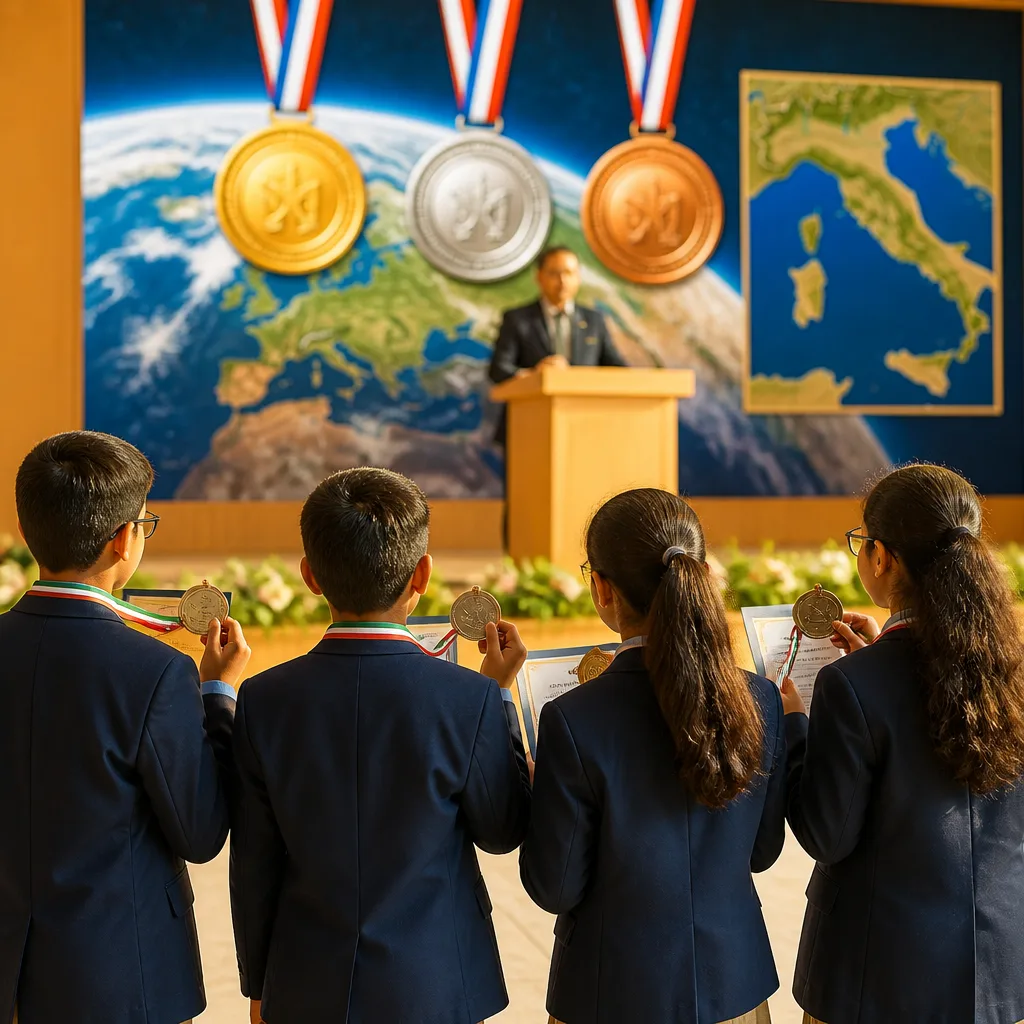
New Delhi: India clinched a total of nine medals at the 19th International Earth Science Olympiad (IESO) 2026, held in Italy from 20 to 27 August, the Ministry of Earth Sciences said on Friday. The Indian contingent returned with four gold, three silver and two bronze medals, the ministry noted as Union Minister Jitendra Singh felicitated the winners in New Delhi.
Selection, training and scale of outreach
According to the ministry’s statement, the students emerged from a nationwide selection process that began with an all‑India test under the ministry’s outreach and awareness programme. About 17,800 students appeared for the examination at nearly 500 centres. From that cohort, the top 25 meritorious students were chosen for an intensive three‑week training camp held in June 2026 at Maharaja Sayajirao University (M S University), Vadodara, Gujarat.
The ministry said the training camp format followed the minister’s suggestion to rotate camp locations across different regions of the country to widen access to resources and coaching for school students.
“The government is committed to empower the youth through student‑centric outreach programmes and to encourage a foundational scientific temperament,” the ministry quoted Union Minister Jitendra Singh as saying during the felicitation ceremony.
Medal tally and international context
The IESO 2026 saw participation from 39 countries. India’s medal haul is part of a wider run of strong performances by Indian school teams at international science olympiads this year:
- India won five gold medals at the 56th International Physics Olympiad (IPhO) 2026 in July, held in Bucaramanga, Colombia.
- India secured four gold medals at the 58th International Chemistry Olympiad (IChO) 2026, held from July 10–19 in Tashkent, Uzbekistan.
The Earth science medals continue a streak of podium finishes that underline growing interest and investment in pre‑college STEM training coordinated by government and academic partners.
| Medal | Count |
|---|---|
| Gold | 4 |
| Silver | 3 |
| Bronze | 2 |
Pathway to the international stage
The ministry described a multi‑stage pipeline: a large‑scale screening examination nationwide, followed by selection of the highest scorers for focussed training. The three‑week residential camp in Vadodara aimed to equip students with both theoretical grounding and practical problem‑solving skills required at the international contest.
Officials framed the success as evidence of both the talent pool among school students and the impact of systematic, government‑supported outreach. The ministry highlighted the national test’s reach—nearly 17,800 participants across 500 centres—as an indicator of rising engagement with Earth sciences among schoolchildren.
In reporting the results, the ministry also noted individual achievements from the pool of medallists. Among notable names mentioned in related coverage was Kabeer Chhillar, who achieved All India Rank 2 in JEE Advanced 2026 and had earlier registered high marks in national engineering entrance examinations; he was listed among the winners at international science events this year.
While the medal wins will be celebrated within academic and policy circles, they also feed into longer‑term debates on how to scale high‑quality scientific training across India’s vast school system. Rotating training locations, expanding centres for the national test, and maintaining rigorous selection pipelines were cited as practical steps being implemented to broaden access.
As India looks ahead to future editions of international olympiads, the ministry’s statement framed the IESO haul as part of a continuing effort to nurture scientific temperament among youth through regular, structured exposure to competitive and collaborative science learning.