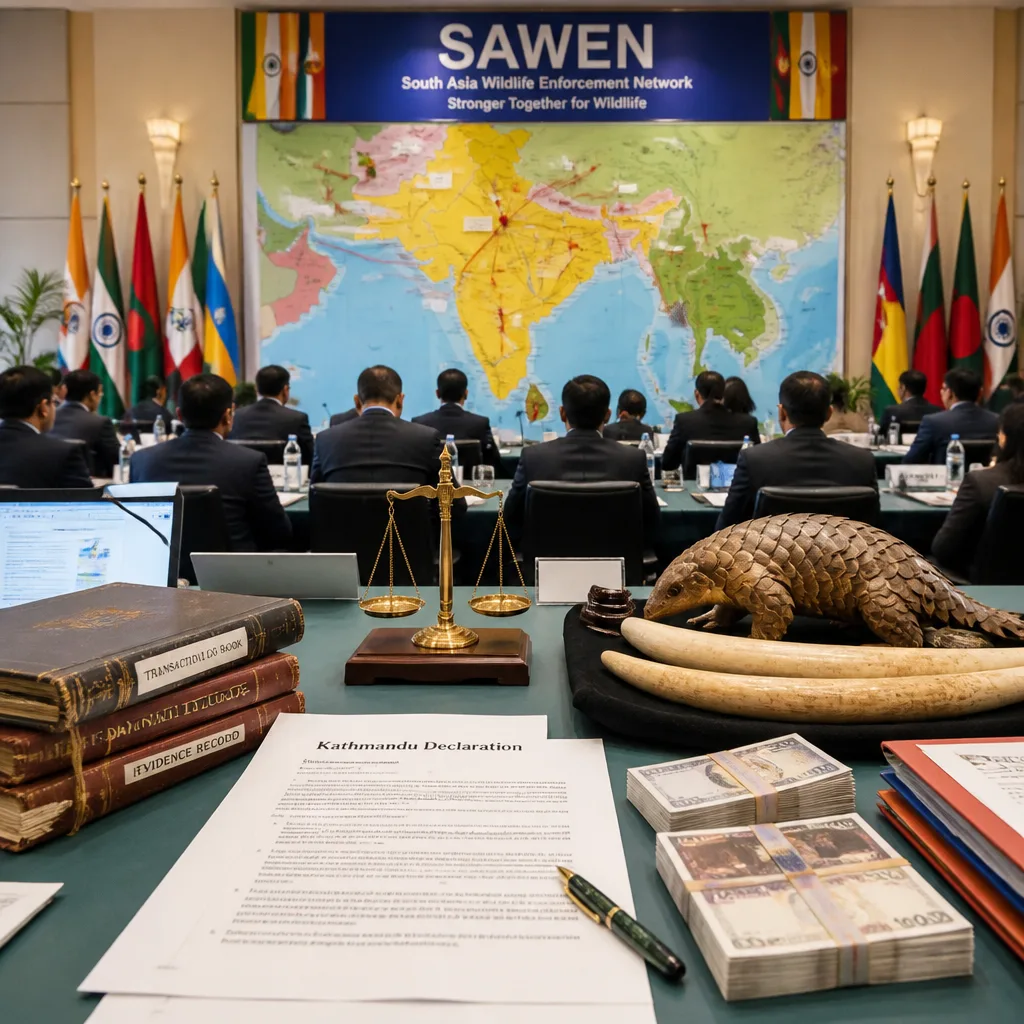
India has joined fellow South Asian nations in endorsing strengthened, coordinated action to counter illegal wildlife trade, officials reported after the first General Assembly of the South Asia Wildlife Enforcement Network (SAWEN) in Kathmandu on September 10–11.
Regional framework to treat wildlife crime as organised cross-border crime
The Assembly adopted the Kathmandu Declaration, in which member countries committed to step up measures including intelligence sharing, financial investigations, anti-money laundering steps and prosecution of organised criminal networks involved in wildlife crime. SAWEN is the regional intergovernmental mechanism for combating illegal wildlife trade in South Asia.
Member states are Afghanistan, Bangladesh, Bhutan, India, Maldives, Nepal, Pakistan and Sri Lanka. The Declaration underlined that wildlife crime threatens the region’s natural heritage and biodiversity as well as the rule of law, security and sustainable development, and it urged criminal justice responses oriented to organised and transnational components of such crime.
"We commit to strengthening information and intelligence sharing, coordinated enforcement action and criminal justice collaboration among Member Countries, consistent with national laws and applicable international obligations," the declaration said.
The Assembly agreed on a package of measures to address serious wildlife crime, particularly cases involving organised groups operating across national borders. These measures include intelligence-led and financial investigations, asset recovery and effective prosecution, according to the text of the Declaration.
Science, technology and combating emerging threats
Delegates also emphasised the role of science, technology and research in strengthening enforcement. The Kathmandu Declaration called for enhanced regional knowledge sharing and cooperation on innovation to counter wildlife crime, including efforts to combat biopiracy, illegal access to biological resources and other emerging threats.
- Intelligence and information sharing among member states to detect and dismantle cross-border trafficking networks.
- Financial probes and anti-money-laundering measures to trace proceeds of wildlife crime and facilitate asset recovery.
- Coordinated criminal justice responses including prosecution and mutual legal assistance consistent with national laws.
- Science and technology cooperation to improve detection, investigation and prevention of wildlife offences.
The Assembly resolved to bolster regional and global initiatives that recognise serious wildlife crime as a form of transnational organised crime. It also set an annual observance to mark the network’s work: January 30 will be observed as SAWEN Day each year.
| Member Countries | Focus Areas |
|---|---|
| Afghanistan, Bangladesh, Bhutan, India, Maldives, Nepal, Pakistan, Sri Lanka | Intelligence sharing; financial investigations; anti‑money laundering; asset recovery; prosecution; S&T cooperation |
Officials at the Assembly described the decision as a step towards harmonising enforcement and investigative responses across South Asia. By prioritising intelligence-led action and financial tracking, member states aim to target the organised criminal groups that increasingly profit from illegal wildlife trade.
The Kathmandu meeting marked SAWEN’s inaugural General Assembly and is intended to provide a coordinated regional platform for law enforcement, judicial and policy actors to strengthen responses to wildlife crime. The Declaration’s provisions will be implemented in accordance with each country’s national laws and international obligations, the text noted.
Observers said the focus on anti‑money‑laundering, asset recovery and prosecution reflects a shift towards dismantling the financial and organisational underpinnings of wildlife trafficking, rather than only concentrating on seizures and arrests.