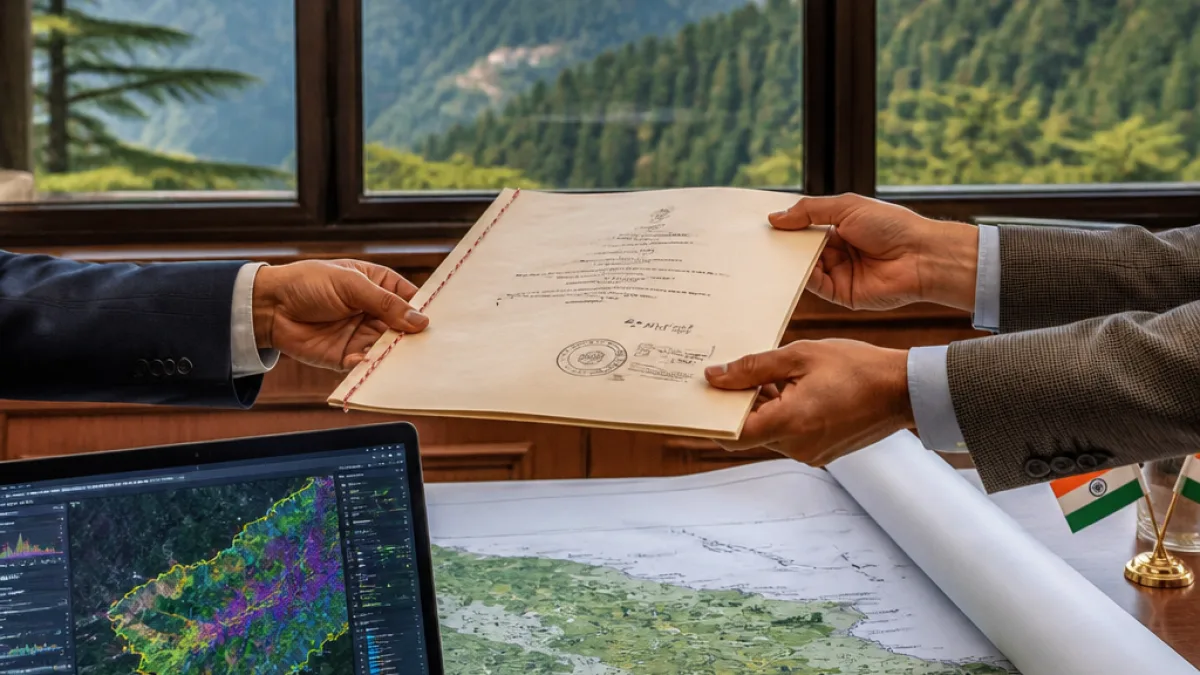
CHANDIGARH / SHIMLA: The Himachal Pradesh Forest Department has signed a five-year memorandum of understanding (MoU) with the Bharti Institute of Public Policy, Indian School of Business (ISB BIPP), to develop plans to sustainably tap an estimated ₹22,600 crore in currently unexploited forest and pastoral value across the state, officials said on Wednesday.
Inventory, AI mapping feed policy tools
The partnership follows a joint forest inventory in which more than 500 forest guards collected over 2,00,000 tree-level records and species-tagged images. These ground observations were combined with satellite imagery and AI/ML analysis and subsequently validated in the field, resulting in maps for seven species published jointly under the title Counting Green Wealth, the Forest Department said.
The inventory and mapping exercise produced species-wise estimates of forest value and enabled identification of a sustainable, species-specific "yield sweet spot" — a level of extraction designed to avoid overharvesting while allowing commercial use.
Five bioresources, estimated values
The assessment focused on five bioresources and assigned estimated untapped values to each. The inventory places the potential at ₹22,600 crore in total, broken down as follows.
| Species / Product | Estimated untapped value |
|---|---|
| Amla | ₹8,700 crore |
| Pine needles | ₹5,500 crore |
| Wild mangoes | ₹4,800 crore |
| Sal seeds | ₹2,400 crore |
| Rhododendron flowers | ₹1,200 crore |
From pilots to state-wide application
According to the Forest Department, the data is already being used in the working plan of the Palampur Forest Division — the first instance of such integration — and the MoU will extend similar planning tools to other divisions with the aim of eventual state-wide coverage.
The MoU was signed in Shimla by Principal Chief Conservator of Forests Dr Sanjay Sood for the Forest Department and Prof Ashwini Chhatre, Executive Director, BIPP, ISB, representing the institute. Himachal Pradesh Chief Minister Sukhvinder Singh Sukhu welcomed the collaboration as a measure to strengthen the rural economy, the department said.
Local enterprise highlighted
The Pir Panjal Jungle Producer Company in Pangi, a women-owned enterprise working in the thangi (hazelnut) sector, was presented during the launch as an operational example of how community enterprises can benefit from improved data and market linkages, officials noted.
- Data-driven planning: The joint inventory combines field-level records with satellite and AI tools to create actionable maps and extraction guidelines.
- Sustainability focus: Extraction is to be governed by species-wise "yield sweet spots" to prevent over-exploitation.
- Economic potential: The identified value stream targets products from a wide altitudinal range, offering new livelihood options for forest-dependent communities.
Implications and next steps
Experts and officials framing forest-based economic development emphasise two linked objectives: to open livelihood opportunities for rural communities and to ensure ecological sustainability through regulated extraction. Embedding the inventory into working plans is intended to give forest managers a stronger evidence base for decisions on permissible harvests, harvesting cycles and community benefit sharing.
Operational questions remain about how the potential economic value will translate into market-ready products, value chains and benefit distribution. The MoU sets a five-year framework for the ISB BIPP to continue providing technical support and for the Forest Department to adopt the inventory outputs in planning and regulation across more divisions.
Officials indicated that the mapping and valuation work will guide administrative directives on species-specific harvesting levels, permitting, community enterprise support and linking collectors to buyers. The Palampur example will be monitored as an early test case for the approach.
The initiative aligns with growing national attention to non-timber forest products (NTFPs) as sources of rural income, while stressing conservation-compatible utilisation. How effectively the MoU's data-driven prescriptions are enforced on the ground — and whether community institutions gain equitable shares of value — will be critical to outcomes in Himachal's fragile mountain ecosystems.