
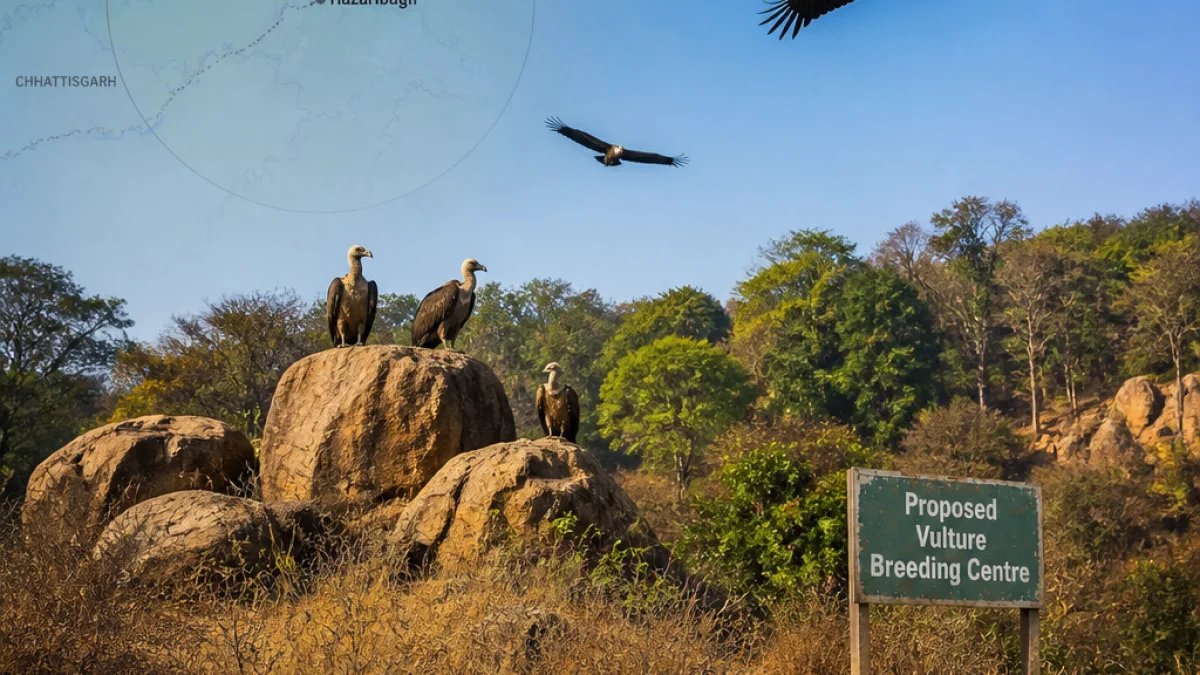
HAZARIBAGH / RANCHI: A roughly 100-km radius around Hazaribagh is being recognised as an emerging safe habitat for vultures, with recent surveys and photographic evidence showing the birds are not only visiting the area regularly but also breeding there, officials said.
Forest department moves to bolster recovery
Encouraged by the upturn in vulture activity, the Jharkhand Forest Department has prepared and submitted a plan to the government to establish a conservation-cum-breeding centre in Hazaribagh. Officials said the proposal is expected to be implemented soon, although no financial or timeline details were disclosed in the submission.
Hazaribagh (West) Deputy Forest Officer (DFO) Maun Prakash said monitoring teams recorded both adult and juvenile vultures — an indication that the species is finding favourable habitat conditions and nesting opportunities in the area.
“Monitoring has recorded not only adult vultures but also juvenile birds, which is a significant indication for the Forest Department that the species is regularly visiting the area and finding favourable habitat conditions,” said Maun Prakash.
The Forest Department views the proposed breeding centre as a way to strengthen ongoing conservation work and to accelerate recovery in the wild.
Why vultures matter and what caused the decline
India’s vulture population has fallen by more than 95 per cent over the last three decades, a collapse that has had both ecological and public-health consequences, officials and conservationists say. Experts attribute the catastrophic decline primarily to the widespread use of certain non-steroidal anti-inflammatory drugs (NSAIDs) in livestock. Vultures feeding on carcasses of animals treated with these drugs were exposed to toxic residues, causing high mortality among the birds.
Conservationists emphasise that safe habitats and contamination-free food sources are both essential to restore vulture populations.
Local landscape and traditional habitats
Conservation activists pointed to Mahavar Hill in Hazaribagh as a traditional vulture habitat. Murari Singh, president of the New Foundation, an organisation working on vulture conservation, said the hills and surrounding forests provide suitable roosting and nesting sites and that recent surveys and photographs confirm the species is thriving in parts of the region.
Murari Singh said these areas are gaining recognition across Asia as safe havens for vultures, and that photographic evidence confirms vultures are thriving safely in these regions.
What the Forest Department plans to address
Officials said the action plan for the proposed centre aims to:
- Provide a dedicated facility for captive breeding and release to boost wild populations.
- Support ongoing monitoring and research to track population recovery and habitat use.
- Promote community engagement to reduce risks from contaminated carcasses and disturb-free nesting.
While the proposal has been submitted, officials have not provided details on scope, funding or a precise timeline for implementation.
Regional significance and next steps
Conservationists said recognition of Hazaribagh and adjacent tracts as a vulture-friendly zone could have broader benefits: stabilising scavenger populations, reducing disease vectors associated with unattended carcasses, and attracting conservation funding and research partnerships.
Officials from the Forest Department and local conservation groups will likely need to coordinate with state and national wildlife authorities to secure approvals, funding and veterinary support for a breeding centre. Continued monitoring and measures to eliminate veterinary drugs toxic to vultures from local livestock management remain critical to ensure the recovered birds have safe food sources in the wild.
| Metric | Detail |
|---|---|
| Area identified | ~100-km radius around Hazaribagh |
| Population decline (national) | More than 95% over three decades |
| Planned action | Conservation-cum-breeding centre (proposal submitted) |
Forest officials said they expect the action plan to be implemented in the near future and anticipate positive results for vulture conservation in the region.












