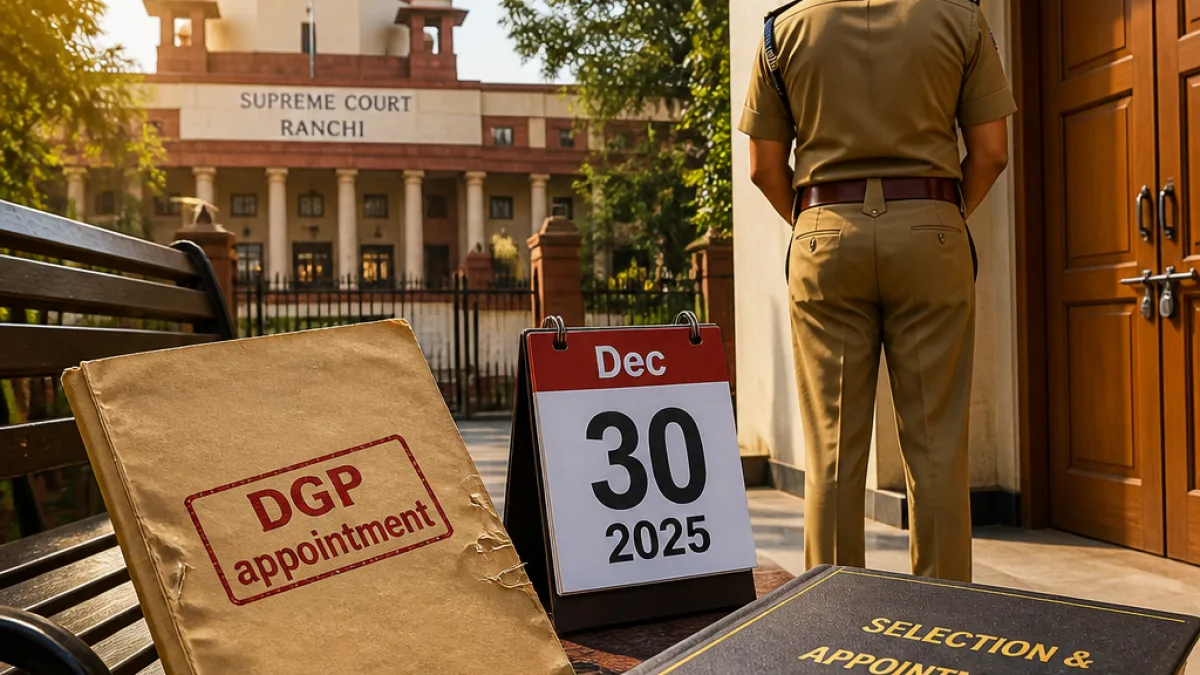
New Delhi/Ranchi: The Jharkhand government's elevation of senior IPS officer Tadasha Mishra to the post of Director General of Police (DGP) on December 30, 2025 — just one day before her scheduled retirement — was in breach of the Supreme Court's requirement that an officer ought to have at least six months' residual service when assuming the office, the top court was told on Friday.
Amicus terms appointment inconsistent with Prakash Singh rulings
Senior advocate and amicus curiae Raju Ramchandran, assisting a bench led by Chief Justice of India Surya Kant and Justice Joymalya Bagchi, submitted a note pointing to what he described as a clear violation of the principles set out in the landmark Prakash Singh judgments. The note was filed in the course of hearing pleas challenging amendments to Jharkhand's rules governing appointment of the state's police chief.
"The appointment of the current DGP (HoPF) one day prior to her retirement is clearly in complete violation of the principles laid down in the Prakash Singh-I, II, and III judgments and orders," the amicus said in the note.
The petition that prompted the hearing was filed by former Jharkhand Chief Minister Babulal Marandi, who has challenged the state's amended rules on the selection and appointment of the DGP. Marandi is represented in the matter by advocates Abhisek Rai and Gyanant Singh.
Facts in the record
According to the material placed before the bench:
- Tadasha Mishra is a 1994‑batch IPS officer of the Jharkhand cadre.
- She was appointed DGP by the Hemant Soren government on December 30, 2025, a day prior to her superannuation.
- By virtue of that appointment, the state effectively granted a two‑year extension to Mishra, the amicus noted.
Ramchandran reviewed the Selection and Appointment of DGP, Jharkhand Rules, 2025, and observed that while several provisions do not offend the spirit of the Prakash Singh decisions, certain clauses require clarification and additional safeguards to prevent arbitrariness and political interference.
Why the six‑month benchmark matters
The Prakash Singh rulings — delivered in stages and reinforced by subsequent orders — established a set of safeguards intended to insulate police leadership from short‑term political considerations and to ensure continuity and merit in the appointment of state chiefs. A key aspect of those judgments is the requirement that an officer considered for the DGP post should have at least six months of residual service at the time of appointment.
The amicus submitted that appointing an officer with barely 24 hours of residual service — then immediately granting an extension — undermines the rationale behind the six‑month rule and may open pathways for circumvention.
What's before the court
The top court had on August 18 directed the amicus curiae to file his note in response to the petition by Marandi. The note now on record canvasses both the compatibilities and the deficiencies in Jharkhand's amended rules, and invites the bench to consider whether specific provisions require judicial clarification or read‑downs to ensure compliance with constitutional principles and prior apex court orders.
| Event | Date |
|---|---|
| Appointment of Tadasha Mishra as DGP | 30 December 2025 |
| Bench hearing pleas on DGP appointment rules | Ongoing (note filed after 18 August direction) |
The matter raises questions about the interplay between state executive discretion and the safeguards mandated by the Supreme Court to preserve the neutrality and effectiveness of police leadership.
Responses and potential consequences
The amicus note stops short of recommending a specific remedy in public documentation, but its finding that the Jharkhand appointment was "clearly in complete violation" of established principles may weigh with the bench as it decides whether the state's amended rules should be struck down, read down or clarified. Any order of the court could have implications for appointments in other states where similar rule changes or appointment practices have been adopted.
No fresh response from the Jharkhand government was on record in the amicus note filed in court. The petition by Marandi challenges the validity of Jharkhand's amended DGP selection rules and seeks a declaration that they are inconsistent with apex court judgments.
The Supreme Court will now consider the amicus' observations alongside arguments advanced by the parties as it determines whether the state's rules and the particular appointment meet the standards laid down to safeguard police autonomy and institutional stability.