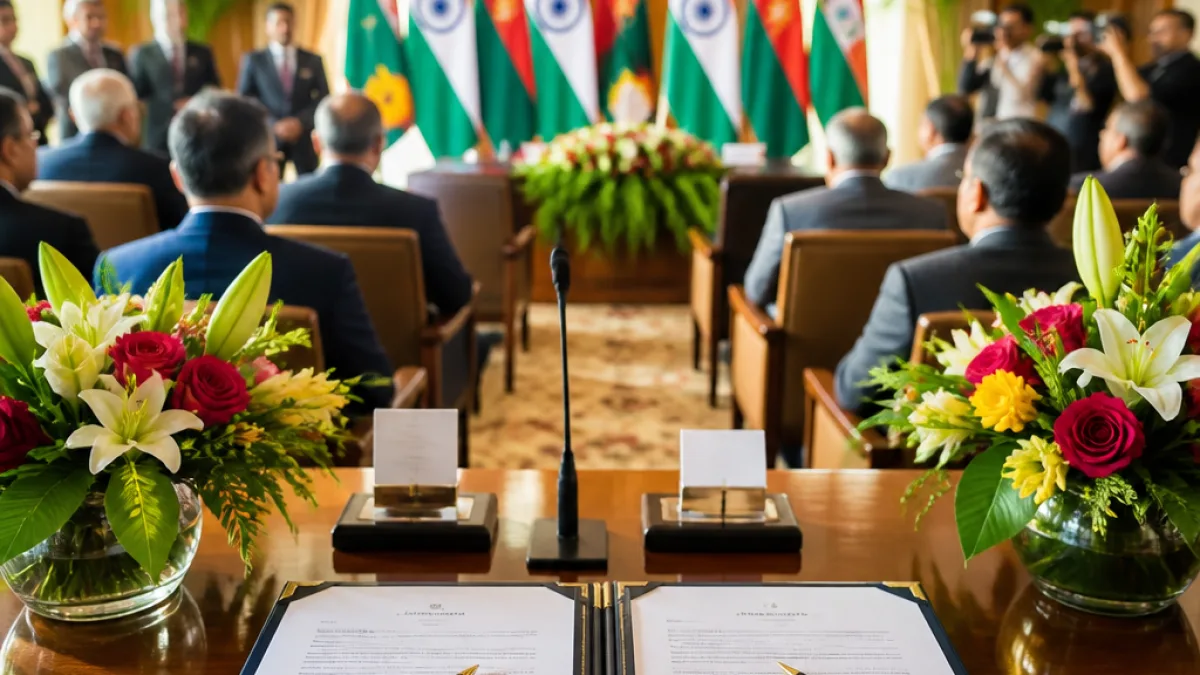
New Delhi: The governments of Bihar and Jharkhand on Monday signed a memorandum of understanding to resolve the long‑standing Son River water‑sharing dispute, in a high‑level meeting chaired by Union Home Minister Amit Shah in the national capital.
Top leaders attend high‑level meeting
The compact was signed in the presence of Bihar Chief Minister Samrat Choudhary and Jharkhand Chief Minister Hemant Soren. Union Jal Shakti Minister C. R. Paatil and senior administrative delegations from both state governments and the Ministry of Home Affairs also attended the meeting, according to official accounts.
Officials described the agreement as an important step towards resolving a dispute that has persisted for years and required intervention at the apex level of government to reach a consensus.
What was agreed and what remains to be done
The MoU outlines a framework for sharing Son River waters between the two states. While the text of the agreement has not been made public in full, officials said the document was intended to settle the major points of contention and establish a mechanism for cooperation and implementation.
State governments will now be expected to follow up with administrative and technical steps required to operationalise the arrangement. These may include formation of inter‑state panels, technical studies and timelines for implementation; however, specific procedural details were not disclosed at the signing.
Why the pact matters for Jharkhand
Water‑sharing accords between riparian states affect irrigation, agriculture, hydropower planning and drinking‑water provision. For Jharkhand, which shares catchment areas and river basins with Bihar, a negotiated settlement could reduce cross‑border tensions and provide a clearer framework for managing seasonal flows.
Politically, the agreement gives both state administrations an opportunity to demonstrate cooperative governance and could lessen recurring litigation and unilateral projects that have previously escalated disputes.
Attendees and institutional representation
A broad set of officials and ministers were present at the signing, signalling central government involvement in facilitating the settlement. The meeting was convened by the Ministry of Home Affairs and included representation from the Union Jal Shakti Ministry.
| Role | Person / Body |
|---|---|
| Chair | Union Home Minister Amit Shah |
| Bihar Chief Minister | Samrat Choudhary |
| Jharkhand Chief Minister | Hemant Soren |
| Union Ministry | Union Jal Shakti Minister C. R. Paatil; Ministry of Home Affairs |
Background and context
Inter‑state river disputes are common in India, often requiring mediation by the central government or adjudication by tribunals. The Son River, a significant tributary in the Ganga basin, has been at the centre of disagreements over allocation, project approvals and timing of releases. The MoU aims to provide an administrative route to settle differences and avoid prolonged legal or political confrontation.
Officials emphasised that the signing represented a collaborative approach and underlined the central government’s role in bringing both parties to a consensus. The presence of senior ministers at the ceremony was presented as an assurance that implementation would be closely monitored.
What stakeholders should expect next
- Formation of joint administrative or technical committees to work out operational details of water allocation.
- Timelines for implementation and periodic reviews to ensure compliance with the MoU.
- Possible technical studies to assess seasonal flows, storage needs and impact on local irrigation.
Officials have said follow‑up meetings and procedural steps will be scheduled to translate the MoU into actionable measures. For communities dependent on Son River waters, the process of converting an agreement on paper into on‑ground benefits will be key.
While the MoU was hailed as a breakthrough by those involved in the negotiations, stakeholders and policy analysts will be watching for clear implementation plans and institutional arrangements that prevent future disputes.