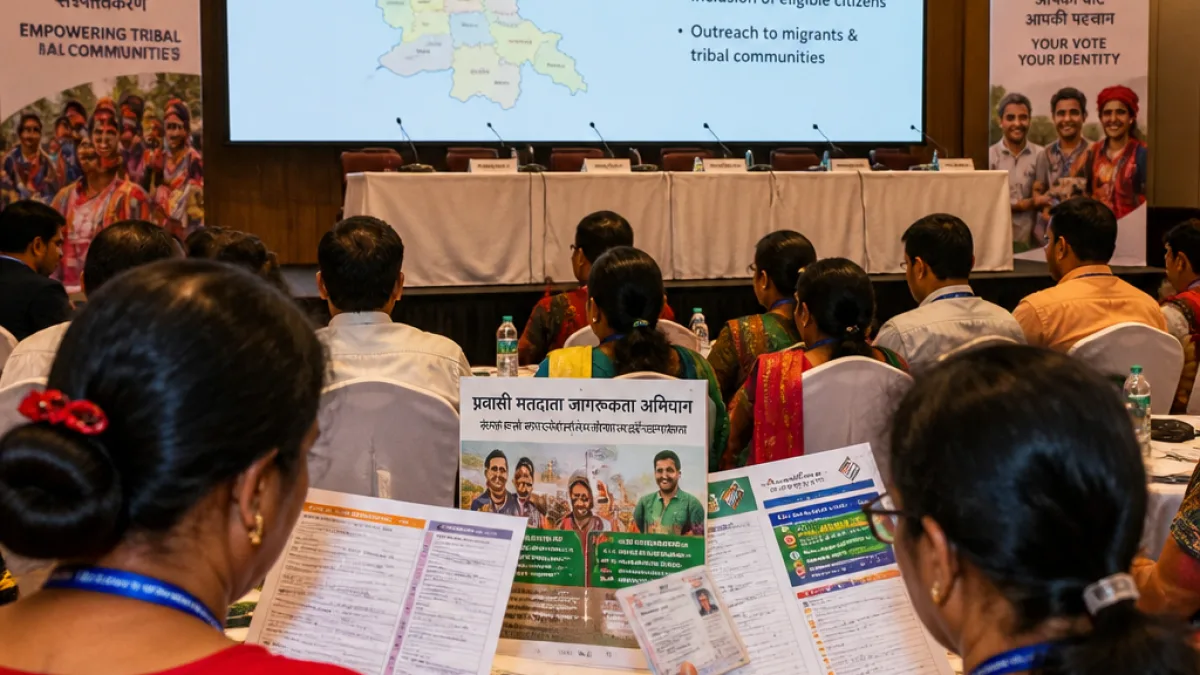
Ranchi: A two-day conference on Voter Registration and Voter Registers held in Ranchi emphasised measures to prevent exclusion of migrants, tribal communities and women from the electoral rolls, officials said on Wednesday. The event combined panel discussions and technical sessions aimed at improving access, accuracy and accountability in voter lists across the state.
Focus on hard-to-reach groups and terrain
The sessions addressed the particular challenges Jharkhand faces because of its significant internal migration, densely forested and hilly areas, and a large tribal population. Officials and experts reviewed operational steps to make enrolment more responsive to mobility and local conditions, including field verification and other safeguards used by the Election Commission of India (ECI).
Jharkhand Chief Electoral Officer K. Ravi Kumar said the conference had moved beyond the ongoing Special Intensive Revision (SIR) exercise and provided a platform for technical exchange between administrators, academics and civil society. The event featured a panel chaired by former Bihar DGP D. N. Gautam and co-chaired by Professor Sandeep Shastri, according to the conference programme.
Technical sessions and participation
Organisers said the conference received substantial interest from the research and administrative community: 230 abstracts were submitted by over 800 institutions. Of these, 80 abstracts were shortlisted and 58 were selected for presentation, reflecting a mix of comparative practice, technology solutions and field-level case studies.
| Metric | Count |
|---|---|
| Abstracts received | 230 |
| Shortlisted | 80 |
| Selected for presentation | 58 |
Key themes discussed
- Inclusion of migrants: Ways to ensure internal migrants are not left off rolls and can exercise franchise at new locations.
- Tribals and difficult terrain: Improving outreach and verification in forested and hilly blocks where enumeration and access are challenging.
- Women’s participation: Measures to raise enrolment and reduce gender gaps in voter lists.
- Data accuracy and uniformity: Aligning Electoral Photo Identity Cards (EPICs) with voter lists and strengthening technology-based checks.
- Accountability: Role of political-party participation, field verification and supervision by ECI in preventing errors or exclusion.
Officials said the conference combined comparative inputs from India and abroad with field-level experience from Jharkhand’s districts. Technical sessions reportedly covered digital tools, verification protocols, grievance redressal and community engagement to ensure that vulnerable groups are not inadvertently left out during revisions of electoral rolls.
What this means for voters
For residents of Jharkhand, the focus on migrants, tribals and women implies planned administrative attention to reduce disenfranchisement during periodic revisions. Measures discussed — such as enhanced field verification, better data matching between EPICs and voter registers, and targeted awareness drives — aim to make enrolment simpler and more accurate, officials said.
State election authorities plan to use the conference findings to refine operational guidelines for future revisions and outreach campaigns. The SIR exercise was already under way in parts of the state; participants recommended that lessons from the conference be integrated into field operations to improve coverage and minimise errors.
Next steps and institutional follow-up
Organisers indicated that technical recommendations and selected papers would be reviewed to shape policy and practice at the state level. The involvement of the chief electoral officer and senior administrators underlines the state’s intent to synchronise local interventions with the Election Commission’s safeguards, including political-party checks and technology-enabled verification.
By bringing together administrators, researchers and practitioners, the conference sought to produce practical measures that can be adopted across Jharkhand’s varied districts to ensure that voter registers are inclusive, reliable and resilient to population movement.