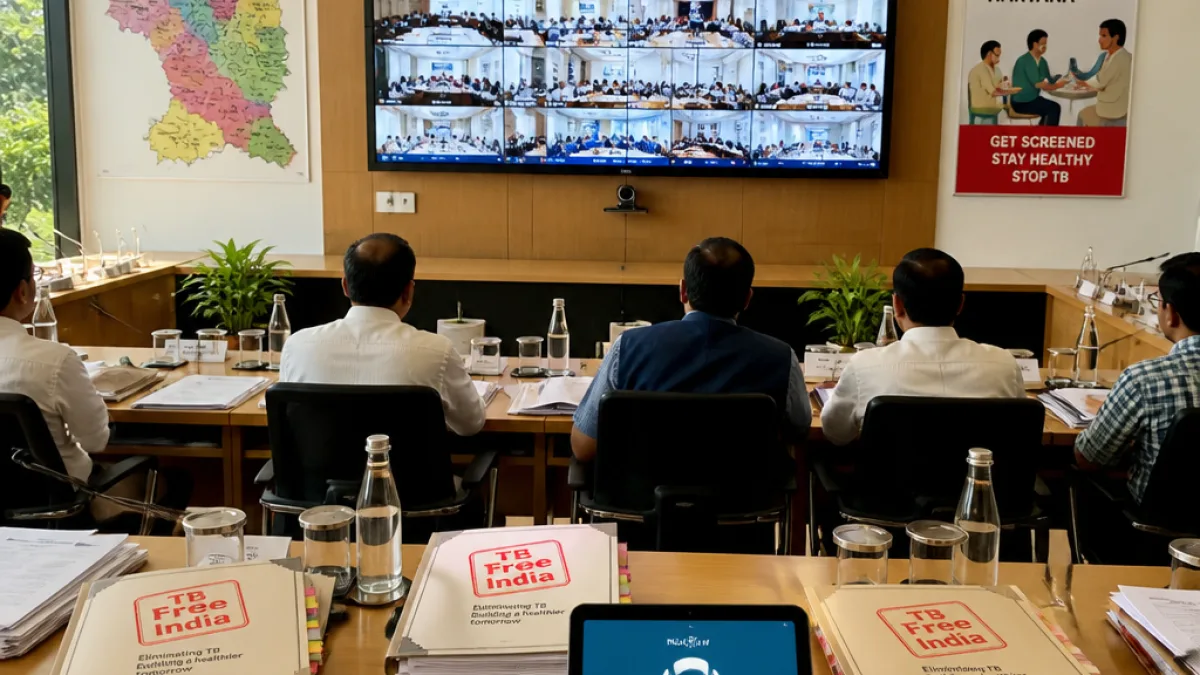
Chandigarh: Haryana Governor Prof. Asim Kumar Ghosh on Wednesday directed Deputy Commissioners of 13 districts to take "concrete and result-oriented" steps to eliminate tuberculosis (TB) from the state, calling for periodic audits of outcomes and a stronger emphasis on community-based screening and treatment delivery.
Focus on detection, treatment and accountability
Addressing the district heads through video conference from Lok Bhawan, Chandigarh, the Governor reviewed progress under the TB Free India Campaign and the Nikshay Mitra Initiative. He asked district administrations to strengthen preventive measures, ensure early detection through community screening, and provide timely treatment and care to patients diagnosed with TB.
Prof. Ghosh underlined the need for periodic audits to assess the impact of actions taken at the district level and to identify gaps in implementation. He stressed that both government and private health institutions should actively participate to ensure the campaign’s success.
Targeting high‑risk areas and vulnerable groups
The Governor directed Deputy Commissioners to pay special attention to high-risk villages where testing and health services are not readily available. He emphasised that testing, treatment and nutritional support must reach the most vulnerable sections of the population.
He directed Deputy Commissioners to take concrete and result-oriented steps to completely eradicate TB from the state and said that results should be audited periodically to assess the impact of the work being done under the ‘TB Free India Campaign’ and the ‘Nikshay Mitra Initiative’.
Nutrition, technology and strengthening district centres
Among operational priorities, Prof. Ghosh asked for:
- Timely delivery of nutritional support kits to needy patients under the Nikshay Mitra Initiative.
- Greater use of technology-based tools, notably the TB Free India App, for tracking, monitoring and ensuring adherence to treatment.
- Strengthening and regular monitoring of district TB centres to ensure effective implementation.
The Governor noted that under the central leadership, India is committed to achieving TB elimination, and said Haryana has emerged as one of the leading performing states in the country in the fight against tuberculosis.
Administrative measures and expected outcomes
By instructing district administrations to adopt measurable, audited interventions, the Governor signalled a shift towards outcome-oriented implementation. Periodic audits, if conducted rigorously, could help identify districts lagging on early diagnosis, treatment completion and social support components such as nutrition.
| Programme/Tool | Purpose |
|---|---|
| TB Free India Campaign | State-level drive to eliminate TB through detection, treatment and community mobilisation |
| Nikshay Mitra Initiative | Provides nutritional and social support to TB patients to improve treatment adherence |
| TB Free India App | Technology tool for tracking cases, monitoring treatment and supporting field-level implementation |
Implementation challenges remain
Experts and health administrators often point to several recurring challenges in TB control: reaching remote and marginalised populations, ensuring uninterrupted supply of diagnostics and drugs, addressing social determinants such as malnutrition and overcrowding, and countering stigma that delays care seeking. The Governor’s instructions place emphasis on several of these elements—screening, nutritional support and technology—but translating directives into consistent field action will require inter-departmental coordination and monitoring.
What the directive means for citizens
For residents of Haryana, the Governor’s focus implies intensified community screening drives in high-risk areas, efforts to deliver nutrition kits to diagnosed patients, and an increased role for technology in tracking cases. Citizens who suspect symptoms or have had contact with TB patients are likely to see more outreach from district health teams and may be advised to use app-based tools where available for follow-up.
The state-level review involved Deputy Commissioners from 13 districts and was conducted via video conferencing. The Governor asked district administrations to regularly monitor and, where necessary, upgrade district TB centres to ensure sustained delivery of services.
Further operational details and district-specific action plans were not released in the review note made public on Wednesday.