Cabinet approval paves way for practitioner-led university
The Haryana Cabinet on Monday approved the Haryana Private Universities (Amendment) Bill, 2026, clearing the path for Masters’ Union University to be established in Gurugram. The decision, taken in a meeting chaired by Chief Minister Nayab Singh Saini, follows a letter of intent already issued to the institution and marks its transition from a business and technology school to a private university under state law.
According to the government communication, the proposed university will expand Masters’ Union’s practitioner-led and experiential learning model to offer programmes in management, technology and engineering. The institute has also indicated plans to develop specialised learning pathways in areas such as family business and executive education.
"We started Masters’ Union with a simple belief that students learn some things best by actually building, solving and doing. The Cabinet approval gives us an opportunity to take that philosophy to the scale of a university," Pratham Mittal, founder of Masters’ Union, said.
Campus, infrastructure and scale
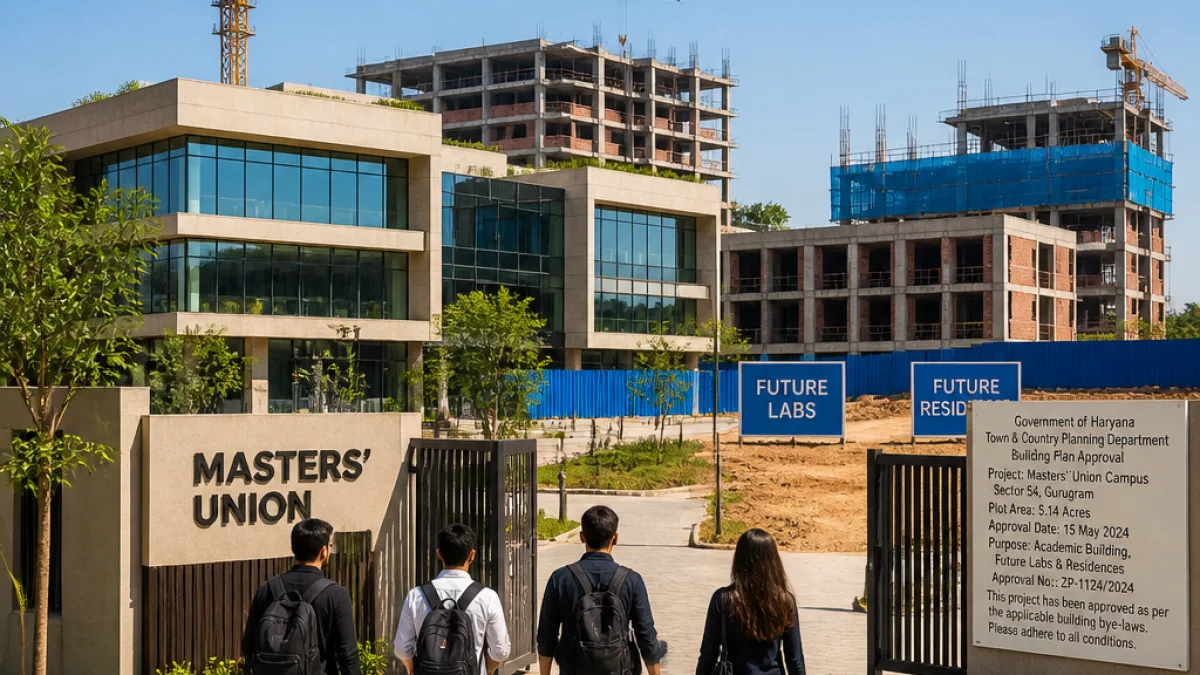
The proposed university campus occupies approximately 5.14 acres of contiguous land in Gurugram and already has an existing built-up area of around 1.07 lakh sq ft. Of this, the authority noted about 96,600 sq ft is instructional space, with the rest covering administrative and other amenities. Masters’ Union has stated that it will expand infrastructure as the university grows, with a campus vision that includes accelerator and venture-building spaces, maker and analytics laboratories, student residences, cultural and sports facilities, and incubation and research infrastructure.
| Item | Detail |
|---|---|
| Campus area | 5.14 acres |
| Existing built-up area | 1.07 lakh sq ft |
| Instructional space | 96,600 sq ft |
What the approval means for students and industry
The Cabinet’s nod enables Masters’ Union to expand programme offerings and enrolment under the regulatory framework for private universities in Haryana. The institution’s stated emphasis on practitioner-led courses and applied research suggests closer industry collaboration and an increased focus on entrepreneurship and problem-solving pedagogy. The university proposal highlights facilities such as accelerators and maker labs that are aimed at translating classroom learning to real-world projects.
For prospective students, the transition implies larger-scale degree options in management, engineering and technology available locally in Gurugram. For employers and the startup ecosystem, the stated focus on applied research, incubation and venture-building spaces could provide an additional pipeline of work-ready graduates and early-stage ventures.
Process and next steps
The Cabinet approval is a legislative step that requires the Haryana Private Universities (Amendment) Bill, 2026 to be processed according to the Assembly and statutory procedures to formalise the university’s status. The government issued a letter of intent to Masters’ Union earlier, and the amendment now clears a major statutory hurdle for the institution to begin operating as a university under state law.
- Regulatory compliance: The institution will be governed by provisions of the Haryana Private Universities Act as amended and will be expected to meet statutory requirements for academic standards and infrastructure.
- Infrastructure expansion: Masters’ Union has signalled plans to grow campus facilities over time, matching programme expansion.
- Programme focus: Initial offerings are expected in management, technology and engineering, with specialised pathways such as family business and executive education mentioned.
Background on Masters’ Union
Masters’ Union began as a practitioner-led business and technology school, offering industry-facing programmes. With the Cabinet approval, it aims to scale this model into a private university in Gurugram, retaining its experiential learning approach while expanding academic scope and physical capacity.
The Cabinet decision was presented as part of the government’s broader private higher-education policy framework, which permits the establishment of private universities through legislative amendments and approvals. The move will be watched by students, educators and industry partners interested in industry-aligned higher education options in the National Capital Region.