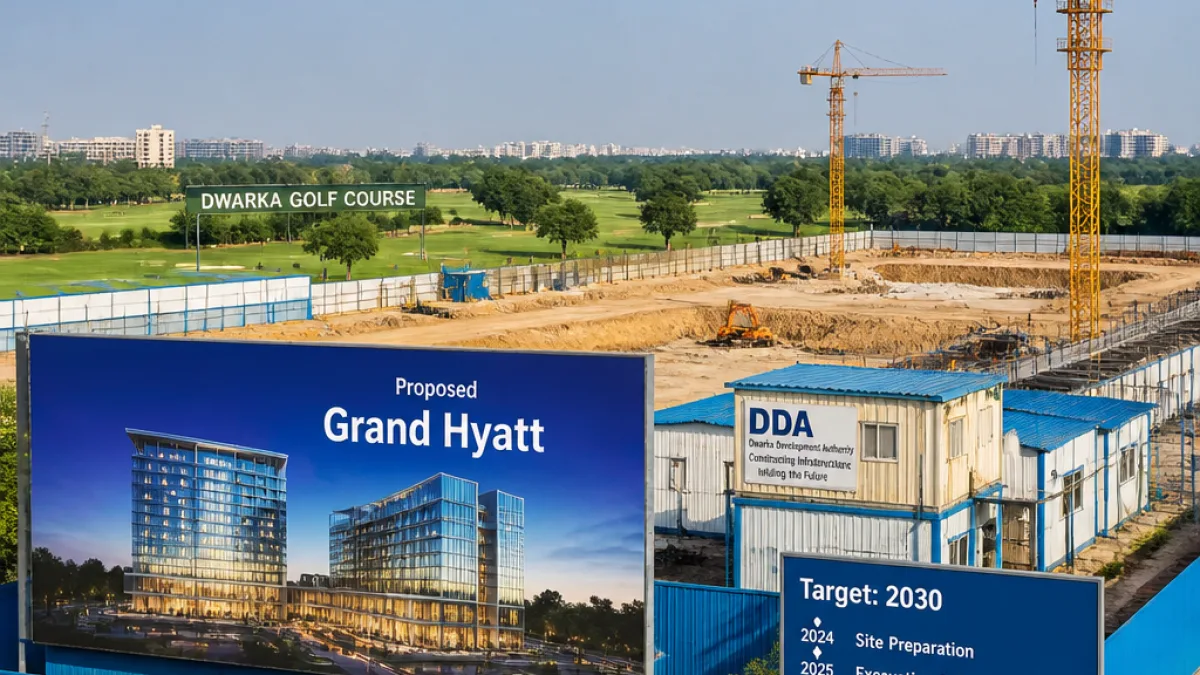
The Delhi Development Authority (DDA) on Wednesday signed an agreement with Juniper Hospitality Assets Private Limited, a subsidiary of Juniper Hotels Ltd, to develop and operate a five‑star hotel under the Grand Hyatt brand in Sector 23 of Dwarka, officials said.
Site, partners and timeline
According to a DDA statement cited by news agency PTI, the hotel site will be handed over to Juniper Hotels Ltd and the property is scheduled to become operational by 2030. Juniper Hotels Ltd is a strategic partnership between Saraf Hotels and Hyatt and currently manages several properties across India.
The project will be developed and operated by Juniper in partnership with Hyatt on a licence‑fee basis, the DDA said. The site overlooks the DDA’s Dwarka Golf Course — described by the authority as the country's longest 18‑hole course — and lies opposite the area earmarked for a proposed diplomatic enclave.
Projected finances and employment
The DDA said the hotel is expected to attract capital investment of more than ₹1,000 crore. Over the 55‑year licence period, the project is projected to generate more than ₹6,000 crore in revenue for the authority, PTI reported.
| Item | Figure |
|---|---|
| Estimated capital investment | ₹1,000 crore+ |
| Projected revenue to DDA (55 years) | ₹6,000 crore+ |
| Licence period | 55 years |
| Estimated direct jobs | ~800 |
The DDA additionally highlighted the employment potential of the project, saying the hotel is expected to create around 800 direct jobs. The authority framed the project as part of Lt Governor Taranjit Singh Sandhu’s vision to transform Dwarka into a major economic and commercial destination.
Location advantages and demand drivers
The DDA noted several locational advantages for the hotel: proximity to the Yashobhoomi Convention Centre — described by the authority as the largest convention centre in India and Asia by area — the Dwarka Sports Complex, the golf course and the planned diplomatic enclave directly opposite the site. These factors were cited as likely to boost demand from business travellers and tourists.
- Prime location near the proposed Diplomatic Enclave and Yashobhoomi Convention Centre.
- Adjacency to the DDA’s Dwarka Golf Course and sports facilities.
- Part of a cluster of four special licence‑fee projects auctioned by the DDA over the past year.
Context within DDA’s development strategy
The project is one of several recent DDA initiatives to monetise land and develop commercial and hospitality assets. The authority has in the past year auctioned multiple special licence‑fee projects as part of efforts to generate non‑tax revenues and catalyse private investment in peripheral subcities such as Dwarka.
By partnering with an international brand like Hyatt through Juniper Hotels, the DDA aims to position Dwarka as a destination for conferences, corporate events and high‑end tourism, officials said in the statement quoted by PTI.
What the DDA has said and what remains
The DDA’s statement provided the broad contours of the deal — the developer, brand affiliation, expected timelines and projected financials — but did not disclose finer operational details such as the exact number of keys (rooms), floor area or the phased construction schedule. Juniper Hotels Ltd and Hyatt have not issued separate detailed disclosures through the DDA release cited by PTI.
Local planners and residents will be watching whether infrastructure — particularly road access, last‑mile connectivity to metro stations and utilities — keeps pace with the projected increase in traffic and commercial activity as the hotel progresses to construction and operation.
The DDA did not provide a comment beyond the statement released to PTI. Further regulatory approvals and clearances will be required before construction begins and the authority did not detail the remaining statutory steps in its announcement.
The hotel proposal underlines the DDA’s push to leverage key parcels in Dwarka for high‑value hospitality projects, and signals growing interest from organised hospitality operators in Delhi’s subcities as demand patterns evolve.