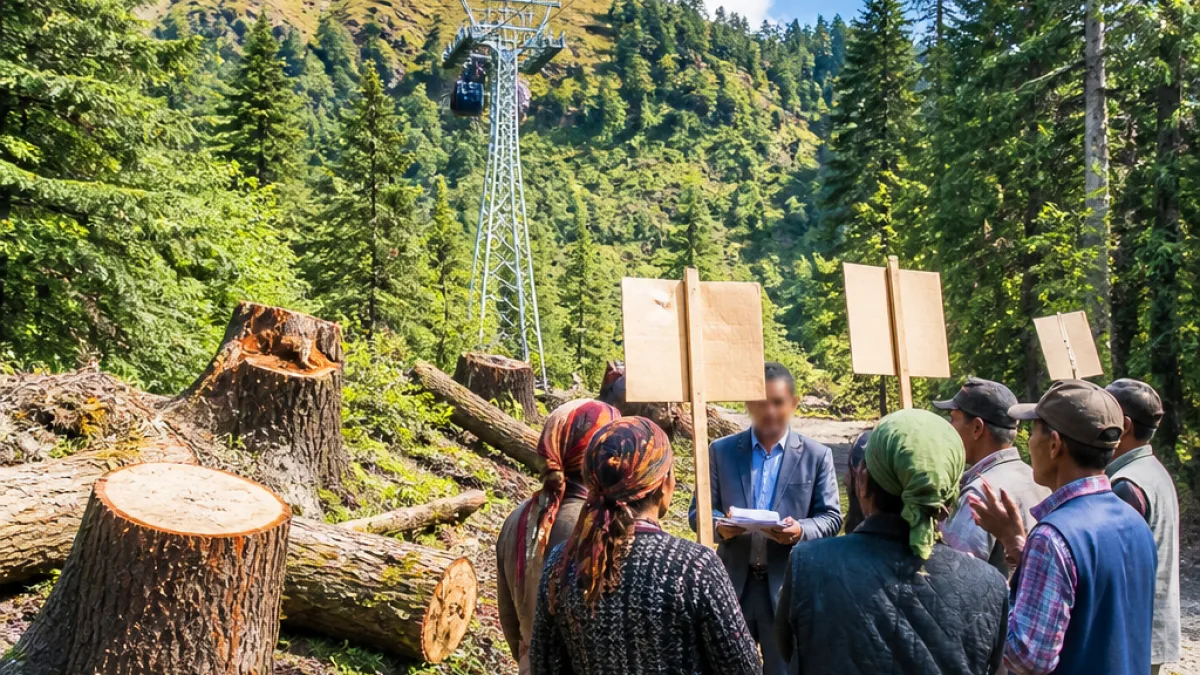
The proposed aerial passenger ropeway to the Bijli Mahadev Temple on Kharal hill in Kullu district, a project estimated at ₹284 crore, has emerged as a flashpoint where religious sentiment, environmental concerns and electoral politics intersect. Proceedings before the National Green Tribunal (NGT) have added a legal dimension to protests by villagers, panchayats and conservation groups.
Local objections and calls for fresh consultation
Residents of Kharal village, traditional custodians of the shrine and civic groups have demanded wider consultation and a fresh public hearing before construction resumes in earnest. For many locals, Bijli Mahadev is not merely a tourist destination but a sacred landscape governed by long-standing religious practices and customary rights; they assert that those local sentiments have not been adequately considered, according to local reports.
Trees felled, images fuel opposition
The controversy intensified after photographs and videos showing felled deodar trees near the temple went viral last year, prompting public anger and renewed scrutiny of the project’s environmental impact. Environmentalists and petitioners before the NGT have questioned both the removal of trees and whether adequate environmental safeguards and statutory consultations were followed.
| Item | Figure reported |
|---|---|
| Project cost | ₹284 crore |
| Trees originally at risk | 203 |
| Reported reduced impact after redesign | around 70 |
| Alleged trees already felled (per petitioner) | 77 deodar |
Political divide and claims of development benefits
Kullu MLA Sunder Singh Thakur has defended the ropeway, arguing it could bolster pilgrimage tourism, generate employment and provide an economic boost to the region. He told reporters that the project was mainly funded by the Centre while the state government’s role was largely facilitative and administrative. Thakur also noted that the ropeway had featured in the BJP’s messaging during the 2022 Assembly election campaign.
On environmental mitigation, the MLA said the original alignment — which reportedly threatened more than 203 trees — was redesigned to lower the impact to about 70 trees and that the developer had paid the required compensatory levies. Environmental advocates and the petitioner before the NGT have countered those claims, continuing to raise concerns about habitat loss, tree felling and adequacy of compensatory measures.
NGT proceedings add legal uncertainty
The matter pending before the National Green Tribunal introduces legal uncertainty over the project’s timeline and the scope of permissible work. Petitioners have sought remedial action and independent assessment of ecological impact, while opponents want a fresh public hearing to ensure local voices and customary concerns are formally recorded.
- Local custodians and panchayats emphasise the temple’s cultural and religious significance and want meaningful consultation.
- Environmentalists question whether compensatory levies and a redesigned alignment are sufficient mitigation for ecological loss.
- Proponents stress potential economic and employment benefits from increased pilgrimage tourism.
What remains unresolved
Key issues that remain open include the final approval of the alignment, independent verification of how many trees were removed, the adequacy of compensation and reforestation plans, and whether statutory public consultation procedures were complied with. The NGT’s directions will be pivotal in determining whether construction can proceed as proposed, needs further redesign, or should be paused pending exhaustive local consultation and environmental assessment.
The dispute highlights a recurring challenge in Himalayan infrastructure projects: balancing development objectives with protection of fragile ecosystems and respect for local cultural landscapes. The outcome of the NGT case and any subsequent administrative decisions will shape both the environmental stewardship and the economic trajectory of the Kharal-Bijli Mahadev area.
Local stakeholders — from village panchayats and temple custodians to environmental petitioners and elected representatives — are watching the tribunal process closely, aware that its findings could set precedents for how faith-linked landscapes are managed alongside tourism-driven infrastructure in Himachal Pradesh.