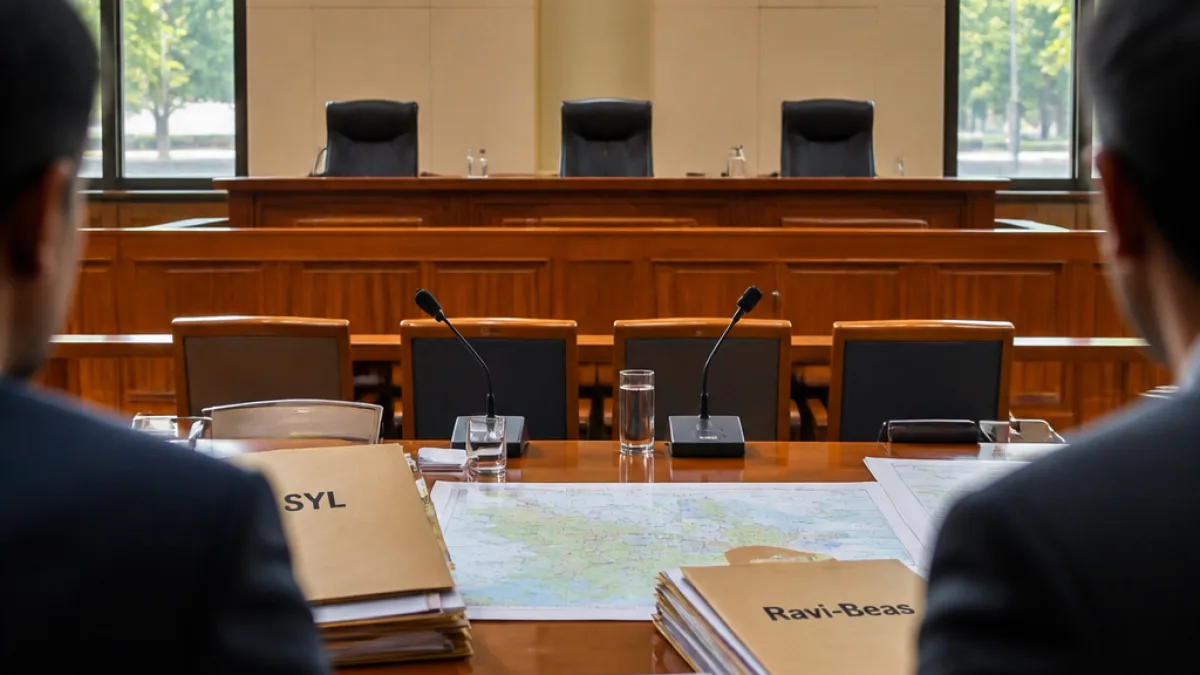
New Delhi/Chandigarh: The Centre informed the Supreme Court on Wednesday that the States of Punjab and Haryana are making tangible progress towards resolving their longstanding disagreement over the sharing of Ravi‑Beas waters and the construction of the Sutlej‑Yamuna Link (SYL) canal.
Government reports improved talks
Attorney General R. Venkataramani told a three‑judge Bench led by Chief Justice Surya Kant that negotiators for the two States were converging on a common stance. He asked the court to defer further hearings briefly to allow the discussions to continue.
“I must say that today we speak in a joint voice. Punjab is coming much closer. They have opened their heart much more than what they were talking last time,” the Attorney General said before the Bench.
Chief Justice Surya Kant observed from the Bench that a willingness to reconcile often clears the path to a negotiated solution. Senior counsel Kapil Sibal, also appearing in the matter, expressed cautious optimism, saying the talks had yielded significant movement.
Background and the current case
The dispute dates back decades to arrangements made after the reorganisation of Punjab and the creation of Haryana in 1966. Haryana filed an original suit in 1996 seeking completion of the SYL canal so that it could receive the share of Ravi‑Beas waters allocated to it. A 1981 water‑sharing agreement envisaged the SYL canal to reallocate waters between the two States.
With both States engaged in negotiations mediated with the Centre’s involvement, the Attorney General requested the court to postpone the matter until 20 August or some time in the following week to permit continued talks. The Bench agreed that a short adjournment would not prejudice the case while parties attempt a settlement.
Practical implications for Haryana
Completion of the SYL canal and a finalised water‑sharing arrangement would determine the volume of surface water available to Haryana from the Ravi and Beas rivers. The outcome could affect irrigation supplies, drinking water planning and inter‑state water management strategies across the region.
- Parties involved: Haryana, Punjab and the Centre (represented by the Attorney General).
- Legal vehicle: Haryana’s 1996 original suit seeking completion of the SYL canal.
- Next court date: Matter to be taken up from 20 August or the following week, as sought by the Attorney General.
What's at stake
Lawyers and officials have noted that the dispute mixes legal, technical and political elements: allotment of river waters under past agreements, construction of inter‑state canal infrastructure and the political sensitivities of resource allocation. A negotiated resolution would likely require both legal accommodation and operational details on flow shares and canal construction.
| Year | Significance |
|---|---|
| 1966 | Creation of Haryana following reorganisation of Punjab |
| 1981 | Water‑sharing agreement envisaging SYL for reallocation of Ravi‑Beas waters |
| 1996 | Haryana filed original suit in Supreme Court seeking completion of SYL canal |
The Bench hearing the matter comprises Chief Justice Surya Kant, Justice Joymalya Bagchi and Justice V. Mohana. The court’s willingness to permit a short adjournment reflects judicial preference for resolving inter‑state disputes through negotiated settlements where feasible, provided legal rights and public interest are preserved.
Officials have not yet placed detailed technical proposals before the court in open pleadings as the States continue the dialogue. Any formal settlement reached by the parties will be placed before the Supreme Court for its consideration and approval as required by law.
For Haryana, the immediate consequence is a brief delay in judicial proceedings while negotiations continue; the longer‑term impact will depend on whether an agreed formula secures the State's lawful share of river waters and the timeline for completing the canal works.