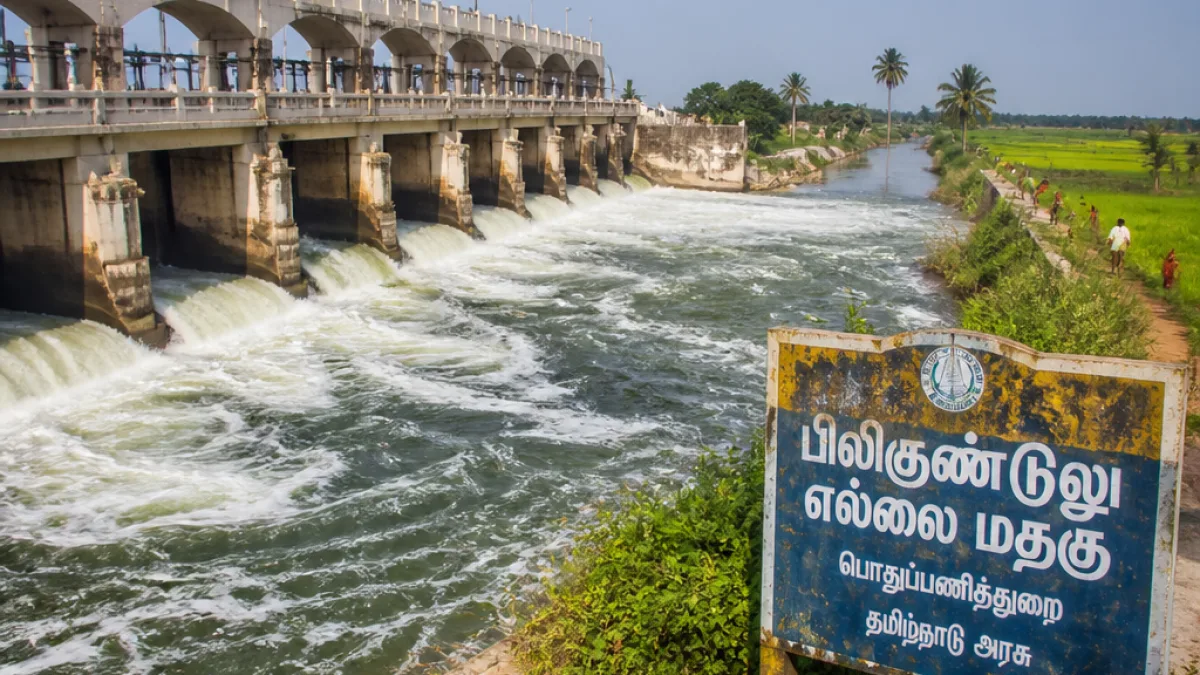
CHENNAI: The Cauvery Water Management Authority (CWMA) on Tuesday upheld the Cauvery Water Regulation Committee's (CWRC) recommendation that Karnataka must ensure a flow of 9,000 cusecs of water to Tamil Nadu at the Biligundulu border point for a continuous period of 15 days.
Meeting and representation
The 56th meeting of the CWMA was held in New Delhi under the chairmanship of S.K. Haldar. Officials from Tamil Nadu, Karnataka, Puducherry, Andhra Pradesh and Kerala participated. Representing Tamil Nadu were Prashant M Wadnere, Secretary, Water Resources Department, and Thiru Subramanian, Chairman of the Cauvery Technical Cell.
What the CWMA decided
The CWMA reiterated the CWRC direction that maintaining a flow of 9,000 cusecs at the inter-state border for 15 days would result in Tamil Nadu receiving roughly 11.66 TMC of water. The decision follows a sequence of earlier directions and is in the wake of a Supreme Court instruction for Tamil Nadu to raise its grievance before the CWMA regarding Karnataka's release of its share.
"According to the CWRC, 11.6 TMC of water has to be released over 15 days. We requested them to reduce it to 6,000 cusecs. Tamil Nadu argued for increasing the release to 28 TMC. After all discussions in the meeting, the CWMA reiterated the recommendation of the CWRC," said Karnataka officer Gaurav Gupta.
Background and numbers
The CWRC had earlier at its 141st meeting directed Karnataka to release water from its reservoirs to secure a flow of 9,000 cusecs at the Biligundulu point. In mid-August the CWRC had temporarily directed an even higher release—12,000 cusecs daily for 15 days starting August 12—and the CWMA had upheld that instruction.
| Parameter | Quantity |
|---|---|
| Flow ordered at Biligundulu border | 9,000 cusecs |
| Duration | 15 days |
| Estimated water to TN | 11.66 TMC |
Implications for Tamil Nadu
The additional release is expected to support kuruvai (short-term paddy) cultivation in delta districts and to help meet municipal and rural drinking-water needs in parts of the State. Tamil Nadu had pushed for a larger allocation, arguing for up to 28 TMC, while Karnataka sought a lower release; both positions were recited during the meeting, according to participants.
Stakeholder positions
- Tamil Nadu representatives sought a substantially higher release and raised the matter following the Supreme Court's direction to place grievances before the CWMA.
- Karnataka officials indicated preference for a lower discharge, and at the meeting said they had requested reducing the flow to 6,000 cusecs.
- The CWMA, after deliberations, opted to endorse the CWRC recommendation of 9,000 cusecs for 15 days.
Next steps and monitoring
The order requires Karnataka to manage reservoir releases so that the specified flow is sustained at the border point. Monitoring will be carried out by the designated technical bodies under the CWMA framework. Implementation in the coming days will be closely watched by farmers, water utilities and political leaders in Tamil Nadu, particularly in the Cauvery delta districts where short-term paddy cultivation is dependent on timely flows.
Officials in Tamil Nadu said the meeting outcome follows the procedural route prescribed after the Supreme Court's direction and that the State will continue to press for implementation to secure irrigation and drinking-water needs.
Longstanding inter-state arrangements and legal directions govern Cauvery allocations, and such CWRC/CWMA meetings are the principal institutional mechanism for resolving short-term release disputes and ensuring operational coordination between basin States.