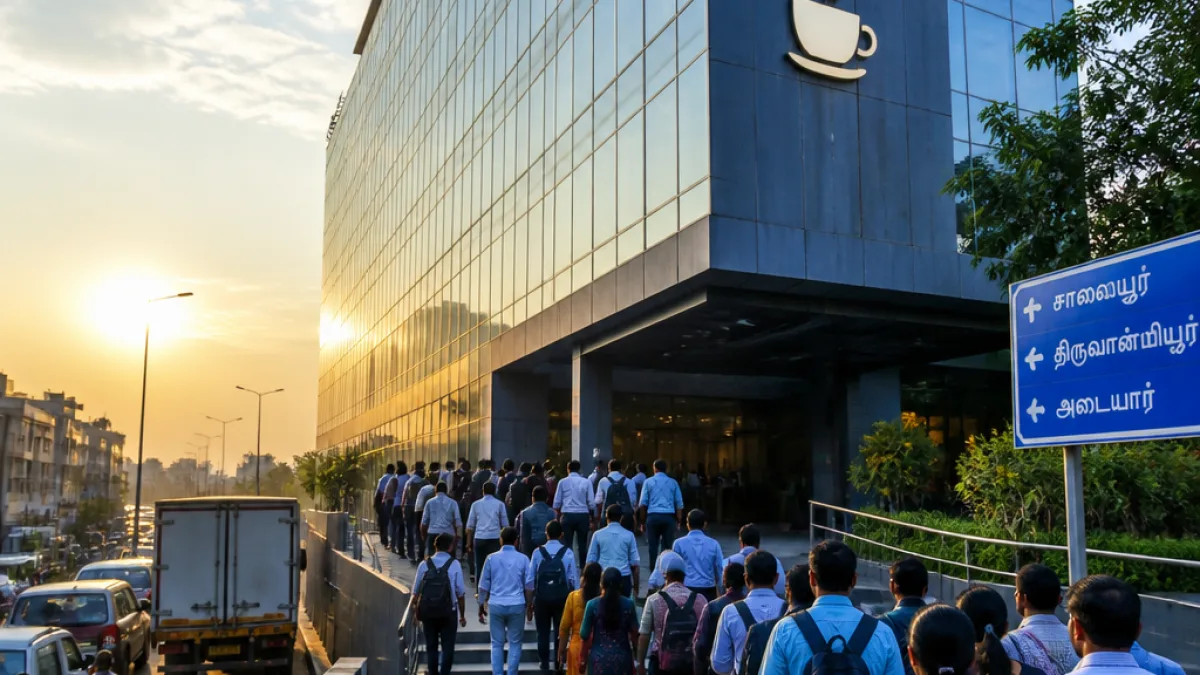
Chennai, Sep 21
Ahead of formal announcements, a government source and international wire reporting have indicated that US coffee chain Starbucks is planning to establish a global capability centre (GCC) in Chennai. The centre is expected to create around 800 jobs in its first phase, according to the reports.
The proposed move adds to Chennai's profile as a location for multinational technology and specialised support functions. Starbucks operates roughly 500 cafés in India through its joint venture with Tata Consumer Products, and the reported plan would expand the company's onshore operational footprint beyond retail.
Global capability centres in India have evolved from cost-focused back offices into higher-value hubs that provide finance, software development, research and other strategic services to company headquarters. The Reuters report cited a government source outlining this intention by Starbucks; the company did not immediately respond to requests for comment, the wire said.
"The centre is expected to create around 800 jobs in its first phase," the report said.
State officials in recent years have pursued a strategy of attracting GCCs and technology centres to boost skilled employment and deepen the local IT services ecosystem. Chennai already hosts technology and operations centres of major global firms, including Citi, Barclays and American Express, which the report noted as part of the city’s established cluster.
- Immediate employment impact: Reported creation of about 800 jobs in the centre’s initial phase.
- Regional context: Chennai’s existing roster of global finance and technology centres strengthens the case for further GCC investments.
- Follow-up investment trend: The Starbucks report comes days after US pharmacy chain Walgreens signed an agreement with the Tamil Nadu government to set up a GCC in the city, expected to generate around 250 jobs.
Officials and industry observers have increasingly highlighted the strategic value of GCCs for multinational corporations. Rather than mere transaction processing, many of these centres now undertake higher-value functions that directly support global headquarters. That trend has made locations such as Chennai attractive for firms looking to centralise specialised functions in India.
Below is a brief snapshot of the figures reported:
| Item | Reported figure |
|---|---|
| Starbucks cafés in India (through JV) | ~500 |
| Jobs expected at Starbucks GCC (first phase) | ~800 |
| Walgreens GCC jobs (reported) | ~250 |
Local employment and industry representatives view such investments as important for Chennai’s broader economic ambitions, including expanding higher-skilled service jobs and growing ancillary sectors such as facilities management, recruitment, training and local vendor ecosystems. A state government source described the Starbucks plan as consistent with recent efforts to attract multinational GCCs to Tamil Nadu, as reported by Reuters.
While the reported figure of 800 jobs refers to the initial phase, details on the centre’s location, investment size, timelines and function mix—whether predominantly technology, finance, analytics, or a mix—remain to be confirmed. The company’s formal confirmation and any memorandum of understanding with state authorities would typically clarify such particulars, including incentives or infrastructure commitments.
Chennai’s competitiveness for such projects rests on a combination of trained talent pools from engineering and arts colleges, an established corporate services ecosystem, and connectivity to ports and highways. The arrival of another global GCC would likely reinforce institutional relationships between corporate human resources, local training institutes and state investment promotion agencies.
For now, the report places Starbucks among a number of international firms seeing India—especially cities like Chennai—as a strategic location for scaling higher-value operations that link back to global headquarters.