Patna: Bihar has become one of India’s most prominent centres for organised cybercrime, with authorities recording a steep rise in complaints and large-scale monetary loss over the past three and a half years, official data and reporting show.
Scale and speed of offences
Between January 2023 and July 2026, cybercriminals reportedly defrauded 3,35,807 people in Bihar of approximately ₹1,490 crore, of which law enforcement managed to freeze about ₹299 crore, according to a review of police records and government data. The pace of complaints has accelerated markedly: the state recorded 68,931 cybercrime complaints in 2024, which rose to 1,17,812 in 2025. In the first seven months of 2026 alone, 1,14,918 complaints were filed.
"The data suggests Bihar’s cybercrime landscape has shifted from localised online scams to an organised digital threat."
Police and investigators who examined the pattern say the nature of offences has moved beyond one-off frauds to more structured operations involving multiple scam types, including OTP and SIM-swap schemes, fake bank calls, phishing, investment fraud and fraudulent customer-care handles.
Hotspot districts and crime profiles
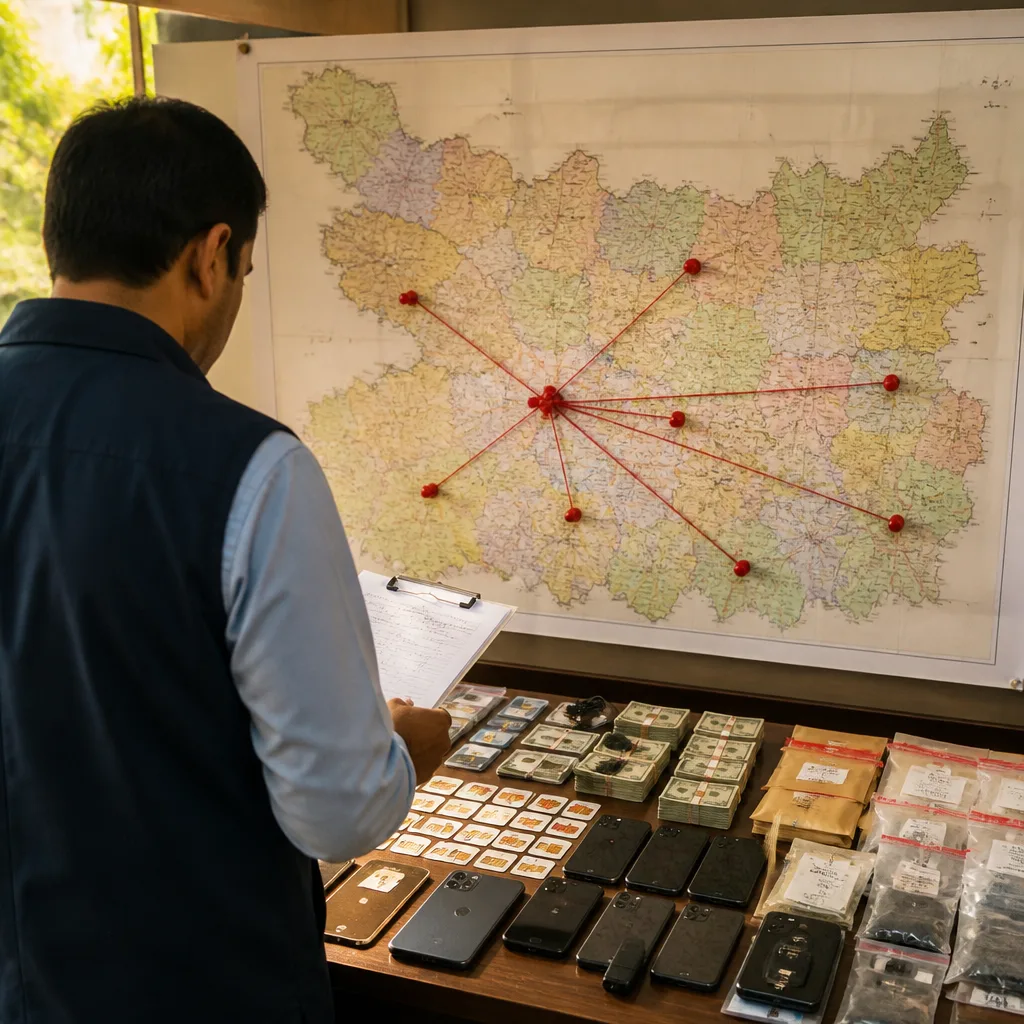
Ten districts have emerged as significant hubs for cybercrime activity, both as points of origin and as major targets. The distribution of fraud types shows an uneven geography of offences across the state.
- Patna leads in digital arrests, investment fraud, UPI scams and phishing.
- The Nalanda–Nawada–Sheikhpura belt is associated with OTP scams, fake bank calls, job and KYC frauds, and fake customer-care handles.
- Jamui reports bank KYC and lottery scams.
- Muzaffarpur sees a prevalence of social media and UPI fraud.
- Vaishali is noted for financial frauds; Darbhanga for online banking fraud; Sitamarhi for SIM-swap schemes; and West Champaran for digital payment scams.
| Period | Complaints | Amount defrauded | Amount frozen |
|---|---|---|---|
| Jan 2023–Jul 2026 | 3,35,807 victims (total cases) | ₹1,490 crore | ₹299 crore |
| 2024 | 68,931 complaints | — | — |
| 2025 | 1,17,812 complaints | — | — |
| Jan–Jul 2026 | 1,14,918 complaints | — | — |
Investigative and policing challenges
Officials and analysts point to several factors that have facilitated the rise: rapid expansion of mobile banking and UPI in rural areas, increasing smartphone penetration, relatively low digital literacy in many villages and the use of sophisticated social-engineering techniques by organised groups. Bihar’s largely rural demography — 88.71 per cent of the population was recorded as rural in the 2011 Census — means many victims encounter scams through informal or family networks before formal redress is sought.
Police have had some success in freezing funds, but the gap between amounts defrauded and assets recovered highlights the difficulty of tracing proceeds that are quickly moved across accounts, wallets and devices. Investigators have emphasised the need for stronger co-ordination with banks, telecom companies and central cyber agencies to trace transactions and intercept suspect communications in real time.
Lawmakers and cybersecurity experts who reviewed the data have urged a multipronged response combining prevention, victim redress and scaled investigative capacity. Suggested measures include public awareness drives tailored for rural audiences, tighter KYC and transaction-monitoring by financial intermediaries, and expanded forensic and cyber-investigation units within the state police.
The emergence of district-level specialisations in fraud types also implies that policing responses should be localised: while SIM-swap and OTP frauds require swift telecom-company action, investment and UPI scams may need coordination with financial regulators and payment platforms.
As Bihar grapples with an evolving cybercrime profile, the figures underline a larger national challenge: the transformation of traditional fraud into organised, digitally enabled crime that crosses administrative and technological boundaries. The scale of complaints and the pattern of hotbeds of activity have prompted calls for both immediate operational measures and longer-term structural changes in how cybercrime is prevented and investigated.
Further details on prosecutions, arrests and specific police actions in the most affected districts were not available in the reviewed material.