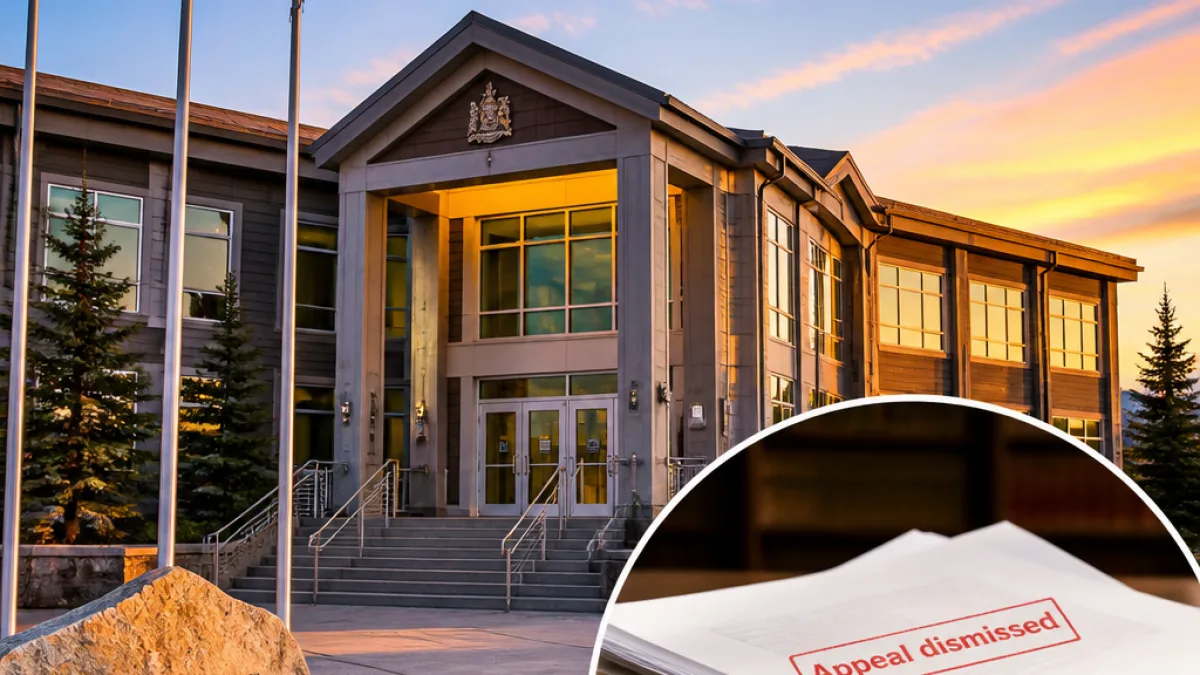
The Yukon Court of Appeal has dismissed an appeal by a man convicted of multiple sexual assaults in Whitehorse, leaving intact a custodial sentence imposed in 2023.
Appeal rejected
Rudra Amin, who now lives in Calgary, was convicted in 2023 after a jury trial that found him guilty of four counts of sexual assault relating to incidents involving three women in Whitehorse occurring between 2017 and 2018. The victims reported the incidents in 2020.
In documents released by the court, Justice Susan Griffin wrote on Aug. 6 that the appeal could not succeed. Amin had asked the appeal court to shorten his sentence by about two months so he would qualify for a conditional sentence order, which would have allowed him to serve the sentence in the community under strict conditions rather than in custody.
“This is simply tinkering and not this court’s proper role,”
Justice Griffin concluded there was no error in principle in the original sentencing judge’s decision and that trimming the sentence by two months would not be appropriate. The court therefore dismissed the appeal and Amin will serve the sentence imposed in 2023, a term of just over two years.
Legal grounds and consequences
The appeal brought forward two core requests: that the sentence be reduced and that a conditional sentence be made available to avoid potential collateral immigration consequences. The appeal court rejected both points. Griffin wrote that a reduction would require a demonstrated error in principle affecting the sentence — something the court did not find.
Because the court found no legal error at sentencing, the prospect of a conditional sentence was not open to Amin. Conditional sentences in Canada are available only when a custodial sentence of less than two years is appropriate and the court determines that it is not contrary to the public interest. The judge on appeal said shortening a sentence for the purpose of securing a conditional sentence is not a proper exercise of the court’s role when there is no error in principle.
Timeline
| Event | Date |
|---|---|
| Incidents alleged in Whitehorse | 2017–2018 |
| Victims reported the incidents | 2020 |
| Guilty verdict (jury trial) | 2023 |
| Appeal decision published | Aug. 6, 2026 |
Impacts and local context
The ruling closes this phase of litigation and means the sentence imposed by the trial judge remains in force. For survivors and for the Whitehorse community, the appeal court’s decision may carry significance for how sentencing outcomes in sexual-assault cases are viewed — particularly when questions about conditional sentences and immigration consequences arise.
Beyond the legal technicalities, the case underlines broader challenges northern communities face in seeking accountability and supports for survivors. Cases that stem from events years earlier can be difficult to prosecute because of elapsed time, evidentiary hurdles and the personal toll on complainants. That this matter proceeded to a jury trial and subsequent appeal demonstrates the criminal-justice system in Yukon addressed allegations that had been reported several years after the events.
What the decision means practically
Key practical points from the appeal decision:
- Sentence remains in place: The custodial sentence of just over two years will be served as imposed in 2023.
- Conditional sentence denied: The court rejected shortening the sentence to permit a conditional sentence alternative.
- No error found: The appeal court did not identify an error in principle in the original sentencing decision.
The appeal decision was published by the Yukon Court of Appeal on Aug. 6. No further appeal information was provided in the court documents released publicly.
As a Northern correspondent, I note that legal outcomes in small jurisdictions can resonate widely. People here often have close ties across communities, and high-profile cases shape public conversations about safety, support for survivors and how the justice system responds to serious offences. The courts’ written reasoning frames how those conversations proceed.