Canada’s largest national park protects rare wildlife and expansive northern landscapes
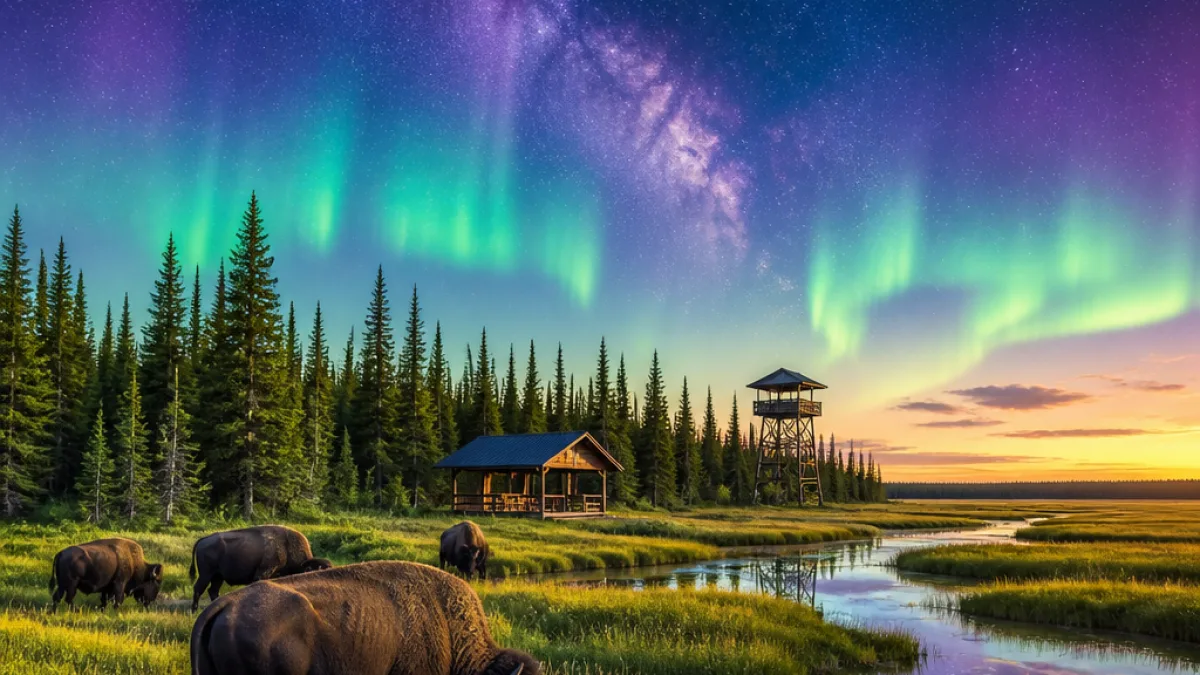
Stretching across the Alberta-Northwest Territories border, Wood Buffalo National Park preserves a vast portion of the Northern Boreal Plains and some of Canada’s most fragile ecosystems. The park is home to the largest herds of wood bison on Earth, essential nesting grounds for the endangered whooping crane and the globally significant Peace‑Athabasca Delta.
The area is the traditional territory of the Dene, Cree and Métis, and remains a place where cultural heritage and natural systems are deeply connected. Visitors to the park may encounter an array of wildlife, including bison, wolves and whooping cranes, while travelling through remote boreal and delta landscapes.
Dark skies, northern lights and seasonal conditions
Wood Buffalo offers some of the darkest skies in the country. Through the fall, winter and spring months the Milky Way can be visible as a broad, star-strewn band across the night sky; on some nights the Northern Lights also appear.
The park’s designation as a major dark-sky area makes it a unique destination for stargazing, astrophotography and quiet night-time nature experiences. Visitors should plan for rapidly changing northern weather and dress and equip themselves accordingly.
Visitor planning and safety reminders
Parks Canada stresses preparation for any trip into Wood Buffalo. The agency advises prospective visitors to plan their itinerary, check weather and road conditions, and ensure they have appropriate supplies and equipment for chosen activities. That advice applies to frontcountry, group and backcountry camping.
Key practical points for people considering a visit:
- Research access routes and seasonal road conditions before departing.
- Confirm visitor centre hours and services, including fees and accessibility, ahead of arrival.
- Be prepared for remote travel: bring adequate food, fuel, communications and emergency gear.
Where to get information
Parks Canada operates a visitor centre and offices to support visitors and residents. The main contact point in the Northwest Territories is the Fort Smith office, with a 24‑hour hotline for urgent inquiries. A satellite office is available in Fort Chipewyan on the Alberta side.
| Location | Contact | Notes |
|---|---|---|
| Fort Smith main office / Visitor Centre | Phone: 867‑872‑7960 24‑hour hotline: 867‑872‑7962 |
Visitor centre hours vary seasonally. |
| Fort Chipewyan satellite office | Phone: 780‑697‑3662 Fax: 780‑697‑3560 |
Alberta‑side satellite contact. |
For general inquiries, Parks Canada provides an email address: woodbuffaloinfo‑infowoodbuffalo@pc.gc.ca.
Seasonal visitor centre hours
The Parks Canada visitor centre at Fort Smith has stated seasonal hours for late summer and early fall:
- Aug. 14 to Sept. 4, 2026: Open seven days a week, 9 a.m. to 6 p.m.
- Sept. 5 to Sept. 30, 2026: Monday to Friday, 9 a.m. to 12 p.m. and 1 p.m. to 5 p.m.; closed Saturday and Sunday.
Visitors should confirm these hours before travel, as seasonal schedules and services can change.
Connections to other northern parks
Wood Buffalo is part of a broader northern parks system that offers varied wilderness experiences. Parks Canada highlights neighbouring protected areas such as Nahanni National Park Reserve, known for granite pinnacles and whitewater river trips, and Nááts'įhch'oh National Park Reserve, which conserves the headwaters of the South Nahanni River and emphasizes the integration of culture with landscape.
For communities, residents and visitors in the Northwest Territories, Wood Buffalo National Park represents both a conservation priority and a major natural draw. Its protection of critical habitat — including for the whooping crane and wood bison — makes it an internationally important conservation area, while the remoteness and scale of the park demand careful planning from anyone who ventures in.
If you are considering a trip into Wood Buffalo, contact Parks Canada in Fort Smith or Fort Chipewyan, review the guidance on camping and access, and prepare for the realities of travel in one of Canada’s largest and wildest national parks.