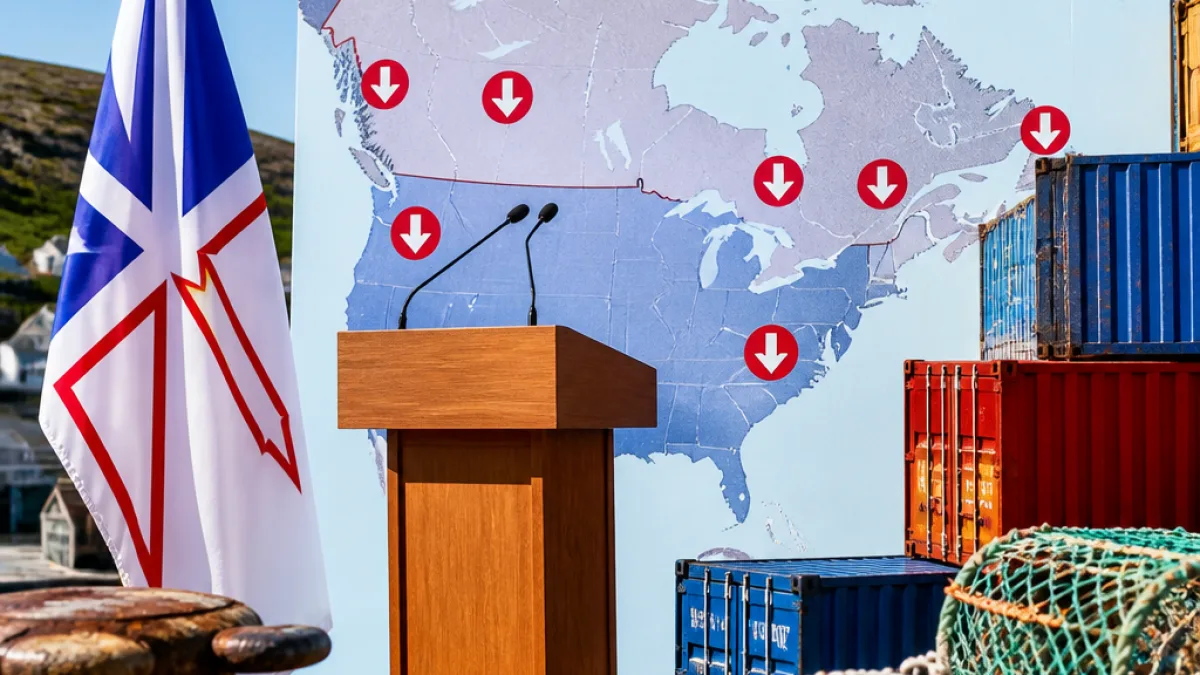
ST. JOHN'S — Newfoundland and Labrador Premier Tony Wakeham says the province will stand united with the federal government as Canada implements retaliatory measures in the widening trade dispute with the United States.
Wakeham issued a statement Tuesday while attending the Offshore Northern Seas conference in Norway, acknowledging that the imposition of tariffs will raise costs for businesses and households, shake up supply chains and sow uncertainty across the economy. He said the provincial government will work with industry to monitor and respond to fallout.
Premier says province will 'stand with Team Canada'
"At a time of uncertainty, Newfoundland and Labrador will continue to stand with Team Canada as we defend our economic interests and advocate for a stable and constructive trading relationship with our closest neighbour and largest trading partner."
The federal government has announced dollar-for-dollar counter-tariffs on US goods valued at $27.6 billion, a move Ottawa says is a direct response to earlier U.S. trade measures. While Newfoundland and Labrador does not face the same immediate exposure as larger manufacturing provinces, Wakeham warned the province is not immune to knock-on effects.
In his statement, Wakeham credited Prime Minister Mark Carney for his leadership in coordinating the national response and said the provincial government is "standing firmly in line" with Ottawa. He also said he had reached out to "key industry partners that drive the Newfoundland and Labrador economy" and pledged ongoing monitoring of impacts.
When asked which organisations he had spoken with, a provincial communications official named Mining Industry N.L. and the Newfoundland and Labrador Federation of Labour, while noting that the list of contacts was not exhaustive.
What the province is tracking
The provincial statement did not list specific measures or sectoral supports, but it indicated two immediate priorities: assessing how tariffs might affect costs and supply chains locally, and coordinating with industry stakeholders to identify vulnerabilities.
- Monitoring price impacts for businesses and consumers
- Assessing potential supply-chain disruptions for resource and retail sectors
- Coordinating with industry groups and labour to identify urgent issues
For a province where resources, seafood, mining and energy play outsized roles, even peripheral trade frictions can reverberate. Firms that import equipment or export intermediate goods could face higher costs or delays; retailers could see narrower margins or higher shelf prices. The provincial government’s outreach suggests it is trying to get ahead of problems before they worsen.
| Measure | Value / Note |
|---|---|
| Canada's counter-tariffs | $27.6 billion in U.S. goods |
| Provincial contacts named | Mining Industry N.L.; Newfoundland and Labrador Federation of Labour |
Political reaction within the province has been swift. Opposition parties called for renewed provincial-level coordination — including the re-establishment of a trade roundtable — arguing that a single voice for businesses, labour and government would help shield the economy and keep oil, fish and mining sectors competitive.
As the trade dispute unfolds, Newfoundland and Labrador officials will face the task of separating immediate shocks from longer-term shifts. At the Offshore Northern Seas conference, Wakeham’s presence underscores Ottawa and provincial governments’ shared interest in protecting trade ties that are crucial to the province’s export-driven economy.
For now, the province’s public-facing response is one of support for federal measures coupled with promises of engagement with affected sectors. Officials encourage businesses to report disruptions to provincial contacts so that government can compile evidence and press for measures that mitigate harm.
With the situation evolving rapidly on the international stage, Wakeham’s outreach to industry and labour signals that Newfoundland and Labrador intends to be an active participant in national efforts to manage the dispute even from afar.