The Office of Immigration and Multiculturalism in Newfoundland and Labrador issued 36 invitations to apply for provincial nomination on Sept. 10, part of a year-long effort to attract foreign nationals to help fill labour shortages and strengthen the province’s economy.
Numbers and context
Those 36 latest invitations bring the provincial tally to 2,592 invitations issued across the province’s two immigration streams as of Sept. 10, 2026. That total breaks down into 2,198 invitations under the Newfoundland and Labrador Provincial Nominee Program (NLPNP) and 394 through the Atlantic Immigration Program.
| Program | Invitations (2026, to Sept. 10) |
|---|---|
| NLPNP | 2,198 |
| Atlantic Immigration Program | 394 |
| Total | 2,592 |
How candidates are selected
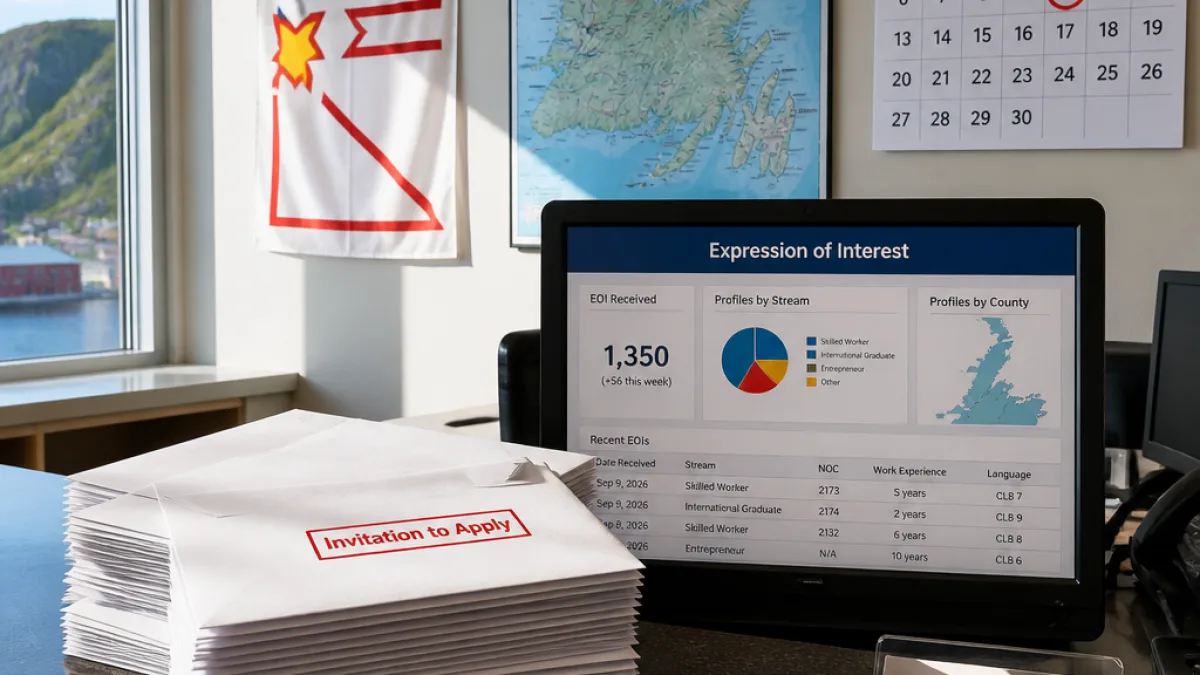
The province uses an Expression of Interest (EOI) model, adopted in February 2025, that collects information on education, work experience, language ability and settlement intentions through the Immigration Accelerator Portal. The system lets the Office of Immigration and Multiculturalism prioritise candidates to reflect current labour-market needs.
Under all worker streams, a qualifying job offer is required. The province reviews EOIs and periodically issues invitations to those who best match priority areas.
Current priorities
The province has signalled the kinds of candidates it is prioritising. Those priorities include:
- health-care workers;
- individuals employed outside major urban centres;
- French-speaking candidates;
- graduates of Newfoundland and Labrador post-secondary institutions.
These priorities guide which EOIs are selected when invitations are issued.
What invited candidates must do next
Invited candidates have up to 60 days to respond by applying for provincial nomination, the Office of Immigration and Multiculturalism says. Successfully nominated applicants can then move forward with permanent-residence applications through Immigration, Refugees and Citizenship Canada.
One recent procedural change that impacts nominees is the faster route to Bridging Open Work Permits for those applying through the base PNP. As of June 9, 2026, qualifying nominees can apply for this permit to continue working in Canada while their permanent-residence applications are processed.
Why it matters locally
Newfoundland and Labrador has been wrestling with population decline and skills shortages for years. Provincial nomination programs are a key lever for local governments to recruit skilled workers and retain graduates from local post-secondary institutions. Employers, particularly outside the biggest urban centres, often rely on the PNP and Atlantic Immigration Program to fill positions that are hard to recruit for locally.
For prospective newcomers, the EOI model offers a way to signal interest and suitability without immediately beginning a full permanent-residence application. For employers, the requirement for a qualifying job offer under worker streams provides assurance that hired candidates meet federal and provincial criteria.
Officials and transparency
The Office of Immigration and Multiculturalism does not disclose the names of invited candidates or the precise composition of each draw beyond numbers and priority categories. The province continues to issue invitations through the EOI system as it balances labour-market needs with settlement capacity across communities.
As the fall progresses, employers and prospective applicants will be watching further draws closely to see how selection patterns evolve and whether the province adjusts its priorities in response to changing economic conditions.