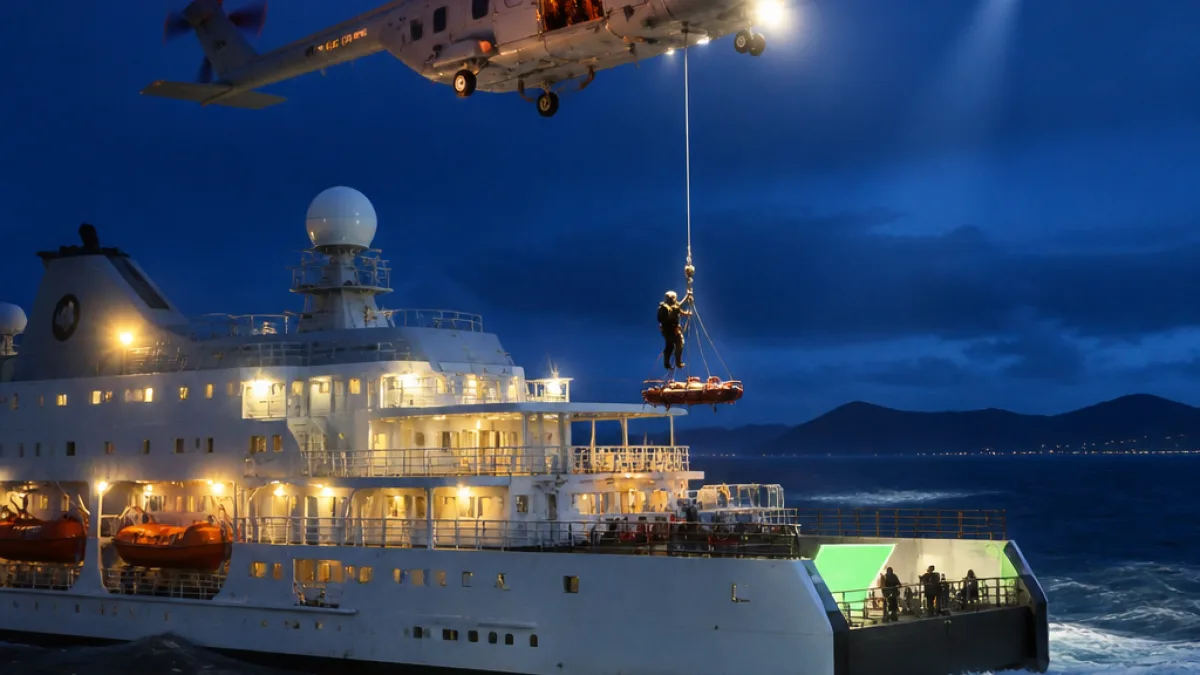
A Royal Canadian Air Force medevac team airlifted a sick cruise ship passenger about 200 kilometres northwest of Port Hardy in the early hours of Saturday, transferring the patient to waiting emergency health services in Comox.
Rapid response by RCAF transport and rescue crews
The RCAF’s 442 Transport and Rescue Squadron launched a high-seas search-and-rescue operation after receiving a call about a passenger in medical distress aboard a cruise ship. A CC-295 Kingfisher fixed-wing aircraft and a CH-149 Cormorant helicopter were deployed to the scene in pre-dawn conditions.
According to a military news release, the Kingfisher arrived first and coordinated the medevac while maintaining “over-watch” for the helicopter as it approached the vessel.
“over-watch”
The ship’s captain assisted by steering the vessel into the wind, switching off the radar and clearing space on the bow so the helicopter could safely come alongside. Two search-and-rescue technicians were lowered from the CH-149 to take over care of the patient and prepare them for transfer.
Who was brought aboard and where they went
Once stabilised and prepared for flight, the patient, a travel companion and a member of the ship’s medical staff — along with the two RCAF technicians — were hoisted into the helicopter. The aircraft then flew to Comox, where emergency health services were waiting to receive the patient.
No further details about the patient’s age, condition or the ship’s name were provided in the release.
| Asset | Role |
|---|---|
| CC-295 Kingfisher | First on scene; coordination and over-watch |
| CH-149 Cormorant | Lowered SAR technicians; hoisted patient and companions |
| 442 Transport and Rescue Squadron | Co-ordinated search-and-rescue operation |
Context for maritime medevacs on the West Coast
Medevacs at sea are a routine but complex part of search-and-rescue operations off British Columbia’s exposed coast. Wide distances between vessels and shore, often-changeable weather and the need to coordinate aircraft, ship crews and local health services all increase the operational difficulty.
This mission underlines how fixed-wing and rotary assets work together: fixed-wing aircraft can arrive quickly and provide situational awareness over a broad area, while helicopters conduct shipboard transfers and hoisting operations that are not possible from a distance.
- Assets deployed: CC-295 Kingfisher (fixed-wing), CH-149 Cormorant (helicopter)
- Unit: 442 Transport and Rescue Squadron
- Destination: Comox emergency health services
While the military release did not disclose the nature of the passenger’s illness or their prognosis, provincial health and marine safety agencies routinely rely on RCAF search-and-rescue units for urgent medical extractions from vessels operating offshore.
Comox, located on Vancouver Island, hosts emergency facilities that received the patient after the helicopter transfer. The use of fixed-wing and rotary aircraft in tandem reflects standard practice in Canadian search-and-rescue operations when incidents occur far from shore.
Local communities along the North Island and inlets of British Columbia have long depended on a mix of federal, provincial and volunteer resources for maritime safety. This operation is the latest example of that multi-agency approach in action.
Further details about the patient’s condition or the cruise line involved were not released.
Reportage from the scene and official statements were based on a Royal Canadian Air Force news release issued on Saturday.