
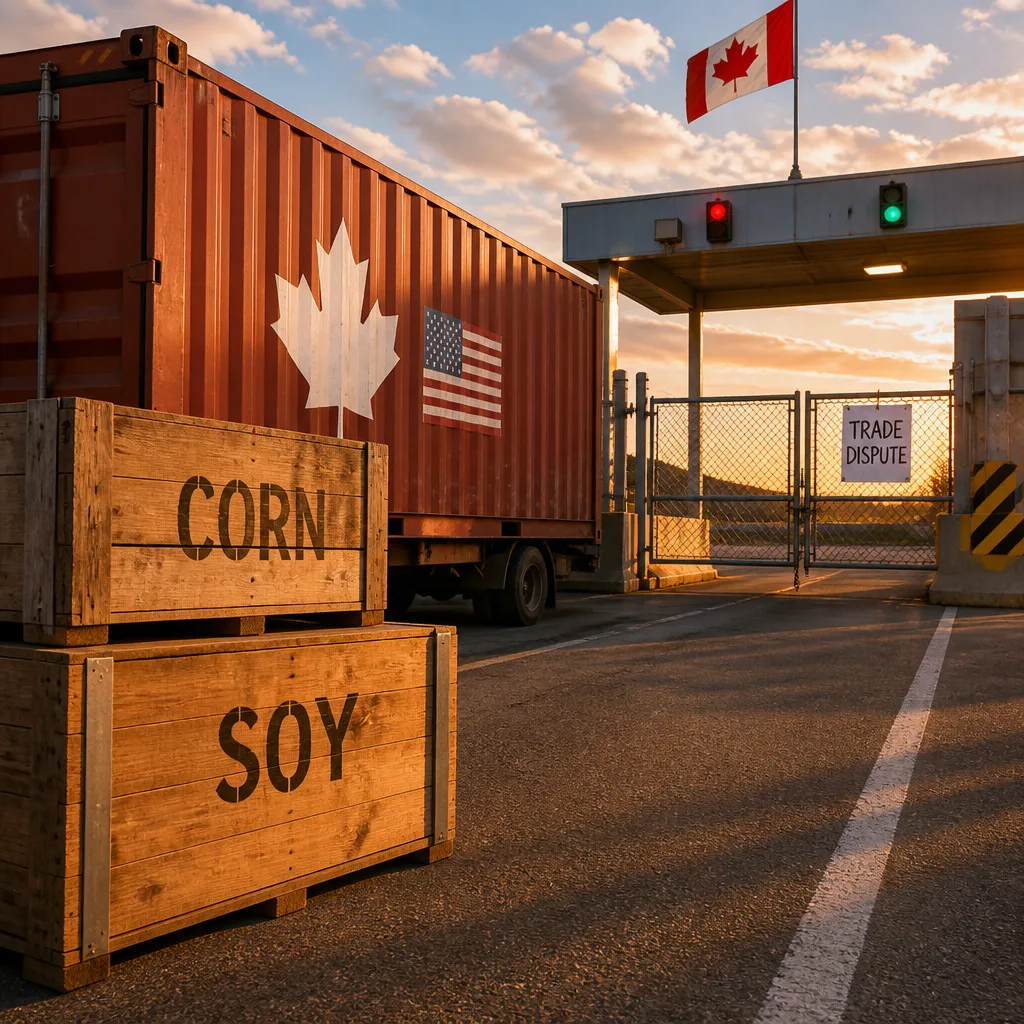
U.S. President Donald Trump said Canada wants a trade agreement with the United States “very badly” and suggested a deal could be reached “fairly soon” if Ottawa addresses his concerns about agricultural trade.
Comments came during overseas visit
Speaking on Saturday while visiting Ireland, the president addressed whether he was considering withdrawing from the United States-Mexico-Canada Agreement. He said he was not, adding that the U.S. has a “good” relationship with Canada but reiterated longstanding criticism of the bilateral trading relationship.
“We actually have a good one with Canada, but the United States has been ripped off for 50 years by Canada,”
Trump framed the path to a deal around agricultural access, specifically repeating his complaint about Canadian tariffs on certain U.S. agricultural products. He said those measures must be removed for a rapid resolution.
Direct lines to Canadian agriculture
Trump singled out treatment of U.S. farmers as central to negotiations, saying Canada “has to treat our farmers better and they can’t charge our farmers tariffs.” He added that if Canada removes such measures, “you’ll probably see a deal with Canada fairly soon.”
The Office of the United States Trade Representative was cited in coverage noting that Canada remains consistently among the top trading partners for the U.S., underscoring the economic significance of any new agreement.
Unusual comparison drew attention
In a comment that drew immediate attention, Trump compared Canada’s desire for a deal to Iran’s, saying: “Canada wants to make a deal and Iran wants to make a deal. At the right time, both of those things could happen.”
The comparison stood out for juxtaposing a long-standing U.S. ally and major trading partner with a country that has been the subject of strict U.S. sanctions and fraught diplomatic relations.
- Where it was said: Remarks made in Ireland during a weekend visit.
- Core issue raised: Agricultural tariffs and the treatment of U.S. farmers by Canada.
- Possible near-term outcome suggested: A trade agreement “fairly soon” if specific Canadian measures are removed, according to the president.
| Claim | Context |
|---|---|
| Canada “wants to make a deal very badly” | President Trump’s assessment during comments in Ireland about NAFTA successor talks and bilateral trade. |
| Removal of agricultural tariffs could lead to a deal | Trump identified tariffs on U.S. agricultural products as a primary obstacle to an agreement. |
| Canada placed in same sentence as Iran | Comparison made by Trump while discussing prospects for a deal. |
For Canadians, the president’s remarks place renewed emphasis on agricultural access and tariffs as bargaining chips in any potential negotiations. The statements also underline the central role of the United States in shaping Canada’s trade environment: when the U.S. president publicly frames an issue, it can affect market sentiment and political priorities in Ottawa and across provincial governments that represent agricultural interests.
While the president said the U.S. would maintain a “great relationship with Mexico,” his comments about Canada highlight that bilateral concerns — particularly in primary sectors — remain on the table.
No immediate response from Canadian federal officials was included in the coverage. The president’s remarks will likely prompt scrutiny from Canadian agriculture groups and from the Department of Foreign Affairs, Trade and Development, both of which monitor tariff measures and market access closely.
As Canada remains a leading U.S. trading partner, any movement toward a new deal would have wide-reaching implications for exporters and supply chains in both countries. The president’s focus on agriculture suggests that sectors tied to tariff disputes may see heightened attention in the coming weeks as Ottawa assesses next steps.